From winning sustainability accolades to achieving record revenues, the future of one Danish sportswear brand is looking particularly bright. SGI Europe meets with Hummel’s CEO Allan Vad Nielsen to learn more about the strategies that have led to its good fortunes.
“It took us 95 years to reach 1B DKK in revenue and within a four-year period we’ve now managed to double our turnover,” said Hummel CEO Allan Vad Nielsen in the mid of December 2022. Just a few weeks before that we talked to him about this goal and the Hummel success story.
SGI: Hummel’s stated goal is to increase revenues from 1 to 2 billion Danish kroner 2017-2023, and it seems you’re well on track. What is the secret to your success?
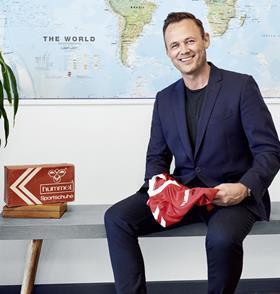
Vad Nielsen: Actually, we’re one year ahead of our original timeline, which means that we’re already heading for a minimum of DKK 2 billion turnover in 2022 – and right now, it’s just a matter of time before we get there [on December 8th Hummel published to have reached the 2 billion goal]. Part of the story behind our success over the last 4 years has been our focus on building a strong hybrid model – focusing on improving our wholesale partnerships while launching a supplementary direct-to-consumer distribution.
That’s an interesting approach considering many businesses are moving their focus away from wholesale in favor of digitization right now. Can you explain what exactly is Hummel’s channel strategy?
Even though we have had great success with an increased focus on digitization for the past three years, wholesale remains our biggest business area and represents nearly 80 percent of our total business. It’s true that several of our competitors have chosen to downgrade wholesale. But this has also left a gap in the market; one which we are trying to exploit to strengthen our presence and be an even stronger partner for our customers. It’s no secret that we have huge expectations for our wholesale business going forward, and that’s also why we expect to continue and further accelerate our presence in the coming years.
This approach is not without its share of risks. What do you see as the greatest among them, and how do you manage it?
There will – of course – always be a risk that our partners move towards other brands, but we are confident that we deliver the best option on the market with our approach. First of all, we have a partnership mindset when it comes to our wholesale partners. This means that we’re always striving to be the preferred brand partner offering a wide range of categories from sport, lifestyle, kids, training, and footwear – and at the same time we listen and adapt to the needs of our partners.
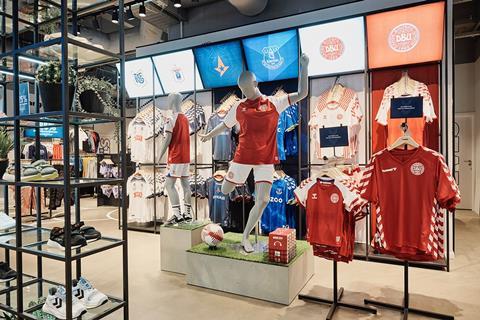
Let’s move on to the second pillar of Hummel’s hybrid strategy: E-commerce. What percentage of total business does this represent now? Can you describe your current strategy and key markets?
The aim of our e-com launch has been to get closer to our consumers and use those insights to become more agile and on-point in both our product and marketing development. The first phase of our e-com strategy focused on Europe, and we are now looking to use our online distribution, within both wholesale and direct-to-consumer, to grow our business outside Europe in the coming years.
What were some of the considerations in selecting a global e-commerce platform?
The first objective for us was scalability, as we wanted a platform not just for the journey towards DKK 2 billion, but a foundation for our future strategy. Moreover, we wanted a platform that carried minimal maintenance and allowed for easy internationalization – and this was also one of the main reasons why we decided to go with IMPACT and Salesforce.
Revenue targets are not the only goals being set (and met) by Hummel of late – perhaps you can share about Hummel’s latest sustainability commitments?
We’re on an exciting journey to become even more environmentally friendly in the future, and that’s also why we have signed up to the Science Based Target Initiative, where we are committed to reducing our greenhouse gas emissions by 30% by 2031.
We’re also taking part in an industrywide Textile Circularity project headed by the Danish Technology Institute and funded by the Danish Environmental Agency. The aim of the project is to identify ways to turn old textiles into new fibers and create a circular design guide.
However, these are just a few examples of the different projects we’re working on in order to strengthen our game plan within this area even further in the coming years.
Having been named Denmark’s most sustainable clothing brand by the Sustainable Brand Index 3 years running, it appears that consumers approve of your efforts here. What do you think are the key factors that make Hummel stand out?
First of all, we’re extremely proud to have been named Denmark’s most sustainable clothing brand three years in a row, and this has definitely whetted our appetite to keep fighting for a more sustainable future. It’s difficult to outline the key factors behind these awards, but we hope that the Danish consumers have noticed the use of organic or recycled fibers in many of our products, our karma projects, and our aim of ‘doing good while doing business’.
How is Hummel addressing its goals of reducing chemicals, pesticides, virgin plastics in products/packaging and CO2 emissions reductions?
We have a long list of chemical restrictions that all our suppliers must abide by in the first instance. Additionally, we are also transitioning from conventional cotton to organic or recycled cotton. All our plastic packaging is already made from recycled plastic, our labels from recycled polyester, and our hangtags from recycled paper. However, this is only the beginning, and we’re constantly working on several different projects to become even more environmentally friendly in the future.
On that note, what major steps are you considering in Hummel’s journey to become even more environmentally friendly?
While we’ve come a long way already, we are also aware that much more can, and should, still be done in this area. One of the most important steps on this journey is therefore going to be to increase the use of organic, recycled, and biobased fibers in our products. In addition to this, we’ll also improve our supplier engagement even further and encourage all our suppliers to change to renewable energy sources and less energy- and water-demanding production processes. Last but not least, we want to contribute to building a circular economy in the fashion and sportswear industry, with the overall aim of using and re-using the same materials over and over again.
Thanks for taking part in this interview, and good luck on this journey!
You can read more about Hummel’s sustainability efforts here.