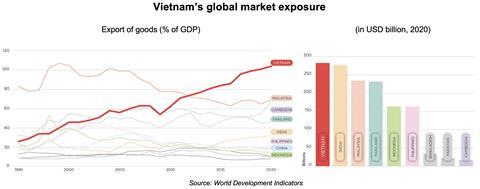
Since the Vietnamese economy largely relies on the export-dependent manufacturing industry, the country is more exposed to multinational corporations and the global consumer market than any other developing Southeast Asian country says a newly released paper by the Institute for Energy Economics and Financial Analysis (IEEFA). The organization has studied the status, plans and future scenarios for the Vietnamese economy in terms of transitioning to more sustainable energy options in the manufacturing sector.
“Multinational companies responsible for up to $150 billion of Vietnam’s export revenue have made specific commitments to carbon neutrality or decarbonization with varying scopes and timeframes,” says the author of the study, Thu Vu. “The path of these brands toward sustainability is one that Vietnam cannot afford to ignore or miss.”
Vietnam is currently the largest exporter of goods in developing Southeast Asia, with many outdoor brands sourcing their backpacks, sleeping bags and apparel in the country. With nearly 60 percent of its exports produced for major brands, the country’s growing role in the global supply chain comes with the pressure to adapt to brands’ needs and preferences. Vietnamese Prime Minister Pham Minh Chinh pledged at the UN Climate Change Conference in 2021 to reduce carbon emissions to zero by 2050, while international consumer brands, many of whose suppliers are based in Vietnam, are making reducing emissions in their supply chains a key part of their decarbonization strategy at a much earlier stage.
The increased focus on businesses’ clean energy needs is reflected in the rapid growth of decentralized renewable energy solutions, such as commercial and industrial (C&I) rooftop solar systems, for which the government has expressed continued support. However, large corporations such as Nike and Apple are advocating for a more speedy and strong effort of the government to enable their supplier’s factories access to clean energy options.