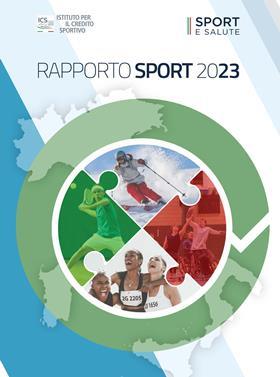
Italy’s sports industry is worth €22 billion and contributes 1.3 percent to the nation’s gross domestic product (GDP), according to a new report. “Rapporto Sport 2023” was presented on Jan. 30 by Istituto per il Credito Sportivo (ICS) and Sport e Salute, an Italian public body that deals with sports development in Italy, in the presence of Italy’s Minister for Sport and Youth, Andrea Abodi.
The publication highlights the great potential of the sports industry, providing a detailed picture of its contribution to GDP, the demand for sports practice, the state of the national facilities stock and the impact dimension of Sport. The document is meant as a reference for decision-makers and other stakeholders to support sports policies and accurately determine the value of the sports industry.
Sport as part of the Italian constitution
The release of the report comes on the heels of a historical step for sports in the country. On Sept. 20, 2023, Italy’s Chamber of Deputies unanimously approved an amendment to include sport in the Constitution. The following paragraph has been added to Article 33, which refers to art and science: “The Republic recognizes the educational and social value of sport in all its forms and its importance in the promotion of psychophysical well-being” (translated from Italian).
Despite the negative impact of the Covid-19 pandemic, Italy’s sports industry employs a workforce of around 400,000 people, who work in over 15,000 private companies and 82,000 non-profit organizations. Sports in Italy can also rely on nearly 900,000 volunteers, adds the report.
In terms of infrastructure, there are around 77,000 sports facilities in Italy, of which 52 percent are located in the North of the country. On a negative note, 8 percent are not functioning at all, while 89 percent of Italy’s sports infrastructures do not use renewable energy sources.
More than a third of all Italians are inactive
In terms of sports participation levels, inactivity rates are still high. More than a third of the Italian population does not carry out any type of physical or sporting activity. Participation is higher in the North (41.5 percent of the population in 2021), followed by central Italy (36.7 percent) and the South (24 percent).
The report also highlights a direct correlation between the economic situation of the family and inactivity levels among young people under the age of 24. The probability of a sedentary lifestyle increases from 20.1 percent for families with adequate resources to 25.1 percent for families with poor or insufficient resources. Education also seems to have a crucial impact on participation in sports. Sedentary lifestyle rates vary from 12 percent among families where the parents hold high educational qualifications and 32 percent among families where the parents have only completed compulsory schooling.
The good news is that the inactivity rate in Italy dropped by 7 percent between 2001 and 2021, and the gender gap also decreased (-30 percent) over the same period.
Around 16 percent of Italians use the bicycle for daily travel. This is below the European average of 24 percent, which also includes virtuous cases like Denmark (nearly 50 percent) and the Netherlands (over 60 percent).
The full 78-page “Rapporto Sport 2023” (in Italian) is available for download from the website of Istituto per il Credito Sportivo (ICS).