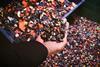
Italy-based Tecnica Group is committed to closing the circle of ski boot life cycles: 4,200 ski boots have already been collected, dismantled and recycled into new products in the first year since autumn 2021 of the group’s “Recycle Your Boots” (RYB) project. With this offer, skiers can make a practical contribution to a more sustainable future by returning their old ski boots when purchasing a new pair.
The strategic goal of RYB, launched by Tecnica Group in 2021, is, first and foremost, to lower energy consumption and emissions in the domain of ski boots. These are recycled, regardless of brand and model, into new raw materials and used to manufacture new boots and other mountain sports products. The Tecnica Group works with a network of project partners. First and foremost, these are the retailers who raise awareness among skiers and collect the old ski boots. The Italian company Fecam takes care of separating the inner boots and disassembles each boot into its plastic and metal parts, which are sent to the nearby Laprima Plastics plant, where they are transformed into second-generation raw materials.
More retailers, more countries
According to Maurizio Priano, Blizzard-Tecnica international marketing manager and RYB project manager, the Tecnica Group aims to collect at least 20,000 pairs of ski boots by the end of the first three years of the project – another 16,000 or more over the next two years. To achieve this, the number of participating retailers (currently at 54) and countries (currently 7) was significantly increased this year. In the now upcoming second season of the project, the U.K., Belgium, Holland and the Czech Republic are now joining Italy, Germany, Austria, Switzerland, France and Sweden.

From boot liner to safety mat
However, according to Giorgio Grandin, Tecnica Group innovation manager, one of the biggest challenges from the beginning was finding a viable solution for the recycling process itself: a boot is made up of 120 or more different composites. “It was remarkably difficult to figure out how to cleanly separate the polyurethane foam and the very complex components of the boots so that they could be recycled properly,” Grandin said. The liners, in particular, represented a challenge in this process because they are made of several different expanded foams. “Thanks to the cooperation with ReMat, we finally developed an upcycling process in which all components, especially the polyurethane, are recycled and transformed into a compact raw material plate made of regenerated material.” This plate is combined in a sandwich construction with two additional plates of virgin polyurethane and serves as padding for protective (crash) mats made by Liski Sport Equipment – thus returning to the ski slopes as a new product. Carlo Fernandez, operations manager at Liski, reports that after appropriate crash tests, the 16cm recycled protection mats have been shown to perform just as well as the company’s previous, “traditional” 20cm mats. “It’s a performance boost in favor of safety that doubles the qualification of what is already a valuable product in its field,” Fernandez said. Liski’s safety mats are used, for example, on lift towers or in ski races – including the Olympic Winter Games in Milano Cortina in 2026.
Nordica joins the project, other partners welcome
In the second year of the project, Nordica is joining Tecnica in the project. In addition, thanks to the collaboration with FISI and Sportsystem in Montebelluna, the group presents the RYB project to other sports companies and businesses. The processes and technical solutions are explained, and the company’s experiences are shared. “We need to change our culture,” says Priano. “We must share our knowledge and experience and collaborate across companies and industries to make a real impact in terms of environmental protection.” Sharing knowledge and information within the industry is still slow. However, most recently, competitor Rossignol Group made the material composition of its first recyclable ski publicly available, representing another big step forward.
Easier recycling due to improved designs

“To understand the environmental impact of ski boot manufacturing, we asked the University of Padua and Dr. Alessandro Manzardo’s team for help. They analyzed every manufacturing process step using the LCA ( life cycle assessment) method. From raw materials through transformation into semi-finished and finally finished products to transportation,” explains Michele Botteon, general technical manager skates & ski boots Tecnica Group. “From this analysis, we were able to identify where to prioritize, i.e., what to improve to reduce and minimize our impact on the environment.” It turned out, for example, that some plastics make a massive difference in terms of CO2 emissions and energy consumption. Especially PVC, which is primarily used in some ski boot components. “That’s why we decided to completely eliminate PVC from all Tecnica and Nordica boots starting next season. We started designing our ski boots according to eco-design principles. Starting with the use of new plastics made from production waste (up to 30 percent of the total) to the use of recycled raw materials in the components of the inner boot. In addition, we are researching less complex materials and components to simplify their recycling.”
A passport for each ski boot
One of RYB’s core ideas from the beginning was to take back and recycle used boots from all brands. “As a result, we were dealing with little homogeneous recovered raw materials that are of lower quality, which can only be used in functional, non-aesthetic elements of boots or other products such as skis,” Grandin said. “For this reason, we introduced a ‘passport for recycling materials’ from which Tecnica and Nordica boots are made.” Starting with the 2023/24 collection, all Tecnica and Nordica ski boots will have a QR code on the outside that will provide accurate information about the materials, their elastic modulus, and the manufacturer when arriving at the Fecam centers. This allows the shell to be separated from the liner and the plastic parts to be sorted precisely by material. This, in turn, enables the generation of homogeneous raw materials, of which the company has precise knowledge regarding their mechanical properties. These materials can be used to a greater extent to produce functional components of the ski boot shell, resulting in a further reduction in the consumption of virgin raw materials as well as the carbon footprint – without compromising the longevity or performance of the ski boot.
More plans, more challenges

Arianna Colombari, Tecnica Group’s sustainability director, comments, “Our RYB project is a mosaic piece of a more extensive and continuous process. The results of an enormous number of measurements, trackings and analyses play a role in the decisions. We communicate all this in our first sustainability report, which will be published soon.” In a virtual press conference, all those involved explained the status quo and plans for RYB in detail. It was also mentioned that the Tecnica Group could also imagine expanding the project to include other products, but this also represents a challenge, especially with highly complex material compositions such as in skis or inline skates.
Unfortunately, because RYP is designed to go beyond the borders of the EU, there are also a number of problems that do not necessarily make “doing good” any easier. For instance, Priano reports that in the first year of the project, Tecnica encountered a gap in the rules that govern the handling of goods from countries that are not part of the Schengen area. “We learned that there are rules to the import or export new goods or for waste but not for secondhand products.” This meant that Tecnica was required to declare the value and country of origin for each old ski boot that was returned – a considerable extra effort – and then pay a tax for transport to the selection center in Italy. This was the case with Switzerland and Norway and will also be next year with the U.K. “That, by the way, is the prize of innovation, I guess, and one of the reasons why the European Commission supports circular economy projects through the LIFE program. Figuring out where the barriers are to the future development of projects like RYB is critical, and we really hope we can start a conversation with the authority responsible for that to solve that problem.”