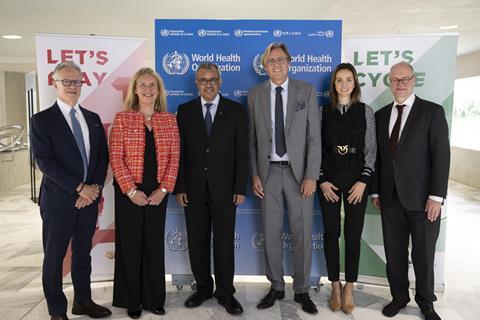
The World Health Organization (WHO) and the World Federation of Sporting Goods Industry (WFSGI) have signed a Memorandum of Understanding (MoU) in Geneva that establishes a framework for collaboration to improve global health through increased physical activity and sports participation.
Recent industry data shows that health and well-being are on the rise, yet a worrying proportion of people are not reaching WHO recommendations for physical activity. The situation is particularly alarming among younger people. High levels of physical inactivity pose a significant risk to global health and also present a worrying picture for sport. The Covid-19 pandemic exacerbated already existing inequalities, including in access to sport. Early data suggest a 41 percent decline in physical activity, particularly among the most disadvantaged social groups, and a 200 percent increase in mental health problems among youth. These statistics are extremely concerning, especially since over 80 percent of adolescents and 27.5 percent of adults were not sufficiently active before the pandemic. The data show that countries are far from meeting the WHO Global Action Plan for Physical Activity (GAPPA) targets of reducing physical inactivity by 15 percent by 2030.
WFSGI and its members have long advocated for increased physical activity and sport. The partnership with WHO aims to meet Sustainable Development Goal (SDG) 17 and GAPPA’s calls for engagement across society. This is the first MoU that WHO has signed with a sports industry association related to physical activity and sport, and a milestone to focus efforts and take a multi-stakeholder approach to empower more people to be more active and improve global health.
“One of WHO’s top priorities is to support countries to make an urgent paradigm shift from just treating disease to promoting health and preventing disease,” said Dr. Tedros Adhanom Ghebreyesus, WHO’s director-general. “Sport and health go hand-in-hand. We are pleased to be able to draw on the expertise and creativity of our partners to increase the participation of people around the world in physical activity and grassroots sport.”
SDGs and Physical Activity
Health is a state of complete physical, mental and social well-being and one of the fundamental rights of every human being without distinction of race, religion, political opinion, economic or social condition. It plays a central role in achieving the Sustainable Development Goals (SDGs), including SDG 3, which calls for healthy lives and the promotion of well-being for all people of all ages. In line with WHO’s strategic work priorities, it includes a target of a 15 percent relative reduction in the global prevalence of physical inactivity among adults and youth by 2030.
Physical activity and sport are intended for all citizens, regardless of gender, race, color, age, disability, religion, ethnic, national or social background, birth, sexual orientation, disability, language, wealth and other status, political opinion or any other reason, and that diversity in and through physical activity and sport must be promoted and all forms of discrimination rejected.
The United Nations General Assembly states in a resolution (A/RES/70/1, adopting the SDGs) the growing contribution of sport to the realization of development and peace in its promotion of tolerance and respect and the contributions it makes to the empowerment of women and of young people, individuals and communities as well as to health, education and social inclusion objectives.
Long history of promoting active lifestyles
When WHO published the Global Recommendations on Physical Activity for Health in 2010, WFSGI participated in the subsequent WHO Global Forum in Moscow, emphasizing that physical activity and access to sports must play a more important role in the future. WFSGI subsequently participated in meetings of the World Health Assembly (WHA) and the World Conference of Ministers of Sport (MINEPS). In response to the urgency of promoting active lifestyles, the industry’s Physical Activity Committee (PAC) was formally launched in 2013 and published a position paper in 2018.
Robbert de Kock, president and CEO of the WFSGI, commented on the latest developments and his association’s partnership with WHO: “The inactivity crisis is real, and it has severe consequences for society. We know that 81 percent of young people do not benefit from enough physical activity, and as countries develop economically levels of inactivity increase and can be as high as 70 percent. That’s why signing this MoU with WHO is a critical step to advocate for elevating levels of sport and physical activity globally so that more people can lead active and healthier lives.”