Muscling ahead of Nike and Adidas on price, local Indonesian shoe brands captured the country’s running-crazed masses even as smuggled imports and global marketing machines fought to shove them back.
Running mania swept Indonesia, igniting a shoe boom that local brands now crash, but the industry’s sprint forward is tripped by both a technology gap and a black market that refuses to die.
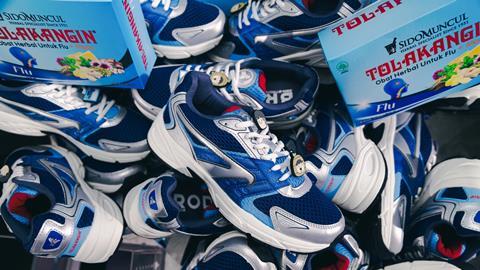
From Ortuseight and 910 to Mills, League, Ardiles, and Specs, plus lifestyle player Brodo, local labels have stormed the starting line, turning the runner’s closet into a battleground where global giants no longer rule alone.
Brodo founder Yukka Harlanda has chased Indonesia’s running shoe market for three full years, yet he concedes his brand still lags behind homegrown rivals.
Sixteen years deep in Indonesia’s shoe trade, and Yukka Harlanda still sees brands get it wrong, selling loafers as status, runners as an afterthought, worshipping design while dismissing the only metric that matters to feet, comfort, a lesson most brands never learn.
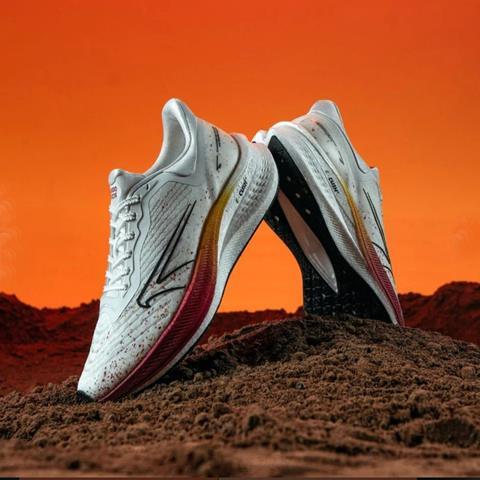
“When mapping out our potential buyers, Jakarta and the major metros will always chase premium, dropping 1.5 to 4 million rupiah without flinching, but outside those cities, where most Indonesians actually are, the spending power shrinks dramatically, with 500 to 700 thousand marking the outer limit of what they can afford,” Harlanda shared.
Currently, local brands rule Indonesia’s running shoe market on e-commerce platforms, with Tangerang’s Ortuseight seizing 35.5 percent of Shopee’s sales according to TMO Group’s May 2025 data and outrunning Nike, Adidas, and Asics in the online arena those global titans once dominated.
This success signals a clear pivot, Indonesian runners now trust local brands that deliver competitive quality, better prices, and tropical ready designs.
For all their e-commerce dominance, sales volume tells one story, but the premium crowd tells another, with Indonesia’s elite runners and upper middle class still lacing up to global names.
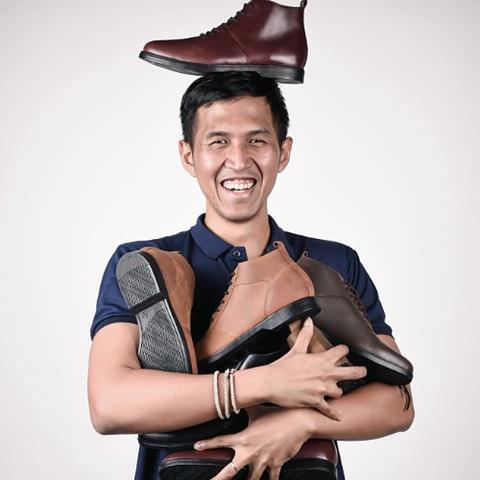
“Demand drives everything, and each tier of consumers has its own needs, so local brands occupy the middle ground once held by cheap imports and knockoffs, offering design, durability, identity, and fair prices without compromise,” Harlanda, a father of two, said, explaining the current market for the local brands.
Harlanda identified one glaring weakness, technology.
With most local brands drawing from the same Chinese production methods as their rivals, the industry struggles to carve out any real technological edge. While most local shoemakers overlook research and development, Harlanda viewed it as the frontier where Brodo can finally separate from the pack.
“We know [that] Indonesian runners, wide feet, flat soles, and a climate that cooks. So we create shoes with thicker cushioning and breathable materials, designed specifically for this country while matching the performance of any foreign brand,” Harlanda stressed.
Technology is not the only battle Harlanda faced, aiming Brodo to project an upper middle class aura, which forces him to concentrate his efforts on Jakarta and the rest of Indonesia’s urban hubs.
“The distribution game is brutal. Local brands almost never secure mall placement beside foreign giants, that is the reality. So we fight in second tier cities outside Jabodetabek, Sidoarjo, Mojokerto, towns without Planet Sports or global flagship stores [Nike, Adidas], just small local sports shops near the square, and distributors demand a heavy toll, eating a significant cut of whatever margin we manage to earn,” he added.
The uphill battle against illegal imports
For Indonesian Footwear Association (Aprisindo) executive director Yoseph Billie Dosiwoda, illegal imports ranked high among the footwear industry’s toughest battles. As such, illegal imports undercut local production and make it nearly impossible to push the industry forward.
According to Info Bank News, by December 29, 2025, The Directorate General of Customs and Excise Directorate (DJBC) under the Finance Ministry had recorded 30,451 enforcement actions against illegal goods across various sectors, with a combined value of Rp 8.8 trillion, or roughly US$540 million.
Meanwhile, the data from Pajakku revealed 371 pairs of footwear confiscated the previous year, cementing shoes as one of the most frequently seized items. In addition, Finance Minister Purbaya Yudhi Sadewa laid out the government’s enforcement roadmap on December 2, starting with used clothing and moving straight to steel, footwear, and beyond.
“Used clothes are first to go, then steel, then footwear, and we do not stop there, we block every illegal import that comes our way” Sadewa said.
“We protect the local market so our businesses can breathe. Without that shield, illegal imports will always hold the private sector back,” he stressed.
School season demand usually fires up production, but not this year. Retailers still flush out 2025 inventory, and ongoing global conflicts keep raw material prices high, leaving manufacturers in a holding pattern, according to Dosiwoda.
“Demand is up for the school year, but manufacturers are not cashing in. Retailers are still drowning in 2025 stock they could not unload,” he said.
He also flagged a deeper structural issue, a thicket of mandatory regulations that weigh on local manufacturers, whether they make sports shoes or everyday footwear. “There are multiple factors at play, starting with the sheer number of mandatory regulations the government imposes on domestic manufacturers,” Dosiwoda added.
He listed the three regulatory beasts dominating the list, Indonesian National Standard, security, occupational safety, health, and environmental standards, and Local Content Requirement, the last of which applies specifically to domestic companies pursuing government contracts.
“A local manufacturer eyeing government deals must swallow the full [respective] regulatory load of National Standard, security, occupational safety, health, and environmental standards, and Local Content Requirement,” he asserted. “This is not business as usual, illegal imports require a crackdown beyond routine law enforcement,” Dosiwoda insisted, warning that counterfeit sneakers have saturated Jakarta at rock bottom prices, undercutting legitimate local producers at every turn.
Further, Dosiwoda flagged a cruel irony, Chinese producers now plagiarize Indonesian footwear and peddle it cheaper online, a fresh wound for an industry already bleeding from weak consumer spending.
“I wear local brands myself, and they are genuinely good. But they stand no chance on the shelf against global imports, because consumers still worship foreign names, and the flood of illegal sports shoes only deepens the hole,” he closed.
Factfile: Who we spoke to
Muhammad Yukka Harlanda is co-founder and CEO of PT. Brodo Ganesha Indonesia . He turned a dorm-room project into one of Indonesia’s premier homegrown footwear brands. Yoseph Billie Dosiwoda, S.IP., M.IP., is Executive Director at the Indonesian Footwear Association (Aprisindo).

Eastern views
Asia-Pacific insights for the sporting goods industry
Analysis, insights, and expert perspectives on the sporting goods industry across Asia-Pacific — covering market trends, manufacturing, retail, and brand strategy from China to Southeast Asia to Oceania. With Jakarta-based contributing editor Yohana Belinda.
Explore Eastern views →