The global sporting goods industry is making its voice heard on the global health stage. At a landmark side event during the 78th World Health Assembly (WHA) in Geneva, the World Federation of the Sporting Goods Industry (WFSGI) launched its first-ever Sporting Goods Physical Activity Impact Report, titled Moving the World Towards an Active Future.
The event brought together senior leaders from health, sport, and business. Speakers included Sir Gareth Southgate, Assistant Director-General of the World Health Organization Dr Ailan Li, WFSGI CEO Emma Zwiebler, Nike’s Dan Burrows, Dr Jane Thornton from the IOC, and Dr Andy Moose of the World Economic Forum. Delegates from Adidas, Arena, ASICS, Decathlon, On, Puma, Speedo, Specialized, and others joined to send a clear message: physical inactivity is a crisis that demands collective action.
A moment of alignment in Geneva
The WHA event built on WFSGI’s growing engagement in global health policy. Following a Memorandum of Understanding with the WHO in 2023 and an industry-wide joint statement in 2024, the federation used Geneva to spotlight progress and the way forward.
“We came to Geneva with a united message: physical inactivity is a global crisis, and one the industry is ready to help play its part to solve,” said WFSGI President Emma Zwiebler, “Our report – Moving the World Towards an Active Future – delivered on that message, highlighting where our industry is currently making a difference, where we can do more, and where we advance private/public collaboration for the benefit of all.”
According to Zwiebler, the audience at the WHA78 side event “really recognised that physical activity is a key to unlocking healthier, more resilient societies.” That included representatives from WHO, the IOC, the World Economic Forum, the Nigerian Ministry of Health, and Nike—as well as attendees from a broad spectrum of public and civil society groups.
Physical inactivity is rising and so are the costs
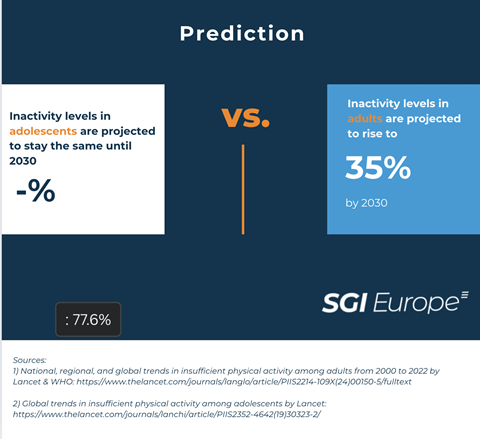
The report outlines a growing crisis. In 2022, more than 1.8 billion adults worldwide did not meet WHO’s recommended physical activity levels. That number is projected to reach nearly 3 billion by 2030.
With inactivity levels forecast to rise to 35% globally, the economic impact is expected to surpass $300 billion per year, driven by healthcare costs and productivity losses related to non-communicable diseases.
This is not new information, but it is newly framed, with the sporting goods industry now pushing for structural change.
Turning momentum into long-term action
“Since the report launch, we have a lot of momentum and believe it must now be translated into real, sustained action—both from our members and at the policy level,” Zwiebler said.
As outlined in the report, WFSGI and its members are now focused on delivering four collective commitments:
- Lead by Example – Supporting active lifestyles among the workforce
- Move the Inactive – Engaging those facing the biggest barriers
- Create Safe and Positive Experiences – Empowering coaches, mentors, and local leaders
- Shift the Story – Making physical activity a stronger part of culture, policy, and public health
“At a global policy level,” Zwiebler added, “I look towards the United Nations as it prepares its next Political Declaration on NCDs and Mental Health in September, and join our colleagues at WHO and across sectors in calling on Ministers of State for stronger integration of physical activity in the UN declaration.”

She also calls on governments to implement the WHO Global Action Plan on Physical Activity (GAPPA) at national level: “with a holistic approach from Ministries of Health, Education, Sport and Youth and a renewed, systems-based approach to get people moving at scale.”
“We don’t believe movement should be a privilege. And that’s why we are calling on our peers across sport, health, and industry to join us—to collaborate and scale what works.”
Emma Zwiebler, WFSGI
Examples that show it’s possible
The report features initiatives from WFSGI member brands that aim to remove barriers and engage those who are often excluded from sport and movement:
- Speedo Swim United: a programme designed to provide swimming lessons to underserved communities through pop-up pools.
- Decathlon Adaptive Sportswear: Products specifically designed for people with reduced mobility or permanent disabilities.
- Puma Let There Be Sport: Promoting sport in India to ensure it is seen as essential and not extra-curricular.
“As an industry with global reach and cultural influence, we are demonstrating how we’re removing barriers to physical activity and creating scalable, cross-sector solutions,” said WFSGI CEO Emma Zwiebler. “This report highlights the breadth of actions our industry is taking to help empower and inspire people to live more active lives and the power of collaboration over competition amongst our member brands.”
Coaches, culture, and the long game
The report also underscores the role of local leaders and educators. Coaches are often the ones creating safe, positive experiences that shape lifelong habits—especially for youth.
“Coaches have a huge role to play in keeping kids and youth engaged, offering them safe spaces and positive experiences,” said Sir Gareth Southgate, speaking at the launch.
“I view their job as both a responsibility and an outstanding privilege—not least because it can make or break positive habits for life, something which is highlighted in this industry-first impact report.”
What’s next
WFSGI is now working with member companies, health leaders, and public sector institutions to carry the momentum into the second half of the year—and beyond.
The goal is to keep physical activity on the agenda: not only as a health intervention, but as part of broader policy frameworks for sustainable development and mental health. With a united voice, the industry is calling for collaboration that reaches beyond brand boundaries and sector silos.
Download the full report here

Impact of Sports
The global physical inactivity crisis is real. Our duty as an industry is to inspire a healthy and active lifestyle. That's why we're dedicating a new content series to the Impact of Sports.
>> Find out more.