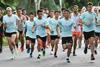
Running clubs surge across Asia and in cities worldwide, turning what was once solitary exercise into a collective ritual of reconnection and belonging.
Spanning from Patung Pemuda Membangun near Senayan to the Arjuna Wijaya horse statue by Monas, running clubs pour down Jakarta’s Sudirman-Thamrin corridor on car-free days, and that same wave now rolls through cities across Asia, with running brands staking their claim in these urban centers.
According to a Statista survey conducted throughout 2025 (from January to December), 24% of Mexicans jog at least occasionally, followed by 19% in China and Spain and 18% in Brazil, whereas in the U.S., that figure sinks to just 8%.
| Who jogs, by market | |
| Share of adults who jog at least occasionally | |
| Market | Share |
| Mexico | 24% |
| China | 19% |
| Spain | 19% |
| Brazil | 18% |
| The US | 8% |
Source: Statista, share of adults who jog at least occasionally, survey conducted January–December 2025.
Running may need less equipment than most sports, but the companies behind the shoes and treadmills are powerhouses. Branded athletic footwear sales rose 5 percent in 2024 to $105.2 billion, according to SGIE’s annual analysis of the international sneaker market, up from $100.1 billion the year before, though growth has continued to decelerate from the double-digit pace of the pandemic years. Nike’s decline made it the only brand in the top ten to post lower revenues. Meanwhile, US consumer wholesale sales of treadmills surged to $1.8 billion in 2023.
More than sport branding
Markus Winter, CEO of Yuzu Kyodai, insisted that running clubs were never really about the athleisure labels themselves, even though major brands had launched their own clubs.
“Every major sportswear brand is setting up its own running clubs. On and HOKA excel at this approach, using run clubs to reach runners across APAC that Nike and other big players have been overlooking. In cities like Bangkok or Sydney, On, HOKA and Asics have a stronger presence and deeper community connection than Nike,” Winter observed.
“On and HOKA made their mark by getting involved [sponsoring and partnering] with everyday run clubs and city fun runs, while Nike poured its energy into elite athletes and big marathons. Nike forgot about the everyday runners, especially in emerging Asia, and that gap is still there. So when you see On, HOKA or Asics at local run clubs, it’s no surprise they keep winning over the runners that Nike left behind.”
Visualizza questo post su Instagram
In Guangzhou, China, Nike set up a pop-up Cantonese soup shop as a post-run refuel spot for the local fitness community, serving herbal soup with dried tangerine peel, bitter melon and pork ribs alongside a branded spoon. The focus was not on sneakers or spectacle, but on food, community and a local message that reads “落足料 点会冇料到,” roughly translated to “No effort goes unrewarded.”
Visualizza questo post su Instagram
The move came at a telling moment: Nike had posted double-digit sales declines in China for three straight quarters while On, HOKA and Salomon ate into its share, making the hyper-local, low-commercial approach feel less like a brand flex and more like a deliberate bid to rebuild trust.
Japan takes the same logic and builds it into infrastructure, as seen at Asics’ Tokyo Marunouchi location, where runners get lockers, showers, shampoo and rented sportswear and shoes for a small fee, meaning someone can walk in empty-handed and still run. adidas does the same at Runbase with custom shoe fittings, lockers and showers. The point is not to sell something on the spot, but to remove the barriers, such as nowhere to change or shower, that keep city runners from running, turning these spaces into genuine services rather than branded advertisements.
Running clubs move more than just feet: the commercial impact is real. According to Business Times, a 2024 YouGov survey of 1,023 adults in Singapore found that 43 percent would consider buying products or services from brands sponsoring the running events.
These days, running clubs are no longer the domain of sportswear brands alone. Non-sport brands are sponsoring events or starting their own clubs, going far beyond shoes and apparel. RIDAR in South Korea offers a case in point, running a cafe that connects with the local running community rather than pushing products.
Winter also pointed out that roughly a third of respondents rated their outfit or gear as important or very important to their sports participation.
“Runners care about aesthetics because it signals their [insider] place in the community, and most of our members agreed that their sport communities have a recognizable look. The ad that resonates is the one you can wear and run in, not the one you swipe past. A run club also grows where ad campaigns fade, since most paid campaigns generate a short burst of attention that disappears within days and never lasts, so brands gain a recurring, self-renewing asset instead of a fleeting moment,” he stressed.
Run for love and friends
From Beijing to Tokyo to Jakarta, each running community carries its own character and opinions, though the culture itself belongs to all walks of life, allowing brands to reach across diverse communities rather than a single niche.
“Sports brands are turning to run clubs because they tackle two things other fitness trends and marketing channels overlook,” Winter said.
“Running is social by nature, unlike solo gym sessions or treadmill runs, which matters in Asian [youth] where loneliness is on the rise, from Japan’s hikikomori to disconnected city dwellers. A run club is a low-stakes way to move, meet people and belong, all without the awkwardness of formal social settings.”
Winter further noted that running clubs in the US and Europe are presenting themselves as an alternative to dating apps, backed by Strava’s 2024 Year in Sport report, which found global run club membership up 59 percent and one in five runners dating someone they met through their club. TikTok has amplified the shift with viral posts claiming users swapped the dating app Hinge for a run club and found love instead.
In Japan, however, the focus shifts to friendship. Half of community members discover their sports group through a friend’s invitation, while only a quarter come through social media. They also tend to show up with friends, making it a social occasion rather than just a workout or a dating scene, since most identify as single yet only about one in ten attend to find romance.
Visualizza questo post su Instagram
In South Korea, run clubs function as mini brands in their own right, producing merch and competition freebies made for social media, naturally opening the door for brand partnerships.
“I think brands find a ‘different’ kind of value rather than ‘more’ value in run clubs. [Big] athlete endorsements inspire the dreamers and aspirational runners, while run club sponsorship reaches the everyday runner, where the bulk of the market sits,” Winter said.
Moqian Sun, founder of The Harvest, pointed out that running communities give people a break from daily life while younger generations lean into wellness, making it a win-win for everyone.
Sun added that running is one of the easiest sports to start, with no need for racquets or expensive gear, making it open to everyone, while also offering brands a high rate of repeat purchases.
“As incomes grow, people are turning their attention from survival to wellness, and running makes sense because it is cheap, easy and fits seamlessly into any schedule,” she expressed.
She went on to say that Xiaohongshu and Douyin are packed with running posts, covering everything from gear reviews and pace updates to race-day vlogs. Running is visual and shareable, which matches how younger consumers and the middle class express themselves socially, creating a cycle where social media drives running interest, which in turn drives more content.
“With China’s birth rate declining and its population aging, older generations are turning their attention to health management, and running, as well as jogging, has become a go-to activity because it is low-cost, easy to sustain and offers clear fitness rewards [for them].”
After all, running is for everyone: a timeless pursuit.
View this post on Instagram
Eastern views
Asia-Pacific insights for the sporting goods industry
Analysis, insights, and expert perspectives on the sporting goods industry across Asia-Pacific — covering market trends, manufacturing, retail, and brand strategy from China to Southeast Asia to Oceania. With Jakarta-based contributing editor Yohana Belinda.
Explore Eastern views →