Younger generations are choosing treadmills over TikTok, according to new data from Strava. The fitness tracking app’s annual report shows Gen Z prioritising real-world connection through exercise, with half planning to use Strava more in 2026 while reducing time on Instagram and TikTok. Could this mark the start of a healthier trend—mentally as well as physically?
Strava’s 12th annual Year In Sport report reveals a behavioral shift among younger fitness consumers in the US. The data, drawn from billions of recorded activities and surveys of more than 30,000 people, shows Gen Z is investing time and money in active pursuits rather than passive screen time.
Running and racing lead, walking gains ground
Running dominated as the top sport, with Gen Z being 75 percent more likely than Gen X to cite races or events as their main exercise motivation. The generation also embraced variety, with more than half of users now tracking multiple activities. Walking claimed second place as the most-recorded activity type.
Women join Gen Z in the weight room
Weight training saw notable growth among younger demographics. Gen Z is twice as likely as Gen X to name weight training as their primary sport, with 61 percent more Gen Z than Gen X reporting they lift for aesthetics. Women increased their participation in the weight room, recording 21 percent more weight training activities than men in 2025.
Fitness spending rises despite inflation concerns
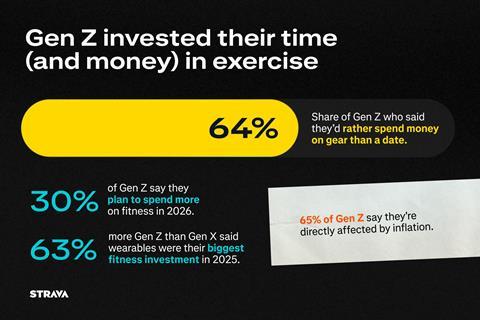
Despite 65 percent of Gen Z reporting direct impact from inflation, 30 percent plan to increase fitness spending in 2026. Wearables emerged as their biggest fitness investment, with Gen Z citing them 63 percent more than Gen X. The generation’s priorities extended to dating, with 64 percent saying they would rather spend money on gear than dates.
Clubs quadruple as community takes center stage
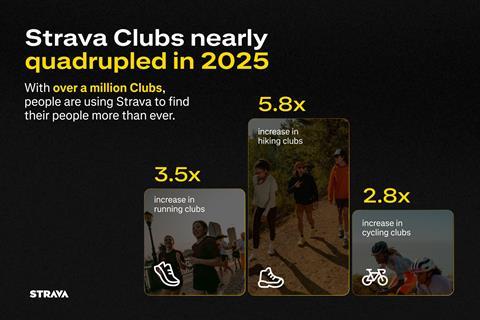
Community-building accelerated through clubs. New clubs on Strava nearly quadrupled in 2025, reaching one million total. Hiking clubs grew fastest at 5.8 times, followed by running clubs at 3.5 times. Club-organized events rose 1.5 times year-over-year.
Domestic travel dominates, workouts stay essential
Travel patterns shifted towards domestic destinations, with survey respondents 22 percent more likely to holiday domestically than internationally. Notably, for Gen Z, fitness on holiday became non-negotiable—23 percent more said workouts while traveling are essential compared to Gen X.

ASICS Novablast tops running shoe rankings
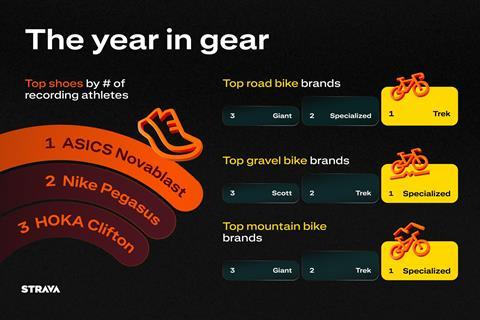
The report identified clear gear winners. ASICS Novablast claimed the top running shoe spot, followed by Nike Pegasus at number two and HOKA Clifton at number three. Apple Watch led the watch category, with COROS gaining traction. Mobile devices remained dominant for workout tracking, with 72 percent of users recording directly through the Strava app.
Boulder, Colorado, sweeps US city performance metrics
This year’s report explores the geographic dimension with city-to-city comparisons, and Boulder, Colorado earned what might be called hall of fame status. The mountain town swept every single US leaderboard: most steps per day (6,302), longest average runs (4.4 miles), most weekly moving time (3 hours and 10 minutes), longest median streak (39 days) and highest share of runners earning personal records (57%). If there were a fitness Olympics, Boulder wouldn’t just win gold—it would claim the entire podium.
Copenhagen in Denmark and Gipuzkoa in Spain lead European rankings
But what about Europe? Copenhagen, the capital of Denmark, claimed the title of fastest metro area worldwide with an 8:52 minute-per-mile running pace. Spain’s Gipuzkoa region on the Basque coast led the step count rankings at 8,125 steps per day—no surprise there. With such a scenic Atlantic coastline, how could you not indulge in long walks and runs along the water?

Back to the numbers: AI is gaining traction as the new fitness coach.
Artificial intelligence has arrived in fitness. Strava’s report confirms it: nearly half of survey respondents (46%) said they would use AI as a smart coach for sports, with Gen Z embracing AI for workout insights at higher rates than other generations.
Our SGI Europe take: the future is connected and intelligent—but also eager to move in the real world, and less on social media.
About Strava
Strava is a fitness tracking application with over 180 million users across more than 185 countries. The platform allows athletes to record and share activities including running, cycling, walking and hiking. Users can analyze performance metrics, connect with community members and participate in challenges. The company released its 12th annual Year In Sport report in December 2025.
Methodology
Strava’s Year In Sport report (downloadable here) analyzed billions of activities from its global community alongside survey insights from more than 30,000 respondents, including both Strava users and non-users. The US-specific data examined activity trends, consumer behavior patterns and gear preferences among American users throughout 2025. Survey data captured demographic differences across generations, with particular focus on Gen Z and Gen X comparisons.