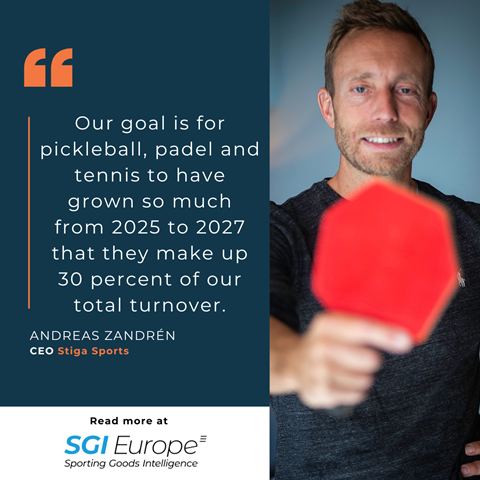
Inside the gates of STIGA Sports combined Stockholm office and showroom, CEO Andreas Zandrén measures a stroke in the air with the octagonal table-tennis racquet with which Truls Möregårdh almost subdued an entire Chinese nation during the Paris Olympics 2024. For Möregårdh, it was double silver at the Olympics, but for STIGA Sports, the Cybershape racquet has since turned to gold. Although it is virtually impossible for a supplier to highlight trademarks and logos during an Olympics, few did not react to Truls octagon. Senior Editor Mattias Björklund sat down with Zandrén not only to talk about the success of the “octagon” but also about the high ambitions of STIGA.
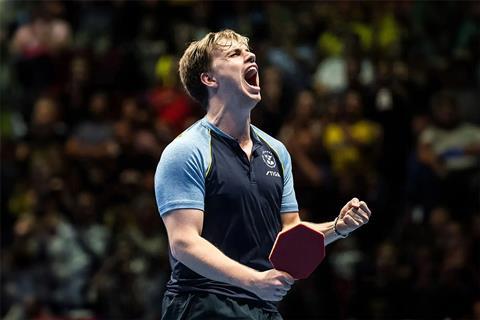
“Some Cybershape models were sold out shortly after the Olympics,” says Zandrén, explaining that the factory in Eskilstuna, Sweden, where STIGA Sports manufactures, is running shifts to meet demand. All this for a racquet that was launched as far back as 2022 but made its impact only this past summer.
The global racquet manufacturer, which produces “a couple of hundred thousand racquet frames” in its factories (Zandrén does not want to give an exact figure), has for a few years been a total supplier for racquet sports, serving badminton, tennis, paddle and pickleball. The 80-year-old Swedish brand is facing a major transformation. Currently, STIGA Sports’s CEO is considering how to market and sell the world-renowned table tennis company in a changing sports industry where competition is as fierce as at the Olympics. With respect to its foundational products in the racquet segment – table tennis frames, finished racquets, balls and tables – STIGA Sports has long been at the top of the world alongside competitors such as Butterfly, Joola and Yasaka.

But it is still in sports such as tennis, padel and, not least, the trendy sport in over half the world right now, pickleball, that STIGA Sports’s growth is occurring, explains Zandrén. Because STIGA Sports is still very new to these segments. And even though local Swedish ping-pong clubs have been reporting during the fall and winter that kids are coming in with hexagonal paddles in the hopes of becoming the Truls of the future, it is in tennis, padel and pickleball that STIGA Sports has the most room to grow.
To understand pickleball and its most expansive market, Zandrén has completed a two-week trip to the US – a trip he describes as a “study tour to understand the phenomenon of pickleball.”
SGI Europe: What did you do during the US trip?
Andreas Zandrén: It was simply about gaining knowledge about the American racquet market and how we at STIGA Sports should approach the American market. There are supposedly over 40 million pickleball players in the US.
Pickleball is played everywhere – from friends and families playing for fun to the very elite. We looked at municipal courts, where people played pickleball in the middle of the day as a break from office work. These facilities are busy evenings and weekends, and tennis courts are often converted into pickleball courts to meet demand. But we also saw the pros play in places like Atlanta, watching matches that were part of the US professional tour. The facility we visited had previously been a tennis club but had now been converted into a huge pickleball facility, with 28 courts and two center courts, where an amateur competition was also taking place at the same time. There were several hundred in the stands. It was indicative of how pickleball is growing in the US, and it was cool to see how quickly pickleball has become this big there.
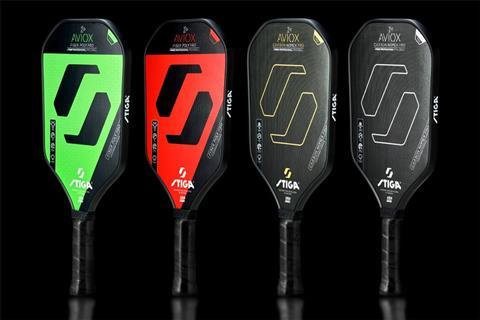
There’s a pickleball gold rush in the US! In 2023 alone, 300 new brands were added to the sport. We at STIGA Sports cannot be part of this first rush; it would be incredibly expensive for us to try to be seen and heard in the noise that is raging right now. Instead, our tactic is to continue developing the products with our own factories and establish ourselves outside the US. Then, when Europe and Asia catch up in pickleball, we will go more on the offensive in the US.
What experiences will you take away from your trip to the US?
The US has a deep love of racquet sports, and we see huge potential for STIGA Sports, especially in pickleball, padel and tennis. This trip was important because it allowed us to make new contacts, gain insights and understand the market on a deeper level. With this experience, we can approach the US with a renewed strategy.
What is the goal of your US venture?
Our goal is to triple sales in the US within three years, although we cannot give exact figures.
STIGA Sports’s plan for the US has been to do what works in all its markets: develop omni-sales and find a combination of physical and online retailers, but also sell directly to consumers from its own platforms.
We go high and low in the US. We sell both through Academy Sports and Amazon in the US.
Zandrén believes that Amazon sales are worthwhile even though the Giant takes much of the sales value. The brand awareness that this exposure brings is simply worth the price. But he also clarifies that STIGA Sports is only at the beginning of its US venture. He continues:
We’ve just started our journey with all racquet sports in the US. The foundation is always good products that consumers recommend to others. The ripples spread on the water, and we get a pull effect instead of a push strategy. That’s why we primarily sell our simpler models of table-tennis tables aimed at families via Dick’s Sporting Goods. We must get many products and expand table tennis in the US. Americans really like the sport once they try it. We see it and hear it from our American partners.

When it comes to table tennis, you’ve worked in the past in the US with event restaurants like Spin to spread the sport in that market.
Yes. The partnerships with Spin have been successful, and we will work more on table tennis. It’s very much about getting people to try the sport. Here, we’ve started using US event partners to help us create more similar events and bring our products to the market in the right places.
The story behind Cybershape
The hexagonal racquet Truls Möregårdh played in the Paris 2024 table tennis final took two years to develop and was launched in 2021, becoming known to the world when he used it in the World Championships that year.
“When we started developing this type of racquet, we realized that the players who got to test it during the process, including Truls, felt something in the game they hadn’t felt before, with better speed and control in the game,” says Andreas Zandrén.
The company turned to KTH, the Royal Institute of Technology, to develop the racquet further. According to the CEO, the university measured how the racquet’s frequencies propagated. The measurements gave STIGA Sports Sports answers on optimizing the hitting surface.
“I have a background from KTH, where I studied civil and mechanical engineering, so it was obvious for me to turn to them to develop the racquet with their expertise.”
In simple terms, the hexagonal racquet has a larger sweet spot (11% larger according to STIGA Sports) than the classic round table tennis racquet, making it less sensitive to where the ball hits the racquet.
What’s the long-term plan to grow racquet sports beyond table tennis in terms of sales?
Our goal is for pickleball, padel and tennis to have grown so much from 2025 to 2027 that they make up 30 percent of our total turnover. It’s an ambitious but realistic target, representing a significant increase from current levels. At the same time, we’ll continue to grow in table tennis, so it’s an exciting challenge to drive growth in all our sports categories.
We aim to be ready for an IPO in just three years. At the same time, we’re open to the possibility that it can happen faster if the conditions are right. The most important thing for us is to build a strong and stable foundation so that we’re not only ready for an IPO but can continue to grow and develop over the long term. It’s about having all the internal processes and structures in place to cope with the transformation that an IPO entails, Mr Zandrén concludes.
What do you think would be the most positive effects of an IPO for STIGA Sports as a company?
The most important thing would be that STIGA Sports then becomes available to the public and that everyone who wants to has the opportunity to own a piece of the company. With our company’s positive focus, I believe many would be interested in becoming a shareholder in STIGA Sports to produce equipment for an active leisure time that provides good health. I also think the brand’s visibility after an IPO will increase as a listed company often gets more media attention. This, in turn, will strengthen STIGA Sports as a brand and thus increase the value of the company even more.
Ok. STIGA Sports had a declining turnover for some years behind us, which was certainly affected by the pandemic. Now, it sounds like things are turning around for you. In 2023, you had a turnover of just over 300 million (€300m) with 3 million (€0,3m) in profit, and last year, the turnover went up almost 35 percent to 405 million SEK (€400m). When the IPO is done in three years, what will STIGA Sports turnover be?
We should have a turnover of 500MSEK (€50m). This is by growing primarily in racquet sports.
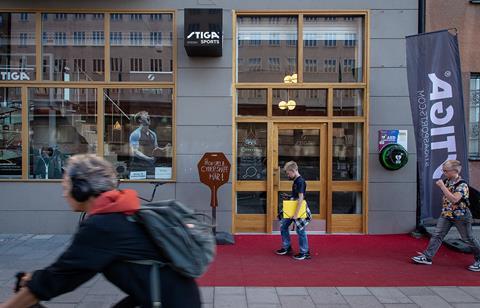
STIGA Sports
Founded 1944 by STIg Hjelmquist in Tranås, southern Sweden.
Owners Swedish investment company Swedia Capital 50% and still the Bandstigen family 50 percent.
CEO Andreas Zandrén since May 2016.
Turnover 2024 405 million SEK (€400m).
Organization Subsidiaries, agents and distributors.
Number of employees We are over 90 colleagues worldwide, in Sweden there are 45 people, in warehouse and subsidiaries in China 30 and in Japan, 6 people.
Production Several 100.000 professional frames/year.