With an operating result of €1.3 billion and sales of €23.6 billion, Adidas recorded revenue growth of 12 percent (currency-adjusted) in 2024. The classic German brand is expecting further growth in 2025 – albeit at a slightly slower pace – despite the difficult market situation. CEO Björn Gulden and CFO Harm Ohlmeyer give seven reasons why they’re confident that Adidas will be a winner in the sports market in 2025/26.
1. Global brand, local mindset
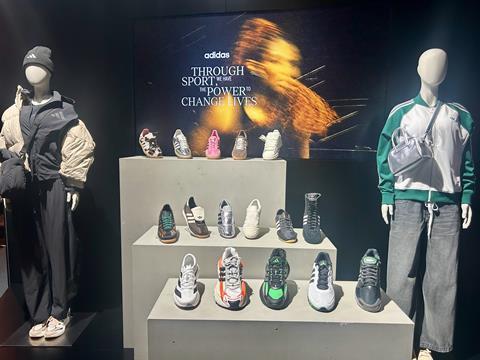
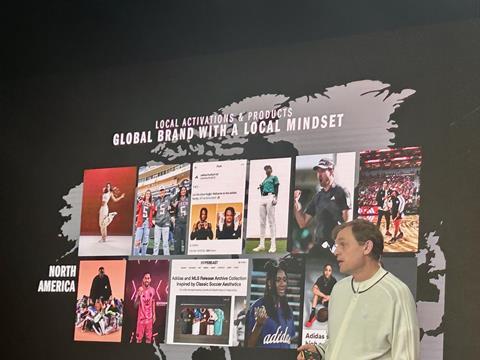
“We need less decision-making at headquarters and to trust our local employees more,” says Gulden. Keeping close to local customers is the responsibility not of the office at Herzogenaurach but of the local teams. That’s why, for example, at least one member of the Executive Board is in China every month, supporting the local team. In addition to China, Adidas’s key regions are the US, Europe, Japan/South Korea, North America, Latin America and emerging markets (from India to New Zealand).
Worldwide, the company has more than 5,000 athletes and brand ambassadors appealing to the interests of different regional target groups. Only a few brand ambassadors – such as Messi, Lamine Yamal and Jude Bellingham – have global relevance, because “football is one of the few globally relevant sports,” says Gulden. “We’re a global brand with a local mindset.”
However, it’s not only the advertising strategies that are regional. The product strategies are too. Adidas has five creation centers – in Herzogenaurach, Portland, Los Angeles, Shanghai and Tokyo – developing products for consumers in their respective regions. For example, in LA, where Adidas wants to play a bigger role in the future, the focus is on lifestyle and basketball.
Dive deeper into Adidas’ financial figure 2025
2. Flexibility as a strategy
Björn Gulden himself says that he’s often criticized for not having “a five-year plan, because of the volatility of the market.” Adidas contrasts this with flexibility, preferring the ability to react quickly to trends and demand. He sees this attitude among his employees as well.
One result has been the elimination of 500 jobs (“roles not people,” says Gulden) at the German headquarter. These were all duplicates or unneeded interfaces. Gulden: “Reducing complexity and making things simpler is the most difficult task we have.”
3. Different production lines for China and the US
The company’s supply chains for the Chinese and US markets are independent. Products for China are made in China on a local-for-local basis. Approximately 95 percent of footwear and apparel for the US market is made in Indonesia and Vietnam. For the time being, then, Adidas will not be affected by any tariffs on products from China for the US market. Gulden is, of course, aware that tariffs, inflation and poor consumer sentiment are bound to depress business across the market in 2025, but he has not yet modelled what would happen if President Trump were to impose tariffs on products from, say, Vietnam.
Regardless, Adidas expects to continue growing at a single-digit rate. The company is confident that it has excellent products with room for growth.
4. Adidas expects growth in sportswear
“In 2024, we had the hottest products on the market,” boasts the Adidas CEO, referring to the lifestyle footwear segment, with the Samba, Gazelle and Spezial, as well as the AdiZero performance running shoe and the football models (F50/Predator).
The company is confident to have an excellent product pipeline and is focusing on a revival of the Superstar model in the lifestyle footwear segment. In addition, it seeks to take its success performance running, particularly with the AdiZero, and extend it into the everyday running segment. To this end, AdiZero models will be sold at a lower price point. Some of the first drops sold out immediately, and the company will now need to launch more models that appeal to the casual runner. This has been difficult in recent years. Trust in retailers needs to be built further. Adidas has a 60 percent share of wholesale revenues, so the retailer is an important factor.
Board members are convinced that Adidas has a high “brand heat” with both retailers and consumers, and that both running and lifestyle footwear will sell better as a result. Generating around 60 percent of its sales with footwear, Adidas is dependent on these categories. It will be making the successful lifestyle shoes available as downgrades, with lower price points in the sportswear segment.
WIth this Adidas is able to avoid discounting high-priced models and appeal to a broader group of buyers. “This is where the business is in terms of money,” says Gulden. “There are a lot of opportunities to scale things: We haven’t done that yet.”
There are also plans to increase sales in the sportswear sector – through functional fabrics, innovative materials and cuts, and trendy styles. “We are taking the momentum from footwear and transferring it to apparel,” says Gulden.
The company also wants to expand accessories, the product area with the best margins. Its involvement in Formula 1 is expected to pay dividends here.
5. Adidas is looking for new opportunities – (1) Basketball
With regards to sports categories Adidas sees further growth potential in basketball and fitness. Of course, basketball is dominated by Nike and Jordan, says Gulden, and it will be difficult, but at the same time it’s “crucial to be successful in the NBA.” The basketball market starts in the US.
Adidas already sponsors several athletes and has signature shoes for NBA star James Harden, for example. These will soon be available outside the high-price segment as well.
6. Adidas looks for new opportunities – (2) Education
Adidas wants to focus more on the training/fitness segment. This is partly due to Gen Z’s trend towards gyms. “We need to break it down here, be more conscious and have a very local approach.”
7. Formula 1 ’can be bigger than football’
The Adidas team around Gulden is convinced that Formula 1 will become a cash cow for Adidas. The commitment is commercial and not driven by marketing. Formula 1 offers high visibility and a large target audience with many young fans. What’s more, it’s not as constrained as football by national teams: “It can be bigger than football, and it will be bigger than people think,” says Gulden. It’s therefore not unlikely that Adidas will try to outfit another F1 team in addition to Mercedes.