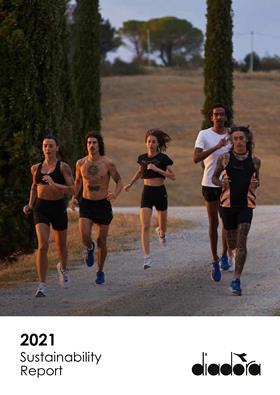
Diadora has published its first Sustainability Report. The document refers to the period from Jan. 1 to Dec. 31, 2021. The “Diadora Sustainability Manifesto 2021- 2025,” incorporated in the business plan, conveys the company’s roadmap for implementing its renewed sustainability strategy. The Manifesto is based on four pillars: People, Planet, Product and Governance. The Sustainability Report is the first step in the Governance pillar. The company’s organizational chart includes a special Sustainability & Intangibles Department that reports directly to the CEO, explains the report. An internal Sustainability & Intangibles Steering Committee has also been set up that consists of members of the board of directors and the head of the Sustainability & Intangibles Committee.
The report highlights the central role of human resources (People pillar) in the company’s strategy. In 2021, its workforce consisted of 194 employees, of which 96 percent were employed with a permanent contract and 72 percent were under 50 years of age. All employees at Diadora are covered by the ISO 45001: 2018 certified Occupational Health and Safety Management System (OHSMS). No occupational injuries or accidents were recorded in 2021. In 2021, the company delivered 2,188 training hours, representing a 46 percent increase compared to 2020, of which nearly 100 percent were voluntary. Starting in 2021, the company also introduced an online training platform called “GoodHabitz.” In terms of equal opportunities, in 2021 Diadora recorded an equal presence of male and female staff.
Under the Planet pillar, in 2021 the company achieved a drop in water consumption of roughly 36 percent compared to the previous year. Water supply comes exclusively from the municipal aqueduct. No drinking water is used for the production cycle. For 2022, Diadora’s environmental sustainability targets include the calculation of all of its annual climate-changing emissions and the associated multi-year reduction plan according to the parameters of the Science Based Target Initiative (SBTi).
Under the Product pillar, in mid-2021, Diadora developed a new tool to collect data from its suppliers. The tool makes it possible to compare the materials that the company uses and the quantities of product it purchases and use by type and geographical area. In 2021, the company worked with 138 direct suppliers and is working to increase the type of suppliers included in its audit system. In recent years, Diadora has relocated part of its production to Europe and Italy. In 2015, it launched a production reshoring project and reopened the internal conveyor system, Manovia, at its headquarters in Caerano di San Marco, including the recovery and upgrading of most of the machinery that represents a founding part of the company’s history. Compared to 2019, the volume of footwear produced in Europe increased by 8 percent, while the volume of apparel and accessories produced in Italy increased by 3 percent. In 2021, footwear production at the historic conveyor system, or Manovia, totaled 18,000 pairs, up from 17,000 in 2020. The company joined the Better Cotton initiative in 2021.
Diadora was founded in 1948 in Caerano di San Marco, in the sports footwear district of Montebelluna, near Treviso. The brand is wholly owned by LIR S.r.L., the holding company of the Moretti Polegato family, a major shareholder of Geox, which bought it in 2009. Diadora is distributed in more than 60 countries.
Further details on Diadora’s CSR commitment can be found in its 2021 Sustainability Report, which can be downloaded from the company’s website.