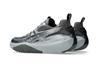
Asics, together with Fast Feet Grinded, a leading footwear recycling company based in the Netherlands, has, for the first time in the company’s history, produced a locally manufactured sneaker named Neocurve. 

The retro-inspired sneaker is made from three sources that all have their origin in Europe: collected, grinded-up dead stock Asics sneakers from EU countries, recycled PET bottles and other plastics and virgin polyester. By collecting unsold sneakers, grinding them down and producing recycled material for new production, Asics’ idea is to lower the company’s footwear manufacturing emissions. To further reduce emissions, Neocurve can only be ordered within the EU.

asics neocurve

Source: Asics

Asics Neocurve, only sold in the EU and produced in two colorways.

Technologies to grind down collected clothing and footwear for producing new raw material are currently under intensive development by many manufacturers. Looking at Neocurve’s table of contents, it’s obvious that brands and manufacturers still have some work to do to make sneakers even more sustainable. Fast Feet Grinded and Asics have made significant progress, with the knitted upper and laces, which do not contain any virgin polyester. Recycled polyester from PET bottles makes up 58 percent and 81 percent of the content for uppers and laces, respectively. The collected, ground-up material contributes 14 percent and 19 percent, respectively, which means that 29 percent new polyester had to be added for the upper.

asics neocurve

Source: Asics

Emissions accounting based on the production of a pair of Asics Neocurve.

As usual regarding high-quality footwear, it is not easy to make a durable midsole and outsole from recycled materials or to avoid oil. That’s why these parts of Neocurve comprise only 20 percent material made from ground-up, leftover shoes. The midsole is also made of 80 percent virgin polyester, which is not unique to Asics. Most shoe manufacturers face similar challenges. The outsole consists of 80 percent oil-based rubber. The sustainability-pioneer and Swedish outdoor shoe manufacturer Icebug, which from 2024/25 will only use FSC-certified natural rubber in its complete collection, still needs to use at least 40 percent oil-based rubber when it comes to their sole production. Natural rubber is still too fragile and wears down too quickly or becomes too expensive to handle in production, Icebug’s developer said to SGI Europe earlier this year.

For Asics, the Neocurve project is a step towards the company’s overall sustainability goal of achieving net-zero emissions by 2050.

Focus Circular Economy: Read SGI Europe’s Re:Thinking Business about circularity in the Sporting Goods Industry

“The Neocurve project began with a simple question: Can we create something new from what we would otherwise throw away?” explains Hidetoshi Muraoka, Head of circular economy projects at Asics. “We wanted to create a circular economy where people can enjoy sports and fashion with as little burden on the environment as possible. Despite our best efforts to reduce waste – through optimized production, digital samples, and donation programs such as to ‘Right To Play’ – some products still end up as unsellable headstock.” 

Asics Neocurve in detail

  • Collection: Old, defective, or unsold ASICS inventory from the EU
  • Disassembly: Carried out by Fast Feet Grinded in the Netherlands
  • Production: Recycled materials and shoes manufactured within the EU
  • Design: Crafted by Studio Hagel, Amsterdam, The Netherlands
  • Distribution: Exclusively available in the EU through direct-to-consumer and select wholesale channels