Decathlon has opened a training center for distance runners. Located in Iten, Kenya, with a rooftop view of the Rift Valley, the center consists of a 500-square-meter main building, with 11 bedrooms of 25 square meters each, a gym and a refectory. It is built to lodge 22 runners at a time, men and women alike.
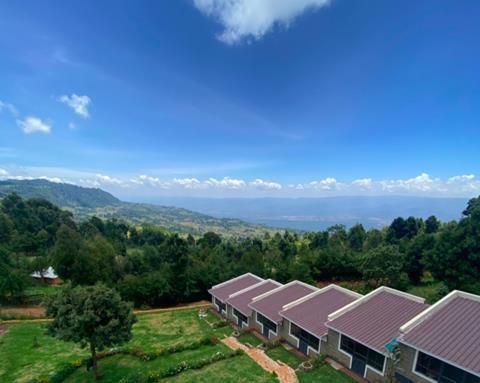
The staff in residence consists of a sports director, two coaches and a manager of operations. Working there daily is a pedagogical supervisor, overseeing communal living and team building, as well as a cook and a security guard. Also hovering about the premises is the center’s “godfather,” Paul Chelimo, a native of Iten who runs the 5,000 meters and was a silver medalist at the Rio Olympics (2016) and bronze medalist at the Tokyo Olympics (2021).
The center is called 42 House – where “42” refers to marathon distance in kilometers and “House” to the notion of family spirit – and it is a Kenyan affair.
Decathlon notes that 60 percent of the victors of the world’s top six marathons – Tokyo, Boston, London, Berlin, Chicago and New York – are Kenyan, but 42 House is not designed to draw runners from abroad to train in the land of champions. Instead, as Kiprun Leader Anthony Dulieu remarks, “The objective is to provide young Kenyans, from the earliest age, with all the keys to success for the athletic and professional future.”

In the summation of Amos Kimutai, the aforementioned manager of operations, 42 House’s singularity lies in its “blend of sports and human support in terms of education, career management, financial autonomy.” Not only does it provide athletic training, says Decathlon, but 42 House teaches aspiring athletes to establish savings, to invest, and to deal with “intermediaries,” from race organizers, agents, and the press to their own families. Athletes, the company continues, must surround themselves with the right people in matters of sport, law and finance and be ready to make the transition to professional life once their athletic career comes to an end.
Athletes receive room and board and a monthly stipend of 20,000 shillings (about €125). By Decathlon’s reckoning, the average monthly salary in Kenya is 15,000 shillings. (The African newspaper Business Daily put it at 20,123 shillings in December 2022, so we are in the ballpark.)
There appears to be a secondary objective as well, product development, but the center’s slide presentation mentions this in passing. It speaks of bringing Decathlon’s “engineers, designers and product directors” into close proximity with runners so as to “imagine technical and innovative products and services.”
42 House has also arranged to work with adolescents aged 13 to 18 at two Kenyan schools, in Iten and Cherangani. These aspiring athletes will be following a dual course of study, with academics and a transition into sports training. Some will go on to 42 House, while others will have the option to take an internship at Decathlon’s stores, of which there are two in Kenya.
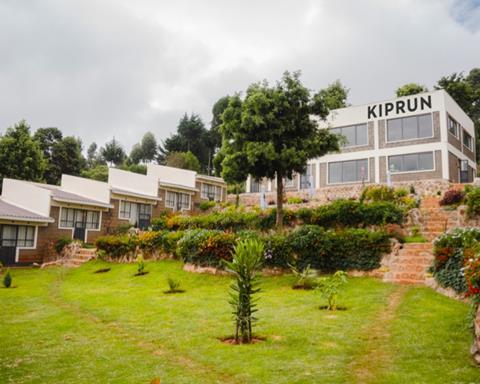
42 House is associated with the Kiprun brand, whose name dates to the Kiprun 1000 shoe model, released in 2010 by Kalenji, Decathlon’s former running brand, itself established in 2004. Kiprun became a brand in 2018. Decathlon’s trail-running brand, Evadict, dates to 2021. The three brands have since been fused into Kiprun.
Decathlon’s objective is to raise Kiprun into the ranks of the world’s top five running brands
What about the competition?
Kiprun is not the only brand to be operating a training center for runners.
As we reported last year, the Japanese brand Asics has opened a European center for professional athletes called Chojo Camp Europe. It is located on the French side of the Pyrenees Mountains at Font-Romeau, long known as a ski resort. The town is, in fact, perched at an elevation of about 1,200 meters, and the camp has a hypoxia chamber on site. Because the runners train for short as well as long distances, there is also a standard track, as well as a gym and a pool, and a staff of physiologists, psychologists and doctors. About 20 runners are there at any given time, some of them at present training for the Summer Olympics in Paris.
Chojo Europe is, in fact, the second of Asics’s running camps. The first, also called Chojo, is right where Kiprun’s is: Iten, Kenya. The coach there is Peter Bii.
On Running’s Tuscany Camp was established in 2014, taking inspiration from Africa – in this case, Bukwo Training Camp in Uganda, which Tuscany Camp’s founder and Head Coach, Giuseppe Giambrone, had visited and admired.
Once back in Italy, Giambrone converted for the purpose an 18th-century villa in the nature preserve of Alta Val di Merse, outside Siena. According to the company, the place offers a variety of surfaces: “asphalt, dirt, and grass, flat and hilly routes with variable slopes,” all of it “immersed in the woods.”
Also available are two gyms, a pool with a water treadmill and motor (for running and swimming against the current), a room for running in controlled humid heat, a sauna, a physiotherapy machine and a cryotherapy tank. Within walking distance is a clinic with “50 medical professionals and physiotherapists.”
Since 2001 On has been supplying professional athletes and covering room and board for young athletes at the camp. “The best athletes coming out of the camp pipeline,” says the company, “receive individual On contracts.” A case in point is Oscar Chelimo, a Ugandan runner of the 5,000 meters who won the bronze at the 2022 edition of the World Athletics championship.
Tuscany Camp lodges about 20 runners at a time. A recent batch hailed from Uganda, Burundi, Tunisia, Rwanda and Italy. An On-funded partner camp in Uganda called Kapchorwa trains about ten youngsters at a time.
New Balance opened a training center of its own in April 2022 and did it close to home – across from its headquarters at Boston Landing, Massachusetts. While not given over to the sport, The Track, as it is called, goes to technological lengths for running.
The centerpiece is, well, the track – 200 meters long and the fruit of the work of Beynon Sports Surfaces, Weems Mechanical, Elkus Manfredi Architects, John Moriarty Associates and Paige Design Group. It is indoors and, according to New Balance, built “for speed, competition, and daily training.” The turns are “hydraulically banked,” and the six lanes are the “widest available,” at 106.7 cm. The combined effect, says the brand, is that “runners experience a smooth transition from turns to straights” so as to achieve their best acceleration. The track is also “dual terrain” for conversion into a field. The stands can accommodate 5,000 spectators.
Also available are an area for track-and-field throwing, “flexible” courts for basketball and volleyball, and a pitch for sports like football and lacrosse.
The New Balance Sports Research Lab, also on-site, covers some 1,765 square meters and offers, among other things, imaging and 360-degree motion capture, force plates to measure foot depression, and a hyperbaric chamber. Its purpose is to “obtain standardized athlete movement and interview data” for product development.
Yet another thing on site is Roadrunner, a 4,645-square-meter concert hall under the Bowery Group’s management. New Balance calls it the largest hall of its kind in New England, with an 18-meter-wide stage and, for the thirsty, a half-dozen bars.
The Track is open to “professional and community athletes.”
Of course, not all running camps are run by shoe brands. For instance, ZAP Endurance Foundation is a non-profit that trains post-collegiate distance runners for the Olympics.
ZAP lies outside Blowing Rock, in the Blue Ridge Mountains of North Carolina, and was founded in 2001 by Andy Palmer and his wife, Zika.
Palmer was a serious runner in the 1970s, training with Bill Rodgers, Joan Samuelson, Greg Meyer and Bruce Bickford and qualifying twice for the Olympic marathon. But lack of financial support, as the website recounts, hindered his career. Once he had stopped competing, he earned a PhD in sports psychology, “adopted the motto ‘The Mind is the Athlete,’ and began mentoring runners of all ages and abilities.
Zika Palmer’s running heyday was in the 1990s when post-collegiate runners had “no groups to train with.”
The site they settled on for their camp covers more than 45 acres and lies at an elevation of 1,067 to 1,219 meters. Around it are more than 40 kilometers of carriage road over “hilly terrain.” The camp now lodges 24 runners at a time, with another building for athletes the camp supports. There is a kitchen, a weight room and offices.
Zika Palmer has been in charge since 2002 when Andy Palmer died of a heart attack on a run at Moses Cone Park.