The vast majority of managers have difficulty trusting the productivity of their employees in hybrid work models. 85 percent expressed this in a survey by Microsoft for the current “Work Trend Index”. This stands in contrast with the employees’ view. In Germany, 86 percent of employees nationwide said they are productive at work. This is backed by Microsoft’s data, as the software company has insights into productivity signals through their user’s activity. The number of meetings per week had increased by 153 percent globally for the average Microsoft Teams user since the start of the pandemic. And, according to Microsoft, there is no indication that this trend has reversed. Also, 42 percent of participants multitask during meetings by actively sending emails or pings.
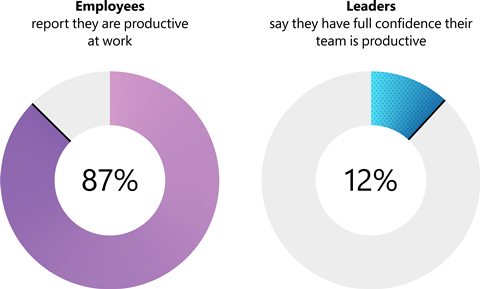
For the analysis of the state of the working world, 20,000 managers and employees were surveyed in 11 countries, 2,000 in Germany alone. The survey reveals a clear discrepancy between employee expectations and manager uneasiness over hybrid work models, as they miss the certainty of visible productivity. However, Microsoft has found that leaders need to adapt to what is has become a reality since the pandemic.
Jared Sparato, Microsoft’s corporate vice president for modern work, says: “The world has changed, and anyone who thinks we’re going back to the way we worked in 2019 is sorely mistaken. It’s become clear to us that work is no longer a place, but an experience that binds employees and leaders across home offices, company headquarters, time zones and more. […] At the same time, many leaders still crave the familiarity of the traditional office where brainstorming happened in person and chance encounters in the hallways led to unexpected collaboration. In short, there’s a disconnect between employers and employees. And in an unpredictable economy, that disconnect is only growing wider.” Control tools and “productivity paranoia” by leaders further enhance the emotional gap between the parties, leading to dissatisfaction and job-hopping. As counter-measures to strengthen loyalty and identification with employers, Microsoft recommends creating and reinforcing a culture that rewards employee impact, not just activity.