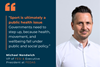
From marketing campaigns to mega-events, the sporting goods industry has long used emotion and inspiration to get people moving. But according to Michael Nendwich, Vice President of the Federation of the European Sporting Goods Industry (FESI) and Executive President of the European Federation of Sports Retail Associations (FEDAS), these approaches fall short. In this exclusive SGI Europe interview, Nendwich explains why sport is a public health issue at heart – and why it’s time for the industry to think bigger.

nendwich-4

Michael Nendwich, Vice President at FESI and Executive President at FEDAS

SGI Europe: Everyone’s talking about the need to boost physical activity across society. Traditional tools include campaigns and major events. Are these still effective?

Nendwich: There are certainly great ideas out there – whether we’re talking about awareness campaigns or major sporting events. But I still believe we’re thinking far too small. And the industry’s overall impact remains modest. Sure, global events like the Olympics or the World Cup create visibility. But in the bigger picture, they’re not enough. Sport is ultimately a public health issue.

What do you mean ?

Physical activity needs to be embedded in everyday life – at work, at school and in our leisure time. I’m convinced that the greatest cost savings, especially in healthcare, can come from making regular physical activity part of our routines. But for that to happen, governments need to step up. Health, movement and wellbeing fall under public and social policy. A healthy lifestyle must be accessible to everyone. And the sporting goods industry alone simply doesn’t have the scale to make that happen.

Still, isn’t it risky to wait for politics to move? Doesn’t the industry have some influence?

Absolutely. What we do have is the power of emotion. We sell more than products – we sell visions. Nobody buys a treadmill for its beauty. They buy it because they picture themselves with a six-pack, feeling fit and confident. Or they see themselves hiking, playing tennis, cycling with the family. We’re good at delivering those images – but mostly to people who are already active. That’s the limit. If we want to reach beyond that group, it needs to be treated as a public health mission.

Michael Nendwich - Quote

Beyond emotions, communities have become increasingly important too, right?

Communities are a huge lever. And they’re not relevant just for big retailers. In fact, smaller local stores can really benefit from strong community branding. Done well, it creates a direct connection between the brand or retailer and the consumer. And it doesn’t take millions of followers. Even small, local communities can make a real impact. Community-building is scalable and deeply effective.


→ Curious how AI and virtual try-ons are set to reshape the sporting goods industry? Read Michael Nendwich’s take on the most disruptive tech trend here.


Partnerships are becoming more important too – for both the industry and retail. What role do FESI and FEDAS play?

We have to distinguish here. FEDAS doesn’t get involved in operational partnerships. But when it comes to overarching policy and advocacy, we absolutely support our members.

Can you give an example?

Take the EU’s current prioritization of defense and security. There’s a real risk that funding is quietly pulled from areas seen as “less urgent” – like sport and culture. That’s why FESI launched an initiative, supported by over 80 brands and organizations – including Nike, Adidas, Puma and FEDAS – to advocate for sport’s societal importance. We presented the Commission with clear arguments for why sport deserves prioritization.

Our message is simple: don’t weaken sport – strengthen it. Especially now, as Europe looks to remain competitive, investment in health and movement is vital. FESI can help by giving sport a political voice and ensuring it’s not sidelined.

Another key area is regulation. At both the national and the EU level, we work to ensure that our members can operate without unnecessary obstacles. We’re not asking for subsidies. We’re asking for fair, enabling frameworks.

Speaking of frameworks – the EU’s regulatory landscape can be quite rigid. Does that affect the agility of the sporting goods sector?

Definitely. In many cases, regulations have gone too far and are holding the industry back. But I’m optimistic. With a new European Parliament, a new Commission and the incoming “Omnibus Directive,” we expect things to get simpler. Existing directives are being reviewed, and that should reduce red tape – especially for SMEs – and lower potential legal risks.

One final question: What’s your message on the “Impact of Sport” given today’s market environment?

My message is directed at policymakers: We in the sporting goods industry know what sport can do. But to unlock its full potential across society, political leadership is essential. It’s up to governments to spotlight the value of sport – so people stay healthy, fit and active. That in turn benefits public health systems, by reducing costs. But it takes a mindset shift. We need decision-makers to truly grasp the transformative power of movement.

Editor’s note

The “Omnibus Directive” is an upcoming bill that bundles several regulatory reforms into one act – designed to simplify rules, lighten administrative burdens for businesses and increase EU competitiveness. Relevant areas include the Corporate Sustainability Reporting Directive (CSRD) and the EU taxonomy.

Impact of Sports 2024 Logo

Impact of Sports

The global physical inactivity crisis is real. Our duty as an industry is to inspire a healthy and active lifestyle. That's why we're dedicating a new content series to the Impact of Sports.

>> Find out more.