Oakley is celebrating its 50th anniversary this year and is one of the iconic sports brands that combines technical innovation with an urban lifestyle. How does the brand remain relevant for young target groups? Which sports is it focusing on today? We’ve spoken to Harry Cockburn, Brand Manager for EMEA, about trends, growth and Oakley’s strategy in the apparel sector.
Founded 50 years ago in California, Oakley has both driven the technical development of sports eyewear and built a true fan culture. Anyone who mattered in sports in the 1990s and 2000s wore Oakley. As the brand’s popularity grew, so did the number of its product categories, from goggles and helmets to apparel for a wide range of sports, including MTB and golf. The lifestyle segment has also become increasingly important.
In 2007, Oakley was sold to the Italian eyewear group Luxottica and has been gradually integrated into the company. How does a brand build on and sustain its past success? After all, the enthusiastic fans of yesteryear have grown older, and the younger generation has its own heroes. We’ve spoken to Harry Cockburn, Oakley’s Business Brand Manager for EMEA, about Oakley and apparel, the brand’s retail category and how it stays close to its target audience.

SGI Europe: How did the winter season go for Oakley Apparel? What kind of feedback have you received from your retailers and your own channels?
Cockburn: It has been a great season for Oakley. Looking at our snow apparel, we’ve added a backcountry collection to our more well-known all-mountain and park offering, which has performed well. We’ve also focused on having more clearly defined fits to suit different preferences, which has been appreciated by our customers. Another addition was developing our layering program to include base, mid- and shell layers. Aside from snow, our Latitude collection, which is our technical lifestyle range, has done really well. Our consumers love it, because every little detail has unique Oakley DNA running through its core.
How is the Oakley Apparel collection structured? Which sports segments do you serve?
The bulk of our collection is for snow sports, in which we have a head-to-toe product offering. Our lifestyle range has always been really important for Oakley, with our heritage in sports like surf and skate. This has expanded in recent collections to include more premium segments, like Field Gear line and Latitude. Of course, bike is another core sport for Oakley. We have a great MTB [Mountain Bike], gravel and road range with performance apparel and helmets. Golf is another important vertical for Oakley, with an expansive product range. Throughout all categories we have many accessories available, as well as rucksacks and travel bags.
In terms of sales, which are the most important apparel segments for you?
Our snow sports apparel segment is really important for us. With our focus on technology and innovation throughout all of our products we’re always looking to push the boundaries of what is possible. Another strength is how we bring our athletes into the design process, consulting them on their needs and hearing first-hand what they are looking for to perform at the highest levels.
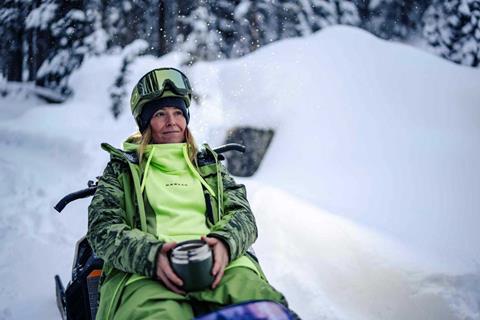
How do you position yourself with Oakley Apparel? The glasses are in the premium segment. Does that also work for clothing?
Our sunglasses and goggles are our main product categories in terms of sales and importance to the brand, but we apply the same rigorous design and testing processes to apparel too. For apparel we aim to have an entry to core to premium offering. You’ll find this from snow to bike to lifestyle.
What target groups do you address?
Our audience is broad, ranging from athletes and sports enthusiasts seeking performance-driven, technical gear across all our disciplines to style-conscious Gen Z consumers drawn to our Latitude and Reserve apparel lines and exclusive collaborations.
We champion individuality and for our consumers to “Be Who You Are.”
What role do sports such as snowboard, free-ski and MTB still play for Oakley and your marketing – and also in the field of professional sports?
Our brand DNA is rooted in sports. Freestyle sports are an incredible combination of performance and style – two things that are always a priority for Oakley. We stay authentic to sport while pushing it forward, by teaming up with world class athletes and developing top-tier products and innovations.
Freestyle sports are also an amazing source for connecting with young consumers, who are always looking to ride at their best while looking great on the slopes.
Streetwear has been the dominant fashion trend in recent years. Are you able to benefit from this development?
Yes, very much, I would say. For the past seasons we have worked hard on reestablishing ourselves in the lifestyle segment. The younger consumer is aware – hence why we need to be more aware. The fit perfection, color palette and right distribution is more important than ever. We see a stronger interest from younger consumers, especially in our key territories – UK, France and Germany – and in the seasons to come we expect southern regions also to pick up, too.
How has the “action wear” market developed overall? Brands like Burton, Quiksilver and Rip Curl, in whose environment Oakley was also previously positioned, used to be strong players and relevant for a broad target group. What’s different today?
The action wear segment will always stay close to Oakley. We still consider ourselves a part of the surf and board community, but we also strive for an increased awareness in the apparel industry. The pinnacle of our snow collection is developed together with snowboard athletes, and it’s here we aim to be bold, with forward-thinking design and innovation.
Does your target group still buy in-store? Or do online shops have the better cards?
Of course e-commerce has been on the rise for several years, but our wholesale distribution and retail stores are incredibly important touchpoints for us. We’ve expanded the number of our retail and partner stores across Europe, including a global flagship store in central Milan. We know our consumers value physical places where they can get advice from experts and test our products, so a balanced distribution between online and in-store is important for us.
Which markets are the strongest for Oakley?
Within Europe our biggest markets are the UK, France, Italy and Germany, but it really depends upon the product category. For snow we have a very strong brand affinity in the Nordics, so our business is strong in this segment. France and Italy are big sunglass and optical markets for us, while the DACH region performs well across all categories.
How do you work with the eyewear and helmet sectors?
Eyewear and goggles are the products most consumers associate with Oakley. We’ve been developing them for nearly 50 years, so they are really our core business. Helmets are a growing category for us. Consumers are looking for complete head systems – sunglasses and bike helmets or goggles and snow helmets that offer seamless useability, a consistent design language and complimentary technology.
How do you plan to continue growing?
We will work across all of our product categories to drive business. We also have a number of exciting game-changing innovations in the pipeline that we expect to perform really well. We’re excited for the future and will continue in our journey to create products that allow our consumers to compete at the highest levels and enable them to express themselves.
![Swiss-Ski 2022 Zermatt_2662[1]_16_9](https://d1f00kj7ad54bu.cloudfront.net/Pictures/100x67/2/5/4/50254_swissski2022zermatt_26621_16_9_467984.jpg)