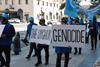
The Uyghur Forced Labor Prevention Act (UFPLA), prohibiting the import into the U.S. of products made by forced labor in Xinjiang, China, is now in force, under the oversight of U.S. Customs and Border Protection (CBP). The act was signed into law by President Joseph Biden on Dec. 23, 2021, over the objections of such companies as Apple, Coca-Cola and Nike. As we reported at the time, the act will ban imports of cotton and other products originating in Xinjiang unless the importers can prove that they were not produced with forced labor.
In its announcement, the State Department declares that “genocide and crimes against humanity are ongoing” in the Chinese province and that it has resorted to “visa restrictions, financial sanctions under Global Magnitsky, export controls, Withhold Release Orders and import restrictions, as well as the release of a multi-agency business advisory.”
To mark the occasion, the American Apparel & Footwear Association (AAFA), the National Retail Federation (NRF), the Retail Industry Leaders Association (RILA) and the United States Fashion Industry Association (USFIA) have issued a joint statement that reads in part: “Our members have a zero-tolerance for forced labor and will continue to make every effort to mitigate, root out, eliminate, and prevent forced labor in their supply chains. The UFLPA is a key component of a broad global strategy, and our shared goal to end forced labor.”
There have been a number of controversies over raw materials sourced from Xinjiang. Amnesty International released a report on the subject last June when the U.S. Congressional Executive Commission was urging professional basketball players to cancel their Chinese endorsement deals.
In December, the Biden administration announced that it, although not American athletes, would be boycotting the Beijing Olympics. The following month, the U.S. Congressional Executive Commission on China (CECC) sought assurances from the International Olympic Committee (IOC) that the uniforms to be supplied by the Chinese companies Anta and Hengyanxiang would be made with cotton grown outside China.
Only last month, the European Center for Constitutional and Human Rights (ECCHR) – a non-profit organization founded in 2007 by Wolfgang Kaleck and other attorneys to surveil compliance with the Universal Declaration of Human Rights and other such documents – alleged, based on investigations carried out by STRG_F for the German media outfit NDR, that traces of Xinjiang cotton remain detectable in the apparel of Adidas, Hugo Boss and Puma, among others. In December, as we then reported, the same group, alongside Prakken d’Oliveira Human Rights Lawyers, filed a criminal complaint in the Netherlands against Patagonia, Nike, C&A and State of Art, alleging these companies “may have been directly or indirectly complicit in the forced labor of members of the Uyghur population in China’s Xinjiang province.” The NGOs Sherpa, the Collectif Ethique sur l’étiquette and the Uyghur Institute of Europe have filed similar complaints with the public prosecutor in Paris against brands like Uniqlo and retailers like Zara. Many of these complaints have taken inspiration from a report released in 2020 by the Australian Strategic Policy Institute (ASPI), as we reported last year.
Topics
- Adidas
- American Apparel & Footwear Association (AAFA)
- Amnesty International
- Australian Strategic Policy Institute (ASPI)
- Brands
- Collectif Ethique sur l’étiquette
- European Center for Constitutional and Human Rights (ECCHR)
- International Olympic Committee
- Legal
- National Retail Federation (NRF)
- Nike
- Patagonia
- Puma
- Retail Industry Leaders Association (RILA)
- Sherpa
- U.S.
- Uniqlo
- United States Fashion Industry Association (USFIA)
- Uyghur Institute of Europe
- Uyghurs
- Xinjiang