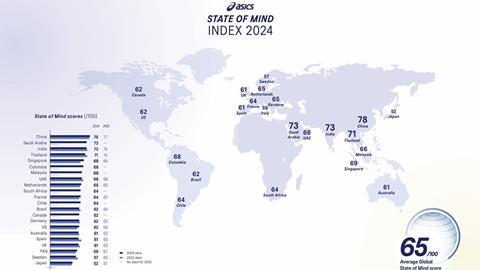
Asics unveils findings from its latest Global State of Mind Study, reaffirming the positive correlation between physical activity and mental wellbeing. Surveying over 26,000 individuals across 22 countries, the study reveals that those who exercise regularly exhibit higher State of Mind scores, with active respondents averaging 67/100 compared to 54/100 for inactive individuals.
Moreover, the research highlights the significance of physical activity during adolescence, indicating a lasting impact on adult mental health. Participants who maintained active lifestyles during their teenage years report higher activity levels and State of Mind scores in adulthood, emphasizing the importance of establishing exercise habits early on.
Notably, the study identifies ages 15-17 as pivotal for maintaining physical activity, with dropout during this period significantly affecting long-term mental wellbeing. Those who remained active during these years display higher State of Mind scores as adults compared to those who ceased exercise, underscoring the enduring benefits of consistent physical activity from adolescence into adulthood.
“Worrying decline in activity levels”
However, the study also reveals a concerning trend of declining activity levels among younger generations. While 57 percent of the ”Silent Generation” reported daily childhood activity, only 19 percent of Gen Z engage in daily activity, indicating a widening exercise gap between generations.
Professor Brendon Stubbs, a leading researcher in exercise and mental health from King’s College London, said: “It is worrying to see this decline in activity levels from younger respondents at such a critical age, particularly as the study uncovered an association with lower wellbeing in adulthood.”
“Gen Zs across the world are already exhibiting the lowest State of Mind scores (62/100) in comparison to the Silent Generation (70/100), so this could be hugely impactful for future mental wellbeing across the world.”