
Josee Larocque has taken over the reins at Elevate Outdoor Collective in turbulent times - but is firmly convinced that the winter and outdoor sports market will recover. How? That is something she told us in an exclusive SGI Europe interview, in which she also showed the conviction that more female decision makers are needed in the industry.

“Be proud and optimistic about that future!”
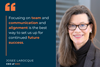
A clear message from Josee Larocque, the new Managing Director of Elevate Outdoor Collective (EOC) - a alliance of currently 12 outdoor and winter sports brands: K2, K2 Snowboard, Marker, Dalbello, Völkl, Line Ski, Ride, BCA, Atlas Snowshoes, Tubbs, Madshus and K2 Skate.
In addition to healthy optimism, the US-American relies on data analysis and lots of conversations. In this interview, she also explains why it is wise to invest in sustainability right now and gives an insight into the decisions she has made in the first 100 days that will have a major impact on the future of EOC.
Josee Larocque brings with her a wealth of experience from over two decades in the winter and outdoor industry - both at brand, production and retail level. Josee Larocque has worked at privately held Burton Snowboards for over 20 years, most recently as Sr. Vice President of Operations. Optimizing global operations, redesigning supply chains and distribution channels, as well as digital transformation are among her core competencies. Priorities that she also successfully applied as COO at the Elevate Outdoor Collective before being appointed CEO. Larocque is a cosmopolitan who has lived and worked in Germany, Canada, the Netherlands, Austria, China and the USA. She is a businesswoman and a family person. She loves German culture and would like to see more optimism and pride about the future in the industry - and more women!
A very personal conversation about a turbulent market and how she wants to ensure healthy growth here. And why it is so important right now for the entire industry (brands, retailers and consumers) to work on a common, stable basis.
SGIE: Mrs. Larocque, how have you experienced your first 100 days as CEO?
Josee Larocque: Coming on as CEO at the onset of Q4 in our industry is not a walk in the park. It has been a tumultuous time since 2020 in the winter and outdoor industry, and my time in this role has been spent trying to collect insights and data to determine when market normalization for the winter and outdoor industry and our collective of brands will occur and how exactly do we ride this line to maximize our performance for our team, our retailers and our shareholders while ensuring the people who ski, snowboard, snowshoe, skate or simply enjoy the backcountry and outdoors get the best service, quality and performance from our amazing products and brands.
I’ve leaned into what has been working for Elevate and leaned on the people and teams who have the skills and experience to create more opportunity for healthy and sustainable growth in our categories and regions. I’ve gotten to hear from customers who have been long term partners of Elevate brands and who themselves have had to weather the growth and contraction that the last four years have brought. Together we are all working toward healthy partnerships in the future.

What decisions have you made in your first 100 days as CEO that will have the greatest impact on the future of EOC? What drove you to make these decisions?
Deciding who the team is I need at the table every day to make the best decisions for Elevate’s future has been a hard but worthwhile effort. We have a large and complex team with different backgrounds, focus and experience, but the team at the table with me now is the right team today. Putting communication and education at the forefront of our strategy with the entire Elevate community has also been key. Our team needed to understand what our specific challenges are, what the macro challenges are, while also understanding how specific and unique our strengths and advantages are and how to lean into and leverage them for the future. Focusing on team and communication and alignment is the best way to set us up for continued future success.
Regarding alpine skiing – where is the most interesting and promising market for the ski industry and retailers? And why?
I hate to be so non-committal, but they all offer up tremendous opportunity. That stop in time moment of a global pandemic where humans across the globe came face to face with just how important it is to have an outlet that brings them outdoors is still impacting skiing. New participants were welcome, traditional participants doubled down into the joy of skiing and riding and other outdoor lifestyle activities and the core never wavered. Nothing is perfect in terms of accessibility and affordability but once we all, brands, retailers and consumers, collectively regain a stable footing, I see only promising signs in all the major markets.

Is there something that you would like to see from the German Speaking Europe ski trade as it is one of the most important?
Neither as a business leader nor as an American today would I preach to anyone or anything German, right now or ever. As a long-time lover of all things Deutsche Kultur and alpine culture in general, I simply would like to see more optimism in the trade. I don’t have to look much further than 100 years of Voelkl or the incredible strength of the Marker ski binding technology and innovation or look at the alpine chalets and Gemütlichkeit experienced at resorts across the world to know that what built ski and alpine culture then is certainly going to be a cornerstone of the future as well.
How will you present new collections to a broad international audience? Regional Events on snow or are you considering a return to ISPO Munich?
I can’t specifically comment on what the future holds for this as we continue to build out our future plans and investments, but I do know that being hyper focused on reaching retailers and consumers on snow and in person as well as in a digital format, where we all interact with just about everything today is the key to our success. We do need to ensure that what we believe in and what we are investing in and who we are is clearly communicated to our retail partners so they can help us reach consumers with our unique value proposition. We continue to learn where those efforts are best pointed exactly.
One of your passions as COO was the topic of sustainability. From the CEO’s perspective – how difficult is it to allocate budgets for sustainability?
Every resource we invest is part of a strategic decision-making process, but often, sustainability investments are not just the right thing to do—they’re a clear business advantage. Our commitment to the Science-Based Targets initiative (SBTi) at the EOC Group level is a prime example. This commitment will guide our decarbonization efforts and requires a structured, long-term approach to reducing emissions. It’s a big challenge, but one we welcome because it pushes us to be proactive, accountable, and innovative.
Sustainability is also a driver of efficiency and innovation. By critically reflecting on all aspects of our business—how we design, produce, and distribute our products—we can improve sustainability while also achieving higher operational efficiency. One of the best examples of this is our focus on material efficiency and waste reduction. Optimizing materials not only reduces environmental impact but also leads to cost savings and improved product performance. These are the kinds of smart, strategic decisions that make sustainability a core part of our growth and success.
March 8th is not only the publishing date of this interview but also International Women’s Day. I would be delighted to ask two questions in this context: The ski industry is very male dominated. Do you feel you have to work harder to get the same attention as your male CEO colleagues?
I love talking about this so thanks for asking! When I think about my role day to day, it is hard to say if I have to work harder because I am a woman, but I know I have to work extremely hard. However, when I take a step back and think about the arc of my career, I am sure that the woman is never the obvious choice for any role, let alone the CEO role. We need to work hard to change that both from our unique individual paths and from a professional perspective at large. Until there are more women in the industry and in leadership roles, a woman will rarely be the first or obvious choice for the ‘big’ roles. We must change that because a male dominated culture sure doesn’t make sense from a commercial perspective where women continue to grow their societal and economic impact. It just feels outdated and out of touch, and no one wants to be a part of that past, certainly not the skiers, riders, and outdoor enthusiasts who are our customers.
What barriers prevent women from reaching leadership positions?
It’s a circular equation but we need more women in leadership positions who see other women as just as capable and as obvious of a choice as any other person, to grow and to lead and be strong and capable. I personally have benefited as much from sports and outdoor activities (think a long winter hike in the dark to an unknown destination or a steep that you just have to go down because there is no other way down) that put your courage and strength to the test as I have from family members and from other leaders, teachers, specific women in leadership programs and mentors who see women and who saw me as a viable and capable leader in every regard. I feel very fortunate that I am at the point in my career where I get to recognize and promote these very capable women who weren’t the ‘obvious’ choice before.