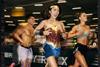
Hyrox sweeps across China, and brands chasing returns find the real gold lies in the local tournaments that pack the venues and spark the buzz, not the global franchise.

Hyrox takes over China’s fitness landscape. A niche fitness race turned social ritual for the urban wealthy and health-obsessed. For PUMA, the spectacle on the sidelines reads as more than a passing trend, more like a way in, but the real battle lies ahead, decoding the community and plugging into local events that build lasting connections.

Hyrox and PUMA teamed up in Hamburg back in 2017, long before the race conquered the world. The partnership deepened over the years, and an early renewal in October 2025 sealed their long-term commitment.

“HYROX, which has grown enormously in recent years, is one of our strategically most important partnerships as a sports brand, and a great showcase for our innovative performance products, such as our combination of NITRO technology and industry leading PUMAGRIP,” PUMA CEO Arthur Hoeld said.

“Our products have proven that they support the different requirements of athletes in this very versatile sport and help them to achieve great results. We are very encouraged by the great feedback we have received from athletes and partners alike, which helps us position ourselves even stronger as a sports brand.” he added.

Among the crowds, celebrities, finance executives, founders and fashion influencers turned out in force, some chasing competitive times, others challenging themselves, many simply wanting to be spotted, proof that Hyrox has evolved beyond a fitness race into a social staple for the urban wealthy.

Shanghai Hyrox alone drew 9,485 entries, including 3,942 in the men’s division, 2,691 in the women’s division and 2,852 in the mixed category: a breakdown that reveals a sport shedding its male-dominated image.


View this post on Instagram

A post shared by HYROX CHINA (@hyroxchina)

The breakdown reveals a sport shedding its male-dominated image. 

Moqian Sun of The Harvest, however, argued that PUMA has yet to seize the moment, struggling to turn race-day crowds into lasting community engagement. The clock is ticking for PUMA, with Nike and other major players already eyeing Hyrox.

“PUMA’s real opportunity lies in transforming Hyrox training camps, local sessions and gym co-branding into genuine ‘community assets,’ but none of those [efforts] has materialised, so calling this differentiation is premature when PUMA appears to have simply completed the baseline move of securing sponsorship rights without going further,” she stressed.

PUMA’s exclusive grip on Hyrox global sponsorship and official gear rights keeps competitors like ATHX at bay, limiting them to regional events or individual athletes without the brand exposure tied to the main stage. She further added that exclusivity does not guarantee sales. Meanwhile, PUMA’s Hyrox investment remains heavy in sponsorship and product design, with retail infrastructure lagging.

Thus, without retail density, the visibility and trust PUMA built through exclusivity will weaken, and competitors with stronger distribution could seize the opportunity.

Sun also pointed out that PUMA’s brand recognition and product quality are already proven. The bottleneck comes when Chinese consumers drawn in by Hyrox cannot find a store or training venue to make the purchase. Brand awareness, pricing and cultural fit drive consumer desire, but retail access decides if that desire becomes a transaction.

“Anta has agreed to acquire only 29% of PUMA and has no plans to buy the rest, so that minority ownership makes it unlikely [for] Anta prioritise PUMA’s Hyrox business with its best retail resources, especially when Anta has its own brands to feed first,” she noted.

Sun pointed out that PUMA already commands strong brand recognition in China, and its HYROX involvement has pushed that visibility even further, drawing in new eyes across the market. The next step for PUMA lies in stretching HYROX activation beyond race weekends and embedding the brand deeper into the fitness community that fuels the sport.

“Running and yoga drive consistent product spend through low equipment barriers and high repeat purchases, with gear used regularly at home or outdoors. Hyrox operates on a different logic, ‘hybrid fitness’ fused with event-based community. Most participants train in gyms, and that gym-based culture places the ‘PUMA Hyrox training shoe’ in a different demand category altogether.”

Despite the buzz, Tom Griffiths, a marketing specialist based in Asia, sounded a note of caution, pointing out that Hyrox’s trendy fitness model could hit a wall.

“All these events are fighting for the same slice of consumer free time. A Lululemon Yoga Club or a Kailas Trail Running Club goes head-to-head with a Hyrox training group, no different from competing with an established grassroots NBA-branded basketball tournament,” Griffiths said.

“When the fitness event market becomes overcrowded [and hits saturation], or where too many events chase too few consumers, retention and growth numbers will drop first, followed by subscription and apparel spend,” he added. 

For Griffiths, the opportunity spans Hyrox and other local competitions that follow its blueprint. BetterWE (BTWE), a homegrown variant, gathers a loyal following, though its size remains modest next to Hyrox.

BTWE was founded by Sam Hui, former head coach of Hyrox China. His time inside international hybrid fitness competitions gave him insight into global race formats and their limits in the Chinese market. Competition design, cultural expression, participant experience and community building often clash with the expectations of local fitness consumers.

BetterWE (BTWE)

Source: BetterWE (BTWE)

BetterWE (BTWE) inaugural event at the Hunan International Convention and Exhibition Center in Changsha (June 2026)

According to Jing Daily, BTWE is positioned by its organizers as China’s first homegrown hybrid fitness racing IP, built around local identity rather than foreign templates. Traditional Chinese aesthetics shape the visual and spatial design, while competition, tourism and social connection anchor the overall event experience.

“Brands always have room to hunt for the next opportunity. ‘BetterWE’ shows promise, though its future trajectory remains uncertain. As every partnership carries risk, and predicting trends requires both instinct and analysis, but the brands that read the signals correctly often secure the early advantage.”

Localised events connect brands with KOLs across sport, social life, brand identity and Chinese culture, while building a community that gives the brand a competitive edge.

“Attaching to an existing audience makes more sense than building one from nothing. Another run club, another yoga activation, keeping the energy alive gets tougher each time. Community building takes real work, far more than just latching onto one, and the ease of entry brings the risk that the community may never fully belong to you. Hyrox could shift its sponsorship strategy or pivot completely, and PUMA could be left behind despite executing its sponsorship flawlessly,” Griffiths closed.

Eastern views

Eastern views

Asia-Pacific insights for the sporting goods industry

Analysis, insights, and expert perspectives on the sporting goods industry across Asia-Pacific — covering market trends, manufacturing, retail, and brand strategy from China to Southeast Asia to Oceania. With Jakarta-based contributing editor Yohana Belinda.

Explore Eastern views →