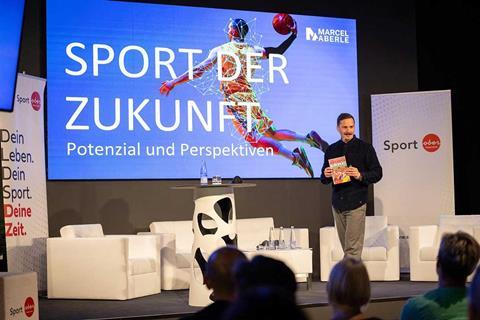
The global sporting goods industry is facing enormous challenges. Technological innovations, rapidly changing consumer behavior and social upheavals are challenging companies to realign their strategies. The simple analysis of historical data is no longer enough. Strategic foresight is required to anticipate changes and minimize risks. In an interview with SGI Europe, Marcel Aberle talks about the current “confusion phase” in which the sports industry also finds itself. He explains why it is now crucial not to fight the transformation but to shape it – and what role visions of the future, genuine collaboration and the intelligent use of AI play in this. The impact of sport: huge for him. Sport means entertaining people and doing good at the same time – namely, getting people moving. Aberle calls on the industry to think about how it can make clever use of this approach.

Why understanding systemic change is key to the future of sport
SGI Europe: Before we can talk about the impact of sports, we need to talk about the cycle theory – what it is, what phase society is currently in and whether these are taking place globally.
Aberle: Basically, all systems always go through the same phases – i.e., society, economy, industry, countries, products, companies. But let’s talk about the four phases. The first phase is the innovation phase. As a company, we try things out in this phase. Prototypes are created, customers are interviewed. In short, we experiment, and once the product-market fit (PMF) has been successfully completed, we move on to the growth phase. This is about scaling and expansion.
At some point, the system enters the so-called status quo phase: the big leap in growth is no longer possible; now it’s more about routines. Routines, standards and efficiency. It is not possible to predict how long a system will remain in the individual phases. But, at some point, every system tips over into the crisis phase. There are different triggers behind this.
Which ones?
These can be disruptions from technology or crises such as the coronavirus pandemic. But legal or geopolitical changes can also topple systems, as can social movements.
After the crisis phase comes the confusion phase. There are two directions that can be taken here. One is re-entry, where things return to the status quo results. This is always the case when we absolutely want to maintain something. If this is not the case, the second direction comes into play, and we end up in confusion. Here we accept that the business model no longer works. This is called the systemic confusion phase – or transformation phase, for short.
And what phase are we currently in?
Both as a society and from an industry and retail perspective, we are currently in the confusion phase. The exciting thing about this time is that both companies and governments are constantly and obsessively trying to move upwards – i.e., into the status quo phase. They do not want to acknowledge the confusion – i.e., the transformation. Companies then speed up processes and lay off employees. Governments pump a lot of money into some industry or other, even though everyone knows that it won’t help. My recommendation would be to actively initiate the transformation and to resist it less compulsively. Those who embrace it can generate new opportunities.
What is your current experience of the corporate world?
A lot of people say, “It’s really exciting and interesting, but we’ll invest when things get going again.” And then I say, ”Guys, you have to invest now and realign yourselves. Diving in and waiting simply doesn’t work anymore.” That’s why we’re in this confusion phase. Ayrton Senna once put it like this: “You cannot overtake 15 cars when it’s sunny weather, but you can when it is raining.” And at the moment it’s extremely rainy. A professor corrected me on this point during a lecture. He said, “Mr. Aberle, I have to correct you. It’s pouring right now.” I replied, “All the better. Then you can overtake 20.”
How sports companies can turn crisis into innovation
Opportunities lead to new products and new systems, right?
Exactly. Something new is created. But new things are exhausting. We humans are creatures of habit. We don’t like change, and we certainly don’t like confusion. That’s probably why the word “transformation” was coined. It sounds more optimistic.
Who is taking on the transformation?
Large corporations, such as Siemens, use phases of confusion to their advantage. They work according to the strategy of second speeds. They know that one thing has come to an end, the tanker can no longer be maneuvered, but we keep it in the loop, build on efficiency and see how long it will run. At the same time, they start with a new team, buy start-ups, merge, then push off again. These are the speedboats, so to speak. And with these, a new identity is launched, into the innovation phase. This is often referred to as ambidexterity. In other words, we work with both hands, optimize incrementally and see what the future holds for our company.
This is where the images of the future come into play. How?
A big one, because we need goals – as a society, as a company, as a country. We need to know where we want to go. The Americans would say: we need visions. But we Europeans find that difficult, especially the Germans. So we need strong images of the future. If the image, the place in the future, is good, is better than where we are right now, then we can deal with almost anything in the present.
And if these images don’t work?
Then we have a huge problem. It costs us an incredible amount of energy and can even lead to depression. In my opinion, attractive images of the future are essential for society. These can be people, institutions but also companies.
What images of the future can companies create and what can they achieve?
They manage to bring together the best of the different “worlds” – i.e., locals with migrants, cultures, climate and profitable growth. This is known as transforming brands. Patagonia is such a transforming brand. They are successfully committed to social and ecological issues and still make a profit.
Why sport has the emotional power to lead change
That brings us to sport. What images of the future can the sports industry generate when we talk about the impact of sport?
Sport appeals to deep human emotions and psychological needs. It has developed into an important substitute for religion, a neo-spirituality in which clubs and associations play a central role in many people’s lives. The leverage of sport is huge and tends to get bigger, not least through the reach of social media and formats such as “Drive to Survive” in Formula 1, which reach an even larger audience than the actual competitions. This also explains why countries like Saudi Arabia are investing massively in sport.
It’s about entertaining people and doing good at the same time. This is a call to action for the entire sports industry to consider how they can cleverly use this approach to meet people’s needs and bring about positive change at the same time.
Another important aspect is that “Well-being is the new luxury.” This applies not only to luxury brands, but also to sports brands, which need to recharge their identity. It is no longer enough to simply offer an expensive product. Brands need to deliver real added value and a holistic experience that goes beyond the product itself. Luxury fashion brands are already investing in film studios or producing films in order to emotionally charge their brands and to communicate values that go beyond pure consumption. This is a trend that is also relevant for the sports industry.
We’ve already talked about major sporting events and films, but can the sports industry – i.e., brands and retailers – also achieve this?
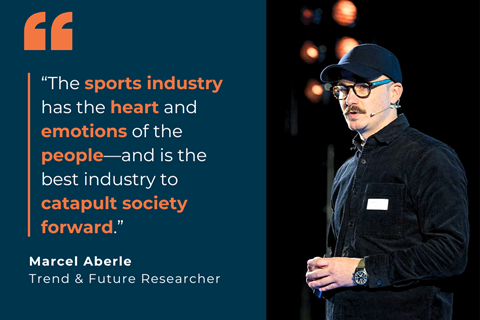
The sports industry has huge leverage, because of its emotions. In my opinion, the sports industry is very exciting for driving transformation.
Are “only” emotions really enough for this?
You see, transformation is primarily about action, and that comes from emotion. When I act out of emotion, I don’t question à la “Should I? Can I?” I just do it, and that is real action. That’s what we need! The sports industry has the heart and the emotions of the people and is therefore, in my opinion, the best industry to catapult society forward.
Unfortunately, I still have the feeling that the industry itself does not – yet – understand this responsibility, this scope. And it’s not about no longer generating profit. Profit is important. That is the driving force behind what we do. It’s more about bringing things, people, views, cultures, climate and environmental aspects and technologies together and showing them. You can operate economically with your company and still promote social and ecological standards. And then we’re back to the transforming brands I mentioned earlier.
The future is collaborative – lone wolves won’t survive
You once said that the time of the “soloists” is over. What is important instead?
That’s right, the age of the lone wolf is over. We live in a world that is too complex and networked for that. We can no longer solve the challenges alone. Instead, we need to think collectively in all areas – society, industry and companies. The magic word here is collaboration. Because, even if I call the sports industry a giant lever, it is also clear that the industry is facing the challenge that society is not moving enough. To counteract this, horizontal collaborations are essential. This means that brands cannot act alone, but must work together with cities, associations, schools and other organizations to tackle societal issues such as physical inactivity. Such collaborations require a real strategy and a willingness to invest in it. It’s not a by-product, it’s a real job that requires a dedicated team and facilitation to overcome egos and power struggles.
Can you briefly explain the differences between cooperation and collaboration?
The two terms are often confused, especially in German-speaking countries. And yet the differences are so significant. In a cooperation, two parties do something together for a certain period of time. Everyone contributes a few ideas, puts in information and gets the benefits.
AI in sport: From scouting talent to building trust
And with collaborations?
You develop something new together, you establish common values. Experience is exchanged, experts are deployed together and they then benefit from a wide reach. This creates synergies. In my opinion, this is one of the major topics when it comes to trends. Collaborations are also increasingly happening between people and technologies. Keyword: “AI.” Those who manage to enter into genuine collaborations in relation to artificial intelligence and think, curate and moderate this as a whole will shape the future and be successful. AI in the sports market is expected to generate around $30 billion by 2032.
Sport will always be human, especially when you’re talking about elite sport. It’s always about human failure or genius. AI is being used in other areas – for example, in talent scouting. However, entire AI-based strategies can also be developed for the fan experience. AI is also used for our sports training.
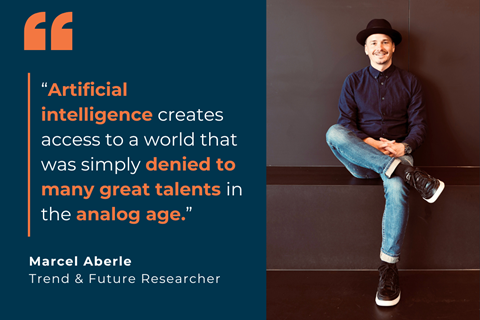
Let’s just take Home Court AI – a basketball training app. I personally find it very exciting. The app analyzes your shooting technique and gives you tips on how you can improve. At the same time, this app is also a scouting platform, which means that if you make certain leaps in your development or reach certain score levels, you will automatically appear on talent scouts’ lists. This is real digital at its best. Artificial intelligence creates access to a world that was simply denied to many great talents in the analog age.
Another impact that sport creates is easy access to artificial intelligence and learning how to deal with it properly and build trust in AI. With all the horror stories we have and all the things we discuss in connection with AI, it’s all justified. But it is also a fact that AI will permeate our lives, our work and our sport much more intensively and on a broader scale in the future. Sport can play a huge role here as a transformer by ensuring that people learn how to deal with AI and helping to dispel fears. That would be real digital innovation.
Are there other areas for shaping the future?
Yes, there is indeed one area that I am currently looking at and questioning somewhat critically, and that is our fast pace of life. It is ingrained in our thinking that we have to react adaptively at super speed. I ask myself, “Do we really always have to?”
Are there any examples here?
My prime example is the fashion brand Zara. The Spaniards have developed a system that enables super-fast adaptive reactions. If, for example, a jacket model is frequently sent back because the fabric or whatever does not meet customer requirements, this pops up at the designers. They come up with a new fabric and send the redesign to the factory. The whole process takes three weeks at Zara. That is the key to Zara’s economic success in this competitive market.
Sounds good at first, doesn’t it?
As a first step, it’s right and important. Brands have to be agile. But I also have to think about the future. If I only look at what customers want, then I can be very successful economically for the moment. But how sustainable is that? How sustainable? How future-proof? Zara won’t make it into the history books, but Coco Chanel will, because she was visionary and didn’t allow herself to be distracted by fast trends. And here I come to my question: Where are the real visionaries? Where are the people who can bring together transformative thinking and incremental action?
Are there none?
Yes, definitely. A good example is Netflix. They started with a DVD rental service, but they also quickly started to analyze customer data. They not only responded to short-term customer wishes, but also thought in a visionary way. They thought about how the Internet could be used as a place to watch films and series. Over the past few years, a DVD rental company has become one of the largest entertainment companies in the world. They have managed to be agile and responsive, but also to think and act in a visionary way. There was a clear vision for the future that was consistently pursued.
Marcel Aberle is a sought-after trend and future researcher. His professional career has been deeply influenced by the intersection of technology, innovation and strategic corporate development.
With a decade of experience in the IT industry and as a successful start-up founder, Aberle has a comprehensive understanding of megatrends, the economy and society. He was Managing Director of the renowned Zukunftsinstitut in Austria for over three years. As a multiple innovation award winner and trend spotter for the leading global agency TrendWatching, Marcel Aberle is a thought leader who imparts sound knowledge in a practical way.

Impact of Sports
The global physical inactivity crisis is real. Our duty as an industry is to inspire a healthy and active lifestyle. That's why we're dedicating a new content series to the Impact of Sports.
>> Find out more.