A published price ceiling, not a legal right on paper, is what determines repair uptake, according to Austrian platform Refurbed, whose own survey shows cost uncertainty, not awareness, is consumers’ biggest barrier.
Germany put its version of the EU Right to Repair Directive (2024/1799) into law on July 23, 2026, when it was published in the Federal Law Gazette. The law took effect in July 2026. The main consumer rules, including the warranty extension and the new repair duty, apply from July 31, 2026, the EU deadline.
The law matters for sporting goods. Ebikes and electric scooters are clearly covered by the new repair duty, along with existing EU Ecodesign rules on repairable batteries and electronics. Connected fitness equipment, such as treadmills, bikes and rowing machines, is likely to face similar rules as Ecodesign plans expand. Even non electronic items, such as boots, rackets and skis, are affected through the warranty extension.
Refurbed, a Vienna based marketplace for refurbished electronics, followed the process at EU and German level and has now published its view of the German law. It supports the overall approach but says one key issue is still unclear.
What the law changes
The law adds a separate repair duty in the German Civil Code (Section 479a and following). It also changes warranty rules. If a consumer chooses repair instead of replacement during a warranty claim, the statutory warranty is extended once by 12 months.
Retailers must tell buyers about this option in advance. The law also treats repairability as a product quality feature and bans some practices that make repairs harder. What is banned will depend on the product category and the EU Ecodesign rules that apply.
The missing number
Refurbed says the law requires spare parts prices to be “reasonable” and not discourage repairs, but it does not explain what “reasonable” means and does not set a price cap. Co founder Kilian Kaminski, who also sits on the board of the European Refurbishment Association (EUREFAS), says that without a public benchmark, “reasonable” is “a word without effect.” He suggests two possible policy options: limit the price of the most expensive spare part to a fixed share of the product’s retail price, or limit the profit margin manufacturers can add on parts.

The company also points to an exception that allows manufacturers to refuse repairs for “legitimate and objective reasons, including intellectual property rights.” It says this could be used to justify practices such as part pairing, serialization, or “genuine parts only” messaging that consumers may find hard to challenge.
Consumer awareness still low
refurbed asked market research firm Appinio to survey 1,000 people in Germany from June 10 to 15, 2026. In that survey, 67 percent said they would use the new right to repair if a device broke outside warranty.
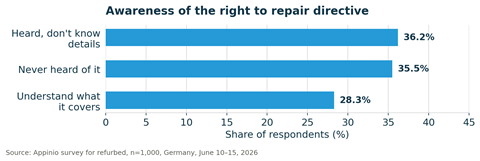
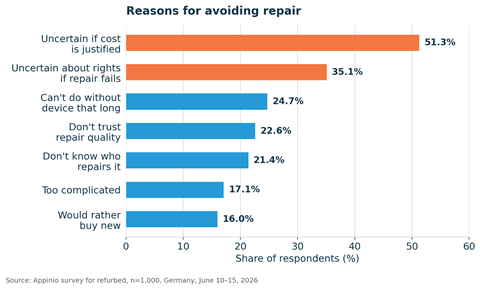
Only 28.3 percent said they already understood what the directive covers, while 35.5 percent said they had never heard of it. The biggest reason for avoiding repair was uncertainty about cost (51.3 percent). That was followed by uncertainty about what happens if the repair fails (35.1 percent). Respondents most often named smartphones, laptops, televisions and washing machines as items they would get repaired.
Sporting goods implications, in detail
For traditional gear such as boots, rackets and skis, the main impact is the warranty extension. Ebikes and electric scooters face the most immediate impact. Goods with batteries for light transport are listed in Annex II of the EU directive, and manufacturers cannot use software locks to block independent repair shops or do it yourself repairs. Smart fitness equipment is not covered in the same way yet, but it may be included as Ecodesign plans expand. That would likely require access to diagnostic software and replacement parts for independent repair shops.
For now, smartwatches, fitness trackers and running watches are outside this framework. These wearables are not among the ten product groups listed in Annex II, so the directive does not create a repair duty for them. The gap may grow.
The European Commission has proposed exemptions that would spare some categories, including wearables such as smartwatches, from the EU Battery Regulation rule on user replaceable batteries. The Commission argued that opening small sealed devices can reduce safety and water resistance. Devices such as the Apple Watch, Fitbit and Meta Ray Ban smart glasses would keep sealed, non user replaceable batteries under the proposed exemption. The proposal still needs approval from the European Parliament and the Council.
refurbed is asking for three changes as German and EU regulators fine tune the rules: a public price formula or cap for spare parts (it suggests a 20 percent cap for the most expensive part, as a share of retail price), a narrow closed list of reasons to block repairs with the burden of proof on manufacturers, and an explicit ban on part pairing in the repair law itself rather than relying on environmental rules.
| Factfile — Germany’s right to repair law | |
| Key dates, sources and figures | |
| Topic | Detail |
| German implementing law | “Gesetz zur Umsetzung der Richtlinie (EU) 2024/1799,” published July 23, 2026; consumer provisions apply from July 31, 2026 German Federal Law Gazette — full legal text |
| EU Right to Repair Directive | Directive (EU) 2024/1799, adopted June 13, 2024; EU-wide application from July 31, 2026 EUR-Lex summary |
| Annex II product scope | Ten categories currently covered: washing machines/washer-dryers, dishwashers, refrigerating appliances, vacuum cleaners, electronic displays, mobile phones, cordless phones, tablets, servers, and goods containing light-transport batteries (e-bikes, e-scooters) Right to Repair Europe — analysis of the adopted directive |
| EU Batteries Regulation | Regulation (EU) 2023/1542; user-replaceable battery requirement for covered devices takes effect February 18, 2027 Notebookcheck — EU relaxes repair regulation |
| Wearables battery exemption (proposed) | European Commission draft exemption for wearables, medical devices, electronic toys and other categories from the replaceable-battery mandate, announced mid-July 2026; pending Parliament/Council review Engadget — Commission wearables exemption |
| Sources as linked above. Compiled by SGI Europe editorial, July 2026. | |