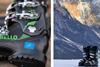
Italian ski boot brand Dalbello celebrated the conclusion of its EU-funded LIFE ReSkiBoot project this February. The stated aim of this LIFE project was to produce and market 1,000 high-quality, competitive ski boots made from around 90 percent recycled secondary raw materials. The raw materials were to be obtained from used ski boots from ski rental shops.
Together with its project partners, including Grifone and Rent and Go, amongst others, Dalbello succeeded in achieving this goal and returned 1,000 pairs of ski boots to a rental shop in February. The sustainable approach of a circular economy ultimately not only ensures that the ecological footprint of production has been reduced by 56 percent, but also that ski boots that should actually be thrown away are given a second life on the slopes.
In 2022, Dalbello had already launched two new ranges of eco-friendly ski boots built from recycled plastics as part of the brand’s circularity project for the 2022/23 winter season.
Dalbello’s LIFE ReSkiBoot project
Dalbello has been an official partner of the LIFE ReSkiBoot project together with six other companies from various sectors since September 2020. The aim of the project, funded by the EU LIFE program, was to rethink the life cycle of a ski boot in terms of sustainability and resource conservation while reducing the cost per boot by seven percent. With a focus on ski rental, the aim was to develop a take-back and recycling system that offers an alternative to the nine million kilograms of plastic waste from discarded ski boots that end up in landfills every year.

The challenge
The fact that each ski boot consists of more than 100 plastic parts, thermoplastic and foamed materials and adhesives was problematic from the start. In particular, solutions for sorting and recycling the inner boots, which consist of foam sandwiches, proved to be a major challenge. In collaboration with its partner network, Dalbello says it has succeeded in optimizing these complex processes and developing a business model based on a closed-loop system that gives discarded ski boots a second life.
“Trying to use the hard multisynthetics effectively has been a major challenge for our team,” said Stefano Prosdocimo, R&D Department and LIFE ReSkiBoot Project Manager at Dalbello. “The inherent complexity of the material, the limited knowledge of its composition and age required a methodical approach of ‘trial and error.’ Ultimately, however, this process enabled us to transform it into high-quality components and achieve the desired quality of the ski boots.”
“Genuine” circular economy
Collaboration within the network and combining the expertise of the individual project partners was crucial to this success. Each of the seven companies contributes to the overall concept with its own innovations. For example, rental partner Rent a Sport was identified as the ideal partner for collecting used boots. The collected ski boots were then broken down into their components – shredded plastics, foams and soft materials – by the company Plastic Sort and prepared for reprocessing. These secondary raw materials obtained from recycling are the crucial piece of the puzzle and are set against the 9.4 million kilograms of untreated raw materials that are processed every year – emitting 33,800 tons of CO2 equivalent – in the conventional production of ski boots. In addition, findings on more sustainable design were provided by studies conducted by the University of Bologna and formed the basis for the further production process. In the Dalbello factory, the harder plastic parts were then finely ground and fed back into the production cycle, drastically reducing the use of new raw materials. At the same time, the previously sorted soft parts of the inner shoes were ground, compacted into blocks and processed into new, recycled inner shoes at Grifone.

EPSI and Studio Fieschi also supported the project as other important partners. They contributed a systematic and comprehensive assessment of the environmental impact associated with the product throughout its life cycle and shared project results and findings with a wide audience. At the end of the cycle, it is once again the rental partner who brings the first 1,000 pairs of ski boots back into circulation and back onto the slopes.
Reduction of the CO2 footprint by 56%
The LIFE ReSkiBoot project also includes an environmental impact assessment of the end products using the Life Cycle Assessment (LCA) as part of the ISO 14000 series. This assessment analyzes each stage of production, the actual use on the slopes and disposal in order to accurately determine the total environmental footprint of a product over its lifetime. Sixteen different categories are examined, including the global warming potential (GWP), which is expressed as a CO2 equivalent in kilograms.
In this context, the production of 1,000 ski boots as part of the project led to a significant reduction in the CO2 footprint by as much as 56 percent. This was achieved by using secondary raw materials instead of virgin materials. The reduction achieved once again highlights the importance of these secondary materials – particularly in view of the reduction in emissions during the extraction and processing of new raw materials and the fact that polymer materials make up more than 60 percent of the total weight of a ski boot, including the shell, cuff and tread.
With the LIFE ReSkiBoot project, Dalbello and its partner companies have managed to save 3,628 kilograms of waste and twelve tons of CO2 equivalent. The target of reducing the cost of a ski boot by seven percent was also achieved. In addition, the inclusion of an Environmental Product Declaration (EPD) in the final product sets new standards in terms of sustainability in the winter sports hardware industry and enables the sustainability performance of different products to be compared.
“Together with our LIFE ReSkiBoot project partners, we have not only managed to extend the lifespan of an almost complete ski boot by almost 100 percent but have also developed an innovative, experimental model of a circular economy that can serve as a guideline and guide for the entire industry and beyond,” said Giuseppe Bianchini, Brand Business Director at Dalbello. “We are proud to play a pioneering role here with all the companies involved and look forward to the projects that will follow.”
Now that Dalbello’s project phase has been completed, the initiative will be continuously developed and refined. According to Dalbello, the innovative processes developed as part of the project will be applied to an increasing number of the brand’s models, but always under the premise of sharing the successes with the entire industry. The focus is on expanding cooperation with new project partners in order to further increase the positive impact on the environment. In particular, the commercialization of recycled ski boots is to be promoted in order to reduce the consumption of resources, the production of waste and greenhouse gas emissions.
Parallel efforts in ski boot recycling at Tecnica Group
The Italian Tecnica Group, which also received funding from the LIFE program of the European Union for its “Recycle your Boots” program in 2021, took a similar path like Dalbello and, as a result, with the 2023/24 collection equipped its Tecnica and Nordica ski boots with QR codes, which give the recycling partners all the necessary information about the used materials, their elastic modulus and the manufacturer.

Dalbello’s LIFE ReSkiBoot project, which – back in 2020 – started a few months before Tecnica Group’s Recycle your Boots project, focuses mainly on eco-design as it explores how the company can recycle its own boots, which are then redesigned with this in mind. Tecnica Group, on the other hand, began its project with the prospect of multi-brand recycling on a pre-industrial scale.
According to the Tecnica Group, it was in frequent contact with Dalbello from the very beginning and planned the further joint development of both projects. A fact that seems desirable to observers, as circular design only really pays off when otherwise competing brands work together. According to insiders, all companies involved in the recycling of ski boots are, in fact, already in constant exchange to share their experiences and jointly develop a recycling project for the entire European ski industry, as the relationships are consistently positive and productive.
WSN pools resources and knowledge
Tecnica Group and Dalbello are also main promoters of the Winter Sports Sustainability Network (WSN), which was founded to pool the strengths of winter sports product manufacturers for joint environmental sustainability projects. On the topic, Dalbello and Scarpa together presented at the last plenary session how the production system of the Italian Veneto region (Sportsystem District) brings together the three biggest experiences to date in the field in order to utilize and enhance them: Multi-brand recycling (Tecnica Group), reuse of industrial waste in new models (Scarpa) and eco-design (Dalbello).
Tecnica Group confirmed to The Outdoor Industry Compass that the Sportsystem manufacturers are indeed sharing their experiences to create a common recycling system and common eco-design rules for recycling. “Collaboration among ski boot industries and brands to turn the Extended Producer Responsibility [EPR] obligations into an opportunity might be the next phase of the three projects,” says Tecnica. We will continue to keep an eye on developments and keep our readers up to date.