adidas introduces Hyperboost Pro foam in a plate-free, high-stack daily trainer. The $200 (€184) shoe launches globally on March 17 and marks the brand’s first new foam platform targeting everyday performance runners.
adidas has entered the unplated super-trainer market with the Hyperboost Edge, a high-stack daily running shoe built around a new proprietary midsole compound the brand says outperformed runners’ existing footwear across key performance and comfort measures in third-party consumer testing.
The shoe is priced at $200 (€184) and launches globally on March 17, 2026, in an initial red colorway via adidas stores and adidas.com. Additional colorways will follow from May 1.
The foam is the argument
At the center of the Hyperboost Edge is the Hyperboost Pro midsole – a new foam formulation developed using material testing and consumer research conducted in partnership with the University of Cologne. In a study involving 60 runners, 73 percent preferred the shoe’s energy return over their current footwear, and 77 percent rated its cushioning as softer. More than half favored the shoe for overall comfort, with a majority also reporting a better overall running experience.
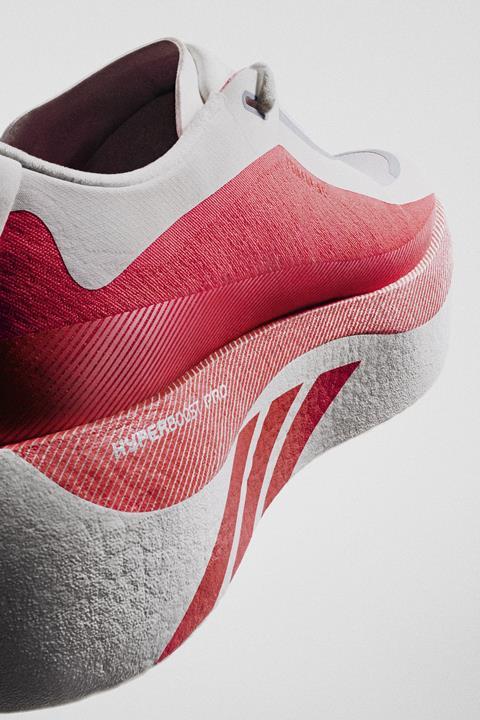
The rearfoot stack measures 45mm with a 6mm drop – specifications comparable to high-stack daily trainers from competing brands. adidas has positioned the Hyperboost Edge as the first entry in its running line to carry no plate or stiffening element, distinguishing the shoe from a market increasingly populated by carbon-plated models and hybrid training shoes where plates are becoming near-standard. The foam performs, adidas argues, without mechanical assistance from rigid structures.
Three components, one construction rationale
The Hyperboost Edge pairs the new foam with a PRIMEWEAVE (woven textile) upper, selected for low weight and reliable fit retention. Integrated heel pods add stability at the rearfoot without introducing structural rigidity. The outsole is a full-length compound called LIGHTTRAXION – a traction material drawn from adidas’ race footwear supply chain, applied here on a thinner, lighter base than in racing applications.
At 255 grams for a men’s size 8.5, the shoe sits toward the lighter end of the high-stack trainer segment, where comparable models from On Holding, Asics, and New Balance typically range between 260 and 310 grams depending on construction.
Putting the midsole on show
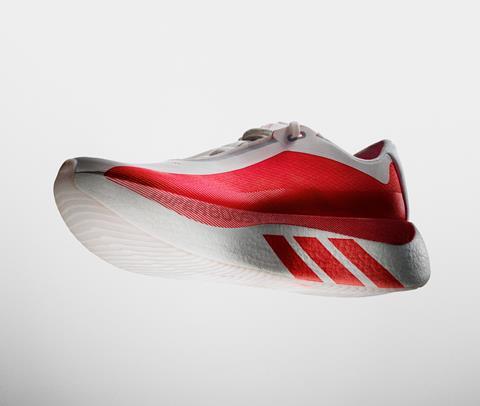
adidas has used the Hyperboost Edge to introduce a new design direction for its running line. The stacked midsole is the dominant visual element, and the brand’s three-stripe logo has been relocated to the midsole itself rather than the upper – a first for its running footwear. The upper is minimal by design, with hidden eyelets and light-bonded construction intended to direct visual attention to the technology beneath the foot.
A measured entry into a crowded daily-trainer segment
Hyperboost Edge lands in a daily training market increasingly shaped by foam-and-plate systems. In the unplated tier, Nike’s Invincible 3, ASICS’ Gel-Nimbus 26, and Hoka’s Clifton remain key reference points, while On’s CloudSurfer and New Balance’s Fresh Foam X More continue to draw runners looking for high-stack cushioning. For adidas, whose everyday lineup has long been anchored in Boost, Hyperboost Pro is the clearest signal yet of a new midsole compound aimed at the high-volume, premium-priced trainer category.