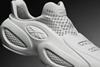
Reebok has become the third major sportswear group to put its name on a shoe built by Zellerfeld, the Brooklyn-based 3D printing specialist, but it is doing so the same way it does most things under Authentic Brands Group  ownership: through a licensing deal rather than an in-house manufacturing commitment. 

Where Nike and adidas each built multiyear, internally resourced programs before putting 3D-printed shoes on court, Reebok’s entry skips the R&D story altogether and goes straight to a heritage product, sold exclusively through its manufacturing partner’s own website.


Visualizza questo post su Instagram

Un post condiviso da Reebok (@reebok)

The shoe is the Question 96/26, a single-piece slip-on reworking of the Question that Allen Iverson debuted during his 1996 rookie season with the Philadelphia 76ers. It launches August 25 at 12 p.m. ET in Lilac and Stone colorways, priced in the $169–$170 range, exclusively through Zellerfeld.com. It marks the Question’s 30th anniversary, with Reebok describing it as the opening move in a longer run of anniversary activity.

Zellerfeld built the shoe as a single printed piece from zellerFOAM, its proprietary TPU-based material, skipping the molds and adhesives a conventional sneaker would require. The print varies in density across the shoe, with firmer material reinforcing the toe area and the sole, and a more pliable structure running through the upper for flexibility.

The Question’s oval Hexalite-style pods and honeycomb pattern reappear as surface texture rather than functional cushioning, and Reebok’s Vector logo sits at the midfoot. Zellerfeld prints the shoe at its own facilities in Austin, Texas, and Hamburg, Germany. Iverson announced the shoe himself on social media, describing it as an extension of the original’s intent to “change the game, not follow it.”


View this post on Instagram

A post shared by Allen Iverson (@theofficialai3)

Third in, not first

The launch announcement treats the Question 96/26 as an innovation story. It is closer to a catch-up story. Nike’s relationship with Zellerfeld dates to the Air Max 1000 in 2024 and continued with the Air Max 95000 in 2025.

adidas took a different route entirely: rather than licensing an outside printer, it built its own additive-manufacturing platform, Project R.A.P., unveiling the BB.01 in July 2026 as the first 3D-printed basketball shoe tested on an active NBA-track athlete, in a limited run of 169 pairs at $250. That program traces back to adidas’ FutureCraft 4D in 2017.

Reebok, by contrast, has no comparable in-house additive-manufacturing effort. It has instead outsourced production entirely, and even distribution: the shoe is not listed on Reebok’s own retail channels, and every source describes the release as exclusive to Zellerfeld.

A vendor scaling beyond one-off drops

Zellerfeld, co-founded by Cornelius Schmitt and Franz-Maximilian Foltin and operating between Brooklyn, New York, and Hamburg, has built its business on printing full shoes to order rather than running a factory. Nike is its most prominent sportswear client, alongside collaborations with Hugo Boss’s Hugo label and independent designers.

The company has been building the infrastructure behind that pitch. It recently deepened a data partnership with foot-scanning platform Volumental, whose database covers more than 66 million scanned feet, and added supply-chain leadership with experience at StockX. For Zellerfeld, a Reebok deal is less about a single archive shoe than about adding another major sportswear logo to its client list

Fitting the ABG playbook

Since ABG’s 2022 purchase of Reebok, the operating model has centered on licensing rather than direct control: ABG keeps intellectual property centralized while specialist partners run categories and geographies, most recently through a new operating partner appointment in China.

The Question 96/26 follows that same logic in manufacturing. Reebok supplies the archive and the athlete; Zellerfeld supplies the factory. That athlete matters here specifically because Iverson is not just the shoe’s namesake: in 2023 he was named vice president of Reebok Basketball alongside Shaquille O’Neal as president, tasked with rebuilding the category. A 3D-printed reissue of his signature shoe gives that relaunch a low-cost cultural moment without requiring Reebok to fund the technology behind it.