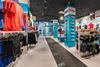
Decathlon is betting on proximity. Intersport is betting on the cooperative model’s ability to deliver premium and volume simultaneously. Sport 2000 Group International is betting on specialist formats at every scale.

All three are making these bets in a German market under real economic pressure: a context that makes the stress-test harder, and the outcome more instructive.

On June 26, Decathlon will open its new Leverkusen store in the Corner 82 shopping center, the former Kaufhof building at the Wiesdorfer Platz, with approximately 2,300 sqm of retail space plus a 700 sqm outdoor test area, in the middle of a city that until recently had no Decathlon at all. The location fills the gap between Cologne and Düsseldorf.

It is also the physical expression of a strategy that has been running for three years: find the cities that fell through the cracks of Decathlon’s traditional retail geography, move in while rents are soft and retail vacancies are plentiful, and build density before anyone else does. Leverkusen follows Schwetzingen in May. Hamm, Chemnitz Center and Isernhagen near Hanover are queued for autumn. Oberhausen’s Neue Mitte flagship — 4,500 sqm, €15 million invested, a dedicated sports park built into the shell — arrives in Q3.

The company has publicly committed to 25 new German stores in 2026, following 18 in 2025, targeting a network of at least 150 by end of 2027. It operated fewer than 100 stores in Germany just two years ago.

The pace alone would be newsworthy. But what matters, too, is where the space is coming from. The Leverkusen store occupies a former Galeria Kaufhof site. The Chemnitz Center entry replaces a Saturn electronics store that closed in early spring. Across Germany, a decade of department store closures and consumer electronics consolidation has deposited prime city-centre square footage onto the market at exactly the moment Decathlon decided it wanted to be urban.

The French retailer recognized the opportunity faster than anyone else.

Decathlon Filiale

Source: Decathlon Press Room

What Intersport is building instead

Intersport isn’t racing Decathlon for square footage. It doesn’t need to, and structurally it can’t. The cooperative model, with roughly 700 independent retail partners operating under the Intersport banner, doesn’t lend itself to centralized rollouts. What it does lend itself to is a network of stores genuinely embedded in their local communities.

In 2024, Intersport formalized what it had been building informally for years. Three flagship stores launched simultaneously in September - Engelhorn sports in Mannheim, L&T in Osnabrück, Sport Reischmann in Kempten - with a fourth-generation retail format built around premium brand partnerships, specialist services (running labs, ski-fitting, foot measurement technology) and experiences designed to justify a trip in town.

Sport Förg in Augsburg and INTERSPORT Krumholz in Mülheim-Kärlich followed in 2025, each covering approximately 3,800 sqm and each carrying the flagship designation that signals to brand partners: this is where your premium lines should live. Krumholz held its formal opening event in March 2026. The group now counts six flagship houses and wants 100 new locations across the network by 2030, according to company targets.

In March 2026, Intersport added a second format to the equation: the Superstore. The first launched in Halle (Saale), positioned not at the flagship end of the spectrum but in the mid-market — accessible pricing, broad assortment, the full brand but without the premium service intensity. It’s the volume play to complement the flagship’s premium play. The group is trying to be everything to everyone. The question is whether that’s a strategy or a contradiction.

Globally, Intersport International Corporation generated over €14 billion in omnichannel sales in 2025, growing 1.2 percent on a currency-neutral basis across more than 5,400 stores in over 40 countries.

DACH sports retail — Recent openings and confirmed projects
Germany, last 12 months to June 2026
Brand City / location Status Timing sqm Format / notes
Decathlon Schwetzingen Opened May 22, 2026 ~2,200 Relocation; replaces ~800 sqm former store
Decathlon Leverkusen (Corner 82 / fmr. Kaufhof) Opened Jun 26, 2026 ~2,300 + 700 outdoor City-centre; closes Cologne–Düsseldorf gap
Decathlon Hamm (Gustav-Heinemann-Str.) Announced Autumn 2026 ~2,000 Closes Dortmund–East Westphalia gap
Decathlon Chemnitz Center (fmr. Saturn) Announced Autumn 2026 ~2,900 2nd Chemnitz store; Radsport / Outdoor focus
Decathlon Isernhagen / Hanover (A2 Center) Announced Q4 2026 ~2,500 Outdoor and Mobility focus
Decathlon Oberhausen (Neue Mitte / Brammenring) Under construction Q3 2026 4,500 + 500 outdoor Flagship; €15m investment; sports park
Decathlon Lüdenscheid / Trier / Saarbrücken Pipeline 2026+ Confirmed in Nov 2025 expansion announcement
Intersport Mannheim / Osnabrück / Kempten Opened Sept 28, 2024 Flagship rollout, simultaneous launch
Intersport Augsburg (Sport Förg) Designated May 2025 2025 ~3,800 Flagship; ski simulator, sports studio
Intersport Mülheim-Kärlich (INTERSPORT Krumholz) Designated May 2025; opening event Mar 7, 2026 2025 / 2026 ~3,800 Flagship; running lab, ortho-box, ski fitting
Intersport Halle (Saale) — Superstore Opened Mar 26, 2026 First Superstore format; mid-market positioning
Sport 2000 Potsdam — Absolute Run Meilenweit Opened Jan 16, 2026 18th Absolute Run; continuity from fmr. Laufladen Meilenweit
Sport 2000 Oldenburg — Absolute Run Opened Feb 6, 2026 360 + 120 community 19th Absolute Run; purpose-built technical hub
Sport 2000 Meppen (fmr. Sport Höfer) Reopened Apr 2, 2026 (event Apr 29) ~450 / 2 floors Format upgrade; Columbia, Patagonia, PUMA; Currex analysis

Sources: Decathlon press releases (einblicke.decathlon.de); Intersport Newsroom; Sport 2000 press portal (sport2000.de); FashionUnited; SGI Europe reporting. All sqm figures approximate unless stated.

Sport 2000 and the specialist argument

Sport 2000 Group International has been making a quieter kind of argument, and it turns out the argument is bigger than running.

The Absolute Run format gets the most attention because it’s the most legible: a specialist running store, typically under 500 sqm, with no distracting categories, a curated brand selection and a community program built around weekly group runs and brand test events. In Potsdam, the 18th Absolute Run opened on January 16, built on the foundation of local specialist Laufladen Meilenweit, a store that owners Diana and René Heyder had operated in the city since 2009. The transition preserved the community base while upgrading the retail offer with modern gait analysis tools and a structured weekly run program. In Oldenburg, the 19th followed on February 6: a different model, purpose-built at approximately 360 sqm on the ground floor with a 120 sqm community space above it, designed from scratch as a technical hub for the region’s running market.

But Absolute Run is one format in a broader architecture. Alongside it sits Absolute Teamsport: a specialist concept for club and team purchasing, where the value proposition is category depth, kit customization and service rather than price.

And then there is the Multi-Category Retailer format: Sport 2000’s answer for partner stores that can’t or don’t want to specialize in a single category, but still want to project genuine expertise. The MCR combines broad range with specialist positioning: a generalist that behaves like a specialist in the categories that matter most to its local market.

In Meppen, the logic of that upgrade is visible in concrete form. The former Sport Höfer location, a family business that had served the town for years, reopened in April 2026 as a fully rebranded Sport 2000 partner, carrying Columbia, Patagonia, PUMA and Hummel across approximately 450 sqm on two floors, with Currex running analysis built in from the start. It’s what the “Home of Experts” strategy looks like in a town of 34,000 people.

More than a third of Sport 2000’s stores are now specialist formats, with many multi-category retailers also moving toward specialization in one or more categories. Sport 2000 Group International — the organization rebranded internationally in 2026 — posted global gross retail sales of €5.3 billion in 2025, up 8.2 percent on a like-for-like basis. Germany led the growth, with external sales climbing 15 percent to €3.2 billion. CEO Margit Gosau put it plainly: “In future, competition in specialist sports retail will not be decided by size, but by relevance.”

That is a direct answer to Decathlon.

DACH sports retail — Network context and key metrics
As of June 2026
Brand Expansion model Key target Revenue reference
Decathlon Centralised; owned stores; infill and city-centre formats 150 German stores by end 2027; 25 openings in 2026 €1.2bn Germany (2023)1
Intersport Deutschland Cooperative; ~700 independent partners; flagship + Superstore dual format 100 new locations by 2030; 50 milestone passed €3.46bn Germany FY2024/252
Intersport International (IIC) Global cooperative; 40+ countries; 5,400+ stores Omnichannel capability; network expansion globally €14.1bn global 2025 (+1.2% currency-neutral)3
Sport 2000 (Germany) Cooperative; specialist formats (Absolute Run, Absolute Teamsport, MCR) 30 Absolute Run stores in Central Europe by 2029 €3.2bn Germany 2025 (+15% YoY)4
Sport 2000 Group International ~2,000 retailers; ~3,000 stores; 17 countries Poland entry 2026; further EMEA expansion €5.3bn gross retail sales 2025 (+8.2% like-for-like)4

1 Decathlon Germany, company-reported figure, 2023 (most recent publicly disclosed). 2 Intersport Deutschland press conference, Jan 2026. 3 Intersport International Corporation / SGI Europe, March 2026. 4 Sport 2000 press portal, Jan 2026. All figures company-stated; independent verification not available for all entries.

The same market, three different answers

Step back and the picture is not a competitive war between three chains. It’s something more interesting: three organizations with fundamentally different structures, each finding the version of German sports retail its model can win.

Decathlon is pressing the gas on density and accessibility. Its stores do not need to be differentiated because differentiation isn’t the point: physical proximity is. If there’s a Decathlon within 20 minutes of every German consumer by 2027, a large share of routine sports spending flows toward it, almost regardless of what else is available. The model wins on convenience and price. It always has.

Intersport is betting on the opposite: that a meaningful slice of sports spending is not routine, that consumers making considered purchases want a human being who knows the product category in depth, and that the cooperative’s network of owner-operators is better placed to provide that than any centrally managed chain. The flagship and Superstore formats are two points on the same spectrum: the cooperative earning back relevance at both ends of the market.

Sport 2000 is making the most specific bet of all: that category authority, at the right scale and in the right location, is a defensible position. A great running store in Potsdam doesn’t compete with Decathlon, because customers who want what a great running store offers are not shopping at Decathlon in the first place. Absolute Run, Absolute Teamsport and the MCR format are different expressions of the same conviction: specialization creates profile, and profile creates loyalty that scale alone cannot buy. The addressable market for any one format is smaller. The defensibility is higher.

All three arguments have merit. All three are being tested in real time in the same market, Germany, against the same backdrop of vacant retail space, softening consumer confidence and a stagnating macroeconomic scenario. Yet the sports participation rate, inconveniently for the bears, keeps rising. The race is on.