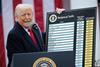
Liberation Day, as US President Donald Trump calls it, has left the economic world reeling.
On Thursday, April 2, Trump delivered an address at the White House’s Rose Garden to lay out his plan for reciprocal tariffs and sign the attendant executive orders, the salient one being: “Regulating Imports with a Reciprocal Tariff to Rectify Trade Practices that Contribute to Large and Persistent Annual United States Goods Trade Deficits.”
Southeast Asia
Of immediate concern for the sporting goods industry is the change in tariffs on products shipped from Southeast Asia, where many big brands do much of their manufacturing. Nike, for instance, farms out sneaker production to Vietnam (50%), Indonesia (27%) and China (18%) and apparel production to Vietnam (28%) China (16%) and Cambodia (15%). The company maintains a “manufacturing map” online detailing such matters.
Adidas too does nearly all of its manufacturing in Asia, farming out sneaker production to Vietnam (38%), Indonesia (32%), Cambodia (5%) and others (another 5%) and apparel production to Cambodia (23%), Vietnam (20%), Indonesia (11%), Thailand (5%) and others (another 5%).
The US government’s Harmonized Tariff Schedule (HTS) is complex, and its tariffs can vary for many reasons. In general, though, tariffs of 32 and 20 percent applied to sportswear and athletic shoes shipped to the US from Southeast Asia until April 2. Such was the case for all of the abovementioned countries except China, for which the tariffs were 39.5 and 27.5 percent.
Reuters cites Sheng Lu, of the University of Delaware, according to whose calculations the average US tariffs on footwear and apparel from Vietnam have until now been 13.6 and 18.8 percent respectively.
At any rate, things have now become more complex. As our chart shows, the old 32 percent tariff on sportswear is in a few cases (Malaysia, China) decreasing. For sneakers, however, the tariff has gone up across the board.
For Vietnam it is more than doubling (20% to 46%). In 2024, according to the Office of the United States Trade Representative (USTR), the US imported in $136.6 billion in goods from Vietnam, whose trade surplus with the US amounted to $123.5 billion, up 18.1 percent year-on-year.
| Selection of US reciprocal tariffs | ||||
|---|---|---|---|---|
| Total foreign barrier to US goods (acc. to USTR) | New US “discounted tariff” | Pre-“Liberation” tariff | ||
| Sportswear | Athletic shoes | |||
| Bangladesh | 74% | 37% | 32.0% | 20.0% |
| Brazil | 10% | 10% | ||
| Cambodia | 97% | 49% | ||
| China | 67% | 34% | 39.5% | 27.5% |
| Egypt | 10% | 10% | 32.0% | 20.0% |
| EU | 39% | 20% | ||
| Iceland | 10% | 10% | ||
| India | 52% | 26% | ||
| Indonesia | 64% | 32% | ||
| Malaysia | 47% | 24% | ||
| Myanmar (Burma) | 88% | 44% | ||
| Norway | 30% | 15% | ||
| Thailand | 72% | 36% | ||
| UK | 10% | 10% | ||
| Ukraine | 10% | 10% | ||
| Vietnam | 90% | 46% | ||
| Source: White House, USITC Harmonized Tariff Schedule | ||||
The discounted reciprocal, or ‘kind,’ tariff
As laid out, the tariffs are not meant to be permanent. Trump is inviting other countries to lower their tariffs and promising reciprocal action. Nor, despite the name, are they meant to be fully reciprocal. Most of them amount instead to about half of what USTR has determined to be the economic pressure that foreign countries exert on American goods by various policies. Tariffs are included, but so are things like currency manipulation and VATs. USTR has published a 397-page report explaining its reasoning, country by country.
“I call this kind reciprocal,” Trump said.
What to do?
SGI Europe and the World Federation of the Sporting Goods Industry (WFSGI) will be hosting a webinar next month to address the issue. On hand will be the WFSGI’s own legal counsel and SGI Europe legal expert Jochen Schäfer, as well as two other experts.
More details about the webinar to come.
Read Schaefer’s initial advice for businesses in our article on reactions to Trump’s tariffs.
Exceptions
Some goods will escape a reciprocal tariff, but they are of indirect concern to the sporting goods industry. They include informational materials (publications, films, artworks, photos, etc.), humanitarian items, steel/aluminum articles, certain auto parts, copper, drugs, semiconductors, lumber, bullion, energy and certain minerals.
US has itself to blame
“The United States can no longer continue with a policy of unilateral economic surrender,” Trump said in his speech. He had no praise for the North American Free Trade Agreement, better known as NAFTA, which was signed in 1994 by US President Bill Clinton and made the US, Canada and Mexico into a trading bloc. According to Trump, NAFTA cost the US 90,000 factories, five million jobs in manufacturing and an increase in the trade deficit of $19 trillion. NAFTA was superseded in 2020, under Trump, by the United States–Mexico–Canada Agreement (USMCA).
Trump claimed also that the US now imports almost all of its antibiotics, computers and electronics and that a single shipyard in China is producing more ships than all American shipyards combined.
He laid the blame for the situation of the past several decades not on foreigners – and “in many cases the friend is worse than the foe” – but on former Presidents. His message to other countries was: “If you want your tariff rate to be zero, then you build your product right here in America.”
Trump’s tariffs: Reactions from within the sporting goods industry and beyond.