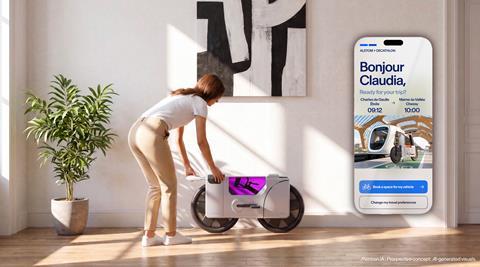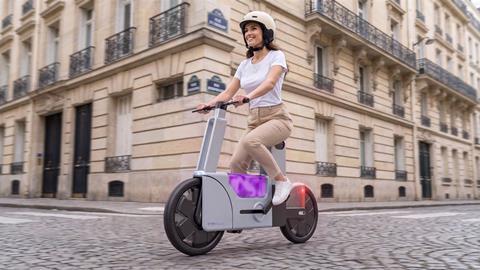
For many commuters, the hardest part of cycling is getting the bike onto a train. Decathlon’s concept work with Alstom takes the problem to the people who design carriages, where decisions on bike space are made years before passengers board.
InnoTrans, the world’s largest trade fair for the rail transport and transport technology industry, fills every hall of the Messe Berlin exhibition grounds and 3,500 meters of outdoor track with locomotives, signaling systems and rolling stock. Held every two years, it is where the sector sets out what transport technology will look like in the decade ahead: rolling stock, signaling, digital systems and the interfaces between rail and everything else a passenger uses to reach the platform.
So what is a sporting goods retailer doing there?
Decathlon answered that question on Sept. 22 by appearing at the 2026 edition alongside Alstom, presenting the results of a joint design, exploration and research project on how commuters move between a bike and a train. It is not a product launch. It is a vision of the future of mobility.
The presence is less incongruous than it first appears.
Decathlon describes itself as Europe’s largest bicycle manufacturer and retailer, and in recent years has expanded its remit beyond sport into urban mobility. Under the European Commission’s Mobility Transition Pathway, the EU program covering the automotive, rail, waterborne and cycling value chains, Decathlon has pledged commitments on bike repairability, long-term rental, second-hand markets and bike sharing, with its repairability pledge tied to the European Declaration on Cycling.
The company has also commissioned its own mobility research. Its first European Urban Mobility Barometer, conducted by pollster OpinionWay in 2025, surveyed more than 4,000 people aged 18 to 28 across six European markets and found that while most respondents generally feel safe cycling, many do not feel completely safe. Asked what would get them cycling more often, respondents ranked protected and separated bike lanes first and secure bike parking second. Decathlon’s B’twin mobility team is also central to the company’s collaboration with Alstom on future bike and train intermodality concepts.
The choice of partner follows from where the problem sits.
For a commuter with a bike, the hardest part of the journey is not the ride but the train: where the bike goes, whether it is secure, and whether there is room at all. That space is designed by manufacturers such as the French Alstom, which builds high-speed and regional trains, metros, trams, signaling and turnkey systems, with revenue of 19.2 billion euros for the fiscal year ended March 31, 2026, and operations in 61 countries.
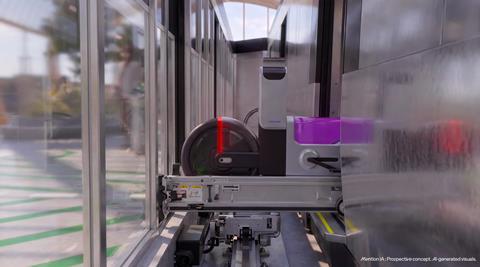
Here is the engineering issue: how a carriage accommodates a bicycle is decided years before a passenger ever boards. A bicycle maker with retail distribution has no say in that. A bicycle maker sitting in the design phase with the manufacturer does.
Three elements were presented in Berlin.
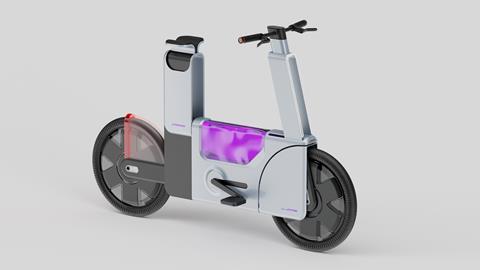
A connected bike and scooter generation reworked for the constraints of rail travel, with reduced bulk and revised ergonomics. Advance booking through a mobile app, which routes the passenger along the platform to a terminal that registers the equipment on arrival. And a dedicated, secured compartment on board, where bikes and scooters are stored rather than left in aisles or watched from a seat.
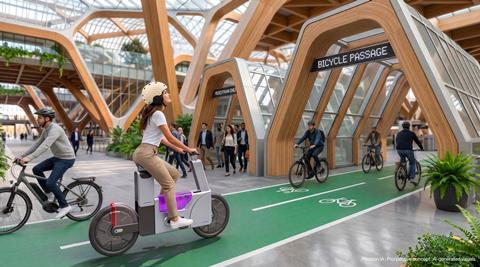
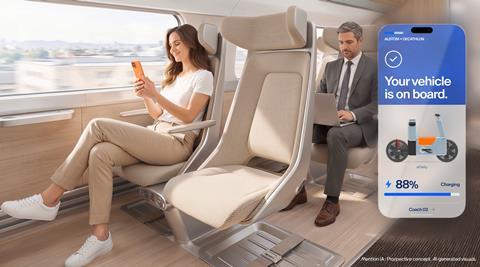
Alexis Bonnet, Design Director at Alstom, presented the project as an effort to remove the obstacles that still complicate traveling with a bike or a scooter, describing mobility as a continuous experience rather than a set of separate modes. Cédric Mollet, who leads B’twin at Decathlon, said the aim was to bring cycling and rail closer together.
No model, price or service date was given. Neither company said whether any element will reach production, nor whether the on-board layout has been offered to rail operators. Alstom sells to national and regional operators, so adoption would rest on their purchasing decisions rather than on the two partners alone. The project grew out of a field study into problems reported by travelers