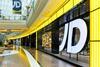
With annual sales of more than $5 billion, JD Sports Fashion is set to become the world's fourth-largest integrated sporting goods retailer, vastly improving its purchasing power with the likes of Nike, following a merger agreement reached on Sunday under which it will take over The Finish Line, a direct competitor of Foot Locker in the U.S. market. Their combination, which was announced yesterday, will come right after Decathlon, Dick's Sporting Goods and Foot Locker on our annual global retail chart, more or less on a par with another U.S. retailer, Academy Sports.
The two companies' shareholders and U.S. anti-trust authorities have yet to approve the deal, which is then likely to be completed after June. JD's and Finish Line's boards of directors have unanimously endorsed it. Several months ago, Finish Line's board had rejected a hostile takeover bid by JD's biggest competitor in the U.K., Sports Direct International (SDI), introducing last August a poison pill that keeps its stake in the company at about 10 percent.
The stake makes SDI the second-largest shareholder in Finish Line. SDI also has an indirect interest in about one-third of the U.S. retailer's shares through a form of share options called Contracts for Difference. In the end, SDI stopped pursuing Finish Line and decided last year to set foot in the world's largest sporting goods market by acquiring two struggling outdoor retail chains on the east coast of America, Eastern Mountain Sports and Bob's Stores. With JD taking SDI's place, Finish Line will end up with a more premium position in the U.S. rather than going down market.
Key shareholders like the Pentland Group have already given their unconditional approval to the deal. Pentland owns 57.47 percent of JD's shares. Interestingly, Pentland started investing in JD 13 years ago to fend off a hostile takeover by SDI. The Rubin family, which owns Pentland, must be proud to be writing another big chapter in its glorious history by taking control of the fourth-largest sports retailer in the world.
However, investors gave a muted response to the merger proposal, perhaps because of the recent disruption of the U.S. retail market, which has mainly affected mall-based store operators like the Finish Line, or because they suspect that it will create an undue burden on JD's finances, which have already been strained by other previous major takeovers. After an initial upward spurt on the London Stock Exchange, JD Sports Fashion's stock price recorded a decline of 3.45 percent by the end of yesterday's trading, giving it a stock market capitalization of £3.34 billion (€3.81bn-$4.71bn).
The terms of the merger contract call for a cash payment by JD of about $558 million for 100 percent of Finish Line's shares. The agreed price per share of $13.50 gives a 28 percent premium to Finish Line's valuation on the Nasdaq stock exchange of $425 million on a fully diluted basis as of last Friday.
Based on the analysts' consensus estimate for Finish Line's latest financial results, the purchase price gives a multiplier of 6.2 times to the chain's Ebitda. According to preliminary figures, its revenues were nearly flat at $1.84 billion for the 53-week financial year ended last March 3, but sales at Finish Line stores suffered a 1.9 percent drop on a comparable store basis, while its concessions at Macy's department stores comped up by 7.5 percent. The fourth quarter followed a similar trend with same-store sales declining by 7.9 percent at Finish Line stores and rising by 8.5 percent at Macy's. For the 52-week financial year ended on Feb. 25, 2017, Finish Line reported a pre-tax profit of $54 million on revenues of $1.84 billion.
JD plans to fund the Finish Line's acquisition in part by replacing the U.S. retailer's existing credit facility of $125 million with a new $150 million credit line, leveraging it with a new loan of $315 million granted by the PNC Bank, secured by Finish Line's assets. The capital and interest charges will be financed by Finish Line.
The $408 million balance of the acquisition costs will be financed by JD by drawing down on a new revolving credit facility that will replace its existing £215 million (€245m-$303m) facility, underwritten by Barclays and the HSBC Bank. Financing of the deal is also being facilitated by the recent depreciation of the U.S. dollar.
JD said the takeover is expected to make a small incremental contribution to its own results for the financial year through Feb. 2, 2019. The longer-term benefits will depend on how quickly it will implement its business plan in the U.S. JD has yet to report its own results for the financial year ended this past January, but they are expected to see another big increase in its turnover. It jumped by 28 percent to £2.3 billion (€2.6bn-$3.0 bn) in the previous financial years, thanks in part to acquisitions.
Finish Line will have to pay a break-up fee of $28.0 million to JD if the deal doesn't go through because of a superior offer or other reasons. There is some speculation that Foot Locker may make a higher bid, but it seems unlikely at this stage.
To justify its big new investment in the U.S. retail market, which is undergoing a major transformation, JD pointed out that Finish Line's takeover raises the importance of the company to its major international brand partners and allows it to bring its “highly differentiated multi-channel retail proposition” to the world's largest athleisure market in an easier way than it would have done organically.
As it has already done by acquiring shares in local retail chains in France, Spain and other markets, it will use Finish Line as a logistic hub for the establishment of a network of JD King of Trainers stores in the country. It plans to bring new and differentiated products to the market such as its own private label offerings. While Pentland has a history of not mingling in JD's buying decisions, it may also use Finish Line to market its own Ellesse apparel collections or its Lacoste footwear, which is now a joint venture with the licensor.
The U.S. retailer being bought by JD operates 556 Finish Line stores in 44 U.S. states and Puerto Rico and has its own, well-established multi-channel offering. As the exclusive online and offline athletic shoe retailer of Macy's, it also operates 375 branded and 188 unbranded concessions in its department stores. It got rid last year of a loss-making chain of running specialty stores, Jackrabbit.
Led by Sam Sato, the management of the Finish Line will remain in place. JD says that the two retailers' combined knowledge of the retail market is also expected to enable Finish Line to develop a “best in class retail theatre” in the U.S., accelerating the refurbishment of its stores. It has no plans to reduce its staff.
We assume that Pentland and JD entered the Finish Line contract after positive discussions with major brands like Adidas and Nike, with which JD is already working well in the U.K. and other markets. After the merger, which JD describes as a “transformational” move, JD will become a strong, more lifestyle-oriented counterpart for their exclusive product launches and special make-ups to their only other really global retail partner, Foot Locker. The news about the change of ownership at the Finish Line didn't particularly affect Foot Locker's stock price, which went up yesterday by 3.48 percent to $45.26.
JD says it has long researched the U.S. market as a key expansion target to maintain its growth strategy. As we have reported, JD already enlarged its global footprint in the last few months with investments in distant markets like Australia, Malaysia or South Korea.