As fashion and performance converge on the slopes, a German-managed label rooted in Austrian ski racing history is betting that craft, restraint, and exclusivity outcompete scale.
The line between alpine performance and luxury fashion has been blurring for years. In a segment where brands compete as much on aesthetics as on waterproofing ratings, Toni Sailer Sports occupies a distinctive position: a German-managed label built on Austrian skiing royalty, engineering what its makers call a fusion of Haute Couture and High-Tech.
Founded in 2004 by Munich-based Fashion Pool GmbH, Toni Sailer derives its credibility — and considerable cachet — from the name of the legendary Austrian Olympic ski racer who dominated the 1956 Winter Games in Cortina d’Ampezzo. Today, that legacy is translated into ski jackets and pants that carry a 20,000 mm waterproofing rating, feature Primaloft insulation and Dermizax membranes, and are crafted in specialized workshops where manual cutting and finishing combine with precision machinery — ultrasonic welding and advanced seam sealing — to achieve waterproofing standards that hand-stitching alone could not deliver. Production runs are deliberately limited, with some styles produced in as few as 60 pieces.
Two decades in, the brand is present in 32 countries, distributed through a network of carefully selected retail partners in high-end ski destinations from St. Moritz to Aspen — and increasingly, in major cities where the après-ski aesthetic has migrated well beyond the mountain. For Hans Taubenberger, who oversees the brand’s strategic direction, the challenge is familiar to anyone navigating the luxury sporting goods space: how do you scale exclusivity? Contributing editor Regina Henkel sat down with him to find out.
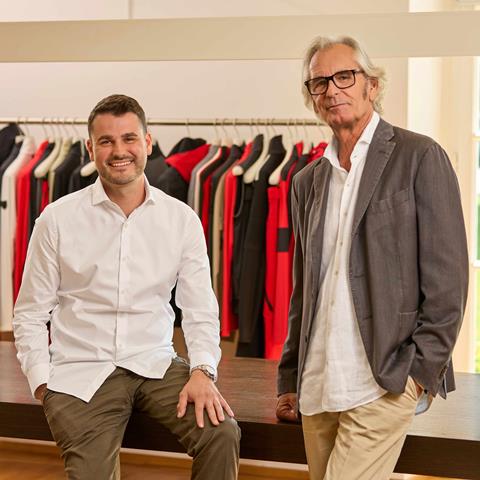
Mr. Taubenberger, your company is celebrating its 20th anniversary. How are you marking the occasion?
Hans Taubenberger: We launched a 20th anniversary collection featuring special prints, which has been very well received. The collection for next season is already sold and finalized, and we’re back on a very strong track.
What is different today compared to back then? How has the business evolved?
Not that much has changed. We still work exclusively with pre-orders. Only for carryover styles such as pants do we allow reorders.
What has changed, however, is the number of retailers in non-mountain regions. In mid-sized cities and outside ski resorts, fewer and fewer retailers are buying ski apparel. In the beginning, we certainly had more than 20 customers in Germany. Today, it’s down to five major key accounts, including Sport Schuster in Munich and Breuninger in Stuttgart.
Today, 80 percent of our revenue comes from ski resorts and only 20 percent from cities. That’s been a significant shift. The focus is now on major cities and top ski resorts - primarily those at higher altitudes with reliable snow conditions. These resorts are growing, and there’s heavy investment in top hotels, wellness offerings, gastronomy, and shopping facilities. More and more shops are opening in high-end hotels.
It’s not as many people claim - that there’s no snow anymore and skiing is declining. That’s simply not true.
Why is skiing disappearing from cities?
Based on our experience, online business is increasing, and customers are purchasing directly in ski resorts. Our city retailers remain important to us because they introduce our brand to customers before their planned ski vacation.
How has the clientele in ski resorts changed? For example, with the absence of Russian guests?
Many Russians are no longer coming. Instead, we’re seeing more Americans in Europe, because skiing in the U.S. has become so expensive that it makes sense to travel to Europe. We’re also seeing more South Americans, Arabs, Indians, and visitors from Hong Kong who may previously have skied in the U.S. but are now coming to Europe.
So how is the market currently performing?
The market isn’t easy - even in the luxury segment. Skiing has become extremely expensive in recent years and is affordable for fewer and fewer people. Retailers feel that as well.
In such phases, commission models are often used because they seem risk-free for retailers. Ultimately, however, they still need to generate revenue to succeed - returning merchandise doesn’t solve the problem. For us, this is critical because every placement takes up retail space.
That’s why we place great value on clear positioning and deliberately focus on long-term partnerships rather than small, non-binding arrangements. That’s our philosophy - and it also applies to our suppliers.
The seasons are increasingly shifting, which also affects skiing. How do you respond?
We deliver very early. Our products are available at the beginning of September. Being among the first is one of our secrets to success. That only works because we are also among the first to close our orders in early December.
We need that long lead time for production since we don’t produce large quantities per model and therefore have to manufacture before the big brands. Being early is crucial. We had a winter onset at the end of September and sold very well. When that happens, the mood immediately turns positive.
Toni Sailer positions itself between fashion and performance. Has that changed?
We’ve always stayed true to our positioning: luxury, fashion, and function at the highest level. That’s our niche. What has changed is the technological depth, quality, and perfection in detail. We’ve established ourselves in an extremely demanding segment: high-priced, functional, and fashionable at the same time.
There are many competitors in the top segment. Some are more fashion-driven but offer less functionality; others are highly functional but have less fashion appeal. We combine both aspects—and that continues to resonate very well. The latest order round showed that the brand has clear relevance and a loyal customer base.
Major luxury fashion brands are increasingly entering the sports segment. How does that affect you?
It doesn’t affect us. On the contrary, we think it’s positive - it energizes the market. When such brands invest in ski collections, it shows that it’s an attractive segment.
We’re relaxed because we are far more functional and have decades of experience. If you’ve been doing something for 20 years and continuously developing it - including our own materials - you naturally have an advantage.
The good thing is that our collection fits into different types of stores. Pure sports retailers tend to buy our more classic pieces, while luxury ski retailers and stores that combine fashion and sport prefer the more fashion-forward looks.
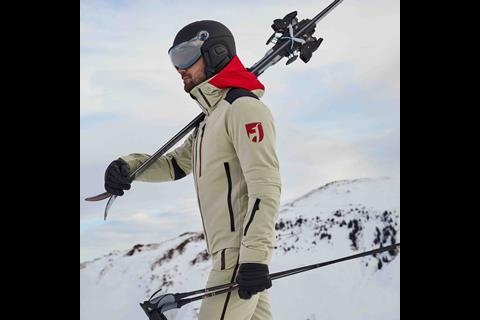

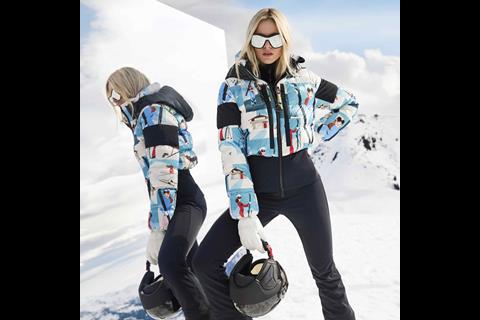
How important is functionality to customers? Or is it ultimately more about the look?
Quality and performance justify our price level. Our entry-level jacket now starts at €1,300. At that price, customers expect quality and performance to deliver. The product has to work - and not just for one season.
Our jackets require an average of 1,200 minutes of workmanship, and we use only the highest-quality materials and construction techniques. That comes at a price.
But fashion appeal is equally important to us. Every year, we create an entirely new collection. Others rely on many carryover styles or only minor adjustments to play it safe. We take a different approach. We have customers in ski resorts who return every year - and they want to see something new.
Prices have risen sharply in recent years. How have your prices developed?
Compared to 20 years ago, our most expensive jacket is certainly 50 to 60 percent more expensive today. This is due to many cost increases, starting with material costs - high-performance technical fabrics mostly come from Japan - as well as rising labor costs.
We manufacture our jackets and pants in China. However, China has become so expensive that Chinese companies are now opening production sites in Bulgaria because production costs there - in Europe - are now lower than in China itself.
Our mid and first layers are produced in Europe. The major challenge for the future is where this kind of high-quality production can still be carried out.
How do you continue to attract younger target groups to Toni Sailer?
That’s a very important topic. Constant renewal and capturing the spirit of the times in the collection are essential. We know that our customers are typically 35 and older. But that’s not necessarily due to the fashion aspect - we have that. It’s primarily about price. When you’re younger, you often simply don’t have the financial means.
Where do you still see growth potential?
I see significant potential in the U.S. and Canada, even though it has recently become more challenging there. Consumer behavior in the U.S. has cooled over the past two years, partly due to import tariffs. But I believe that will change again - often faster in America than elsewhere.
So I continue to see potential there, including for our e-commerce business. Beyond that, we want to grow with our existing retail partners.
In virtually every country, we already work with all the retailers that make sense for Toni Sailer. Our policy is not to supply additional retailers within the same ski resort. We are not driven by investors - I don’t have to increase revenue by 15 to 20 percent every year.
In which countries are you present?
In a total of 34 countries.
What is your DTC share?
In DTC, we essentially operate our online stores for Europe and the U.S., as well as our store in Kitzbühel. I estimate that about 10 percent of total revenue comes from DTC.
What’s next?
My son Kevin has been with the company for 12 years, and I’m fortunate that he wants to take over the business - and that he’s capable of doing so. I have complete confidence in him. Of course, he’ll want to do certain things differently, but that’s a good thing.
When will the handover take place?
It’s planned for the end of February. Kevin will then become sole Managing Director, and I will support him in an advisory capacity for another two years. But I will step back from day-to-day operations. I’d like to spend more time experiencing and enjoying life outside of business with my wife.