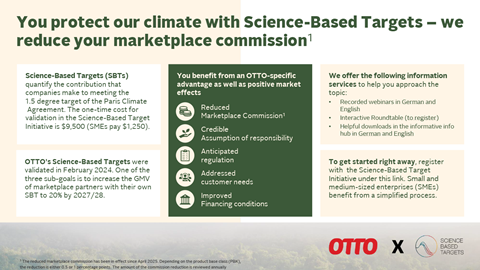
Hamburg-based e-commerce company Otto has introduced a new incentive program linking marketplace commission rates to verified climate targets. The initiative, part of Otto’s broader Science Based Targets initiative (SBTi) strategy, rewards brands whose emissions-reduction goals are officially validated, aiming to accelerate climate action across its supply chain. Under the program, Otto plans to reduce its own greenhouse gas emissions by 42 percent by 2031 compared to 2021 levels – covering not only its operations (Scopes 1 and 2) but also the entire value chain (Scope 3). By 2027/28, at least 75 percent of third-party brands and 20 percent of marketplace partners (by sales volume) should have SBTi-approved goals.
“Companies that take responsibility need fair conditions – and incentives – for future-ready business practices,” said Antje von Dewitz, CEO of German outdoor brand Vaude, which offers products on Otto’s platform, in a LinkedIn post. “Until clear regulations are in place, we’re taking action ourselves. It’s encouraging to see partners like Otto reward companies that make measurable climate progress.”
Vaude collaborates with other outdoor brands on carbon reduction
Vaude has pursued an SBTi-validated net-zero strategy since 2022 and aims to reduce its absolute emissions by 50 percent by 2030. The company operates a climate-neutral headquarters in Tettnang, Germany, powered by renewable energy, and collaborates with nine other outdoor brands through the European Outdoor Group’s Carbon Reduction Project to help material suppliers transition from fossil fuels to low-emission energy sources.
Founded in 1949, Otto is part of the Otto Group, one of Europe’s largest retail and e-commerce groups. The new incentive framework reflects its long-standing sustainability agenda, dating back to the 1980s, and aligns with the company’s goal to make climate protection an integrated business standard across the European retail ecosystem.