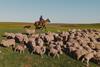
Australia and New Zealand may dominate global wool production, but Uruguay offers something different: a focus on sustainability and premium quality. For more than 70 years, Engraw has embodied these values, supplying spinning mills and knitwear manufacturers worldwide with wool tops that meet the highest environmental and ethical standards.
Founded in 1949 by American textile engineer Frank Raquet Hosey after his emigration to Uruguay, Engraw has become a benchmark for sustainable production. Located just 100 kilometers from Montevideo, the company processes around 4,500 tons of combed wool annually, with approximately 1,200 tons undergoing superwash treatment at its own facility.
But Engraw’s reputation rests on more than technical expertise or decades of experience. What truly sets this family business apart are its values. For years, Engraw has consistently championed environmental responsibility and sustainable practices, making it a pioneer in a country already recognized for its progressive environmental policies. Today, 98 percent of the company’s energy comes from renewable sources, primarily wind (two Vestas windmills installed in its facility), and all wastewater is thoroughly treated before being released back to irrigate 10,000 hectares of land.

This commitment extends to the company’s network of farmers. Engraw partners only with suppliers who provide mulesing-free wool and practice the highest standards of animal welfare.
In an exclusive interview, Federico Raquet, the Managing Director, discusses how Engraw translates sustainability into practice, the certifications that validate its efforts and why Uruguay deserves greater recognition as a world-class wool producer.
SGI Europe: Why should brands that value sustainable wool in their products be interested in you?
Federico Raquet: For us, the starting point is always transparency and honesty. I know that saying it this way might sound like greenwashing, but there’s no other way to put it. This, meaning our business, has always been built on trust – not based on a signed contract, but on honoring our word. You can ask any of our clients from the past 70 years to confirm whether we have ever failed to deliver on our word. These two values cut across everything we do – from how we treat growers, our employees and our clients to how we relate to the environment. More than once, we have invested in sustainability strategies and projects simply because our clients told us they were important to them – such as product carbon-footprint measurements, achieving carbon neutrality for 2019 under ISO 14064, and chlorine free treatment in house.
And regarding your products?
At the same time, our real differentiation compared to other suppliers is the direct contact we have with wool growers – a.k.a. producers – and the fact that we operate our own top-making plant. That gives us the ability to provide brands with quick and efficient service: whether they need to increase volumes when sales are strong, reduce them when sales slow down or develop a new product by shifting fibers into wool. Many others, without an industrial base or without being close to producers, simply cannot offer that kind of flexibility.
On the sustainability side, like others in the sector, we hold recognised certifications, but we also go further. Our plant operates with renewable energy and energy-efficiency measures, and at the producer level we work with certifications in animal welfare, organic production and regenerative practices, which are increasingly important to brands. Being close to our growers also means that if a client needs a new certification, we can move quickly to deliver it, thanks to our own sustainability program.
In short, what we offer is not only credibility and long-term trust, but also the flexibility and strategic position to deliver exactly what brands need – in both volume and sustainability.
Engraw participates in Performance Days Oct 2025 in Munich. Join them at Booth D09
What exactly do you produce, and how do you do it?
We produce combed wool tops – the main raw material for spinners and knitwear manufacturers. But we like to say that, more than an industrial company, we are a service company. What we really do is adapt to what our clients need: different qualities, specifications, certifications, storytelling, logistics solutions and commercial conditions that allow them to grow.
We produce wool tops suitable for machine washing and tumble drying through the Hercosett treatment, and we also offer a chlorine-free option. Our products are available with certifications – such as RWS, GOTS, Oeko-Tex, Cradle to Cradle at Gold level, Land to Market and Origen by Engraw – and we can additionally provide product carbon footprints under ISO 14067.

Regarding technical and quality aspects, our tops are produced with over 70 years of expertise and the latest technology, ensuring consistent quality. We process wool taking into account our impact on the environment and [its status] as a living, changing fiber, while also responding to client requirements – whether that’s higher quality standards or stricter sustainability demands.
From an environmental perspective, nearly all our production is powered by renewable energy from our own wind turbines, and we have been investing in sustainable practices for decades, because we believe it’s not only good for the planet, but also the most efficient way to process wool in the long term.
So, while the product is wool tops, what truly defines us is how we do it: with flexibility, transparency and a long-term vision that combines industrial know-how with sustainability.
Normally, brands buy their yarns from yarn manufacturers. Why does it make sense to know the upstream producers and even the farmers?
Ultimately, it’s the brand’s decision whether to engage with upstream producers. Nevertheless, it does make sense for those who want to add value to their products through transparency and by committing to a supply chain that looks after environmental and animal welfare. In that regard, Engraw can be a reliable partner.
How many and what type of farmers do you work with? Where does your wool come from?
We currently work with around 300 farmers located in Uruguay, where the majority of our growers are from. All of these producers are part of our sustainability program [e.g., RWS, GOTS, Land to Market, Origen by Engraw], and in recent years we have also begun working with a small number of growers in Argentina and New Zealand, aligned with our sustainability goals and backed by our Origen by Engraw label and third-party certification, such as RWS.
Our producers are diverse: large and small farms, family-owned and commercial establishments. What unites them is that the sheep are raised on open fields, where natural pastures are respected, and the farming is carried out in harmony with both animal health and the land.
Beyond our own Origen by Engraw certification, many of our farmers are also certified in animal welfare [RWS], organic production [GOTS], and regenerative practices [Land to Market], in different proportions. Approximately 60 percent hold animal welfare certification, around 40 percent organic, and 10 percent regenerative. In addition, we offer ISO 14067 [product carbon footprint] or ISO 14064 [establishment carbon footprint] on demand.
It is important to note that the certifications we implement, such as RWS, are often a way to organize and communicate the good practices that farmers have already been applying for decades, sometimes requiring only small changes to formalize them.
You’ve invested in measuring environmental impact. What data can you provide your customers with?
We have invested significantly in measuring our environmental impact, at both the company and the product level. As a company, we have been certified Carbon Neutral under ISO 14064, and we continue to measure and reduce our emissions. At the product level, we can provide customers with detailed product carbon footprint data under ISO 14067.
Our Sustainability Report for last year makes this information transparent, including the fact that almost all of our production is powered by renewable energy from two Vestas wind turbines installed at our own facility. We have also planted more than 6,000 trees as part of our climate action. Together with water and energy efficiency and circularity practices, this means our clients can access reliable, third-party-verified data to support their own sustainability goals and communication.

International supply chains have been severely disrupted in recent years. How secure is Uruguay as a sourcing country?
Uruguay is one of the most secure sourcing countries you can find. It is known as the most peaceful country in South America, with long-standing political, economic and social stability. The country also has a strong agricultural tradition and is internationally recognized as a pioneer in renewable energy, with one of the cleanest energy matrices in the world. According to the Global Footprint Network, Uruguay has one of the latest Country Overshoot Days in the world [Dec. 17, 2025], ranking among the best-performing countries in terms of resource consumption and sustainability.
From a supply perspective, we have been operating since 1951, and, while our base is Uruguay, we also have access to production facilities outside the country.
For brands, sourcing from Uruguay means combining security and reliability with a tradition of sustainable farming and wool production.
What’s special about Uruguay as a location for production?
Uruguay is a very special location for wool production because wool growing here is not just an industry, it is a tradition passed down from generation to generation – part of our folklore and a way of life for rural families. Unlike other countries, where sheep and cattle require deforestation or heavy land-use change, Uruguay is naturally prairie. Much of the land has preserved its natural grasslands for centuries, making it ideally suited for grazing. In many cases, farmers even plant trees to provide shelter for their animals.
Beyond geography, Uruguay offers political, economic and social stability, together with one of the cleanest energy matrices in the world, with around 99 percent of its electricity coming from renewable sources. As an industry, we have decades of expertise. Uruguay has been combing wool for generations, and our company has been doing so for over 70 years. Although small, Uruguay has often been a pioneer in areas such as worker protection and sustainability, which continue to set us apart internationally.
Uruguay has lost many wool producers in recent years. Why?
Uruguay has indeed lost a significant number of wool growers in the last decades, slowly but steadily. The main reason is that wool has not always been a profitable business for farmers, so some growers have reduced or even abandoned their flocks for other rural activities, such as beef or crop farming.
However, the main threat was the rise of fast fashion, which has changed the textile market. Consumers can now buy a garment for the same price as a fast-food meal from a famous fast-food chain I will not name, which puts enormous pressure on natural fibers like wool, which are more costly to produce. This has discouraged some producers, even though the fiber itself has unique value.
Sustainability certifications, while increasingly demanded by the market, also bring additional costs that can be difficult for farmers to absorb. At Engraw, we try to ease that burden by covering certification costs for our growers, helping them to maintain access to international markets.
Looking ahead, we see that brands and consumers are showing more interest in transparency, traceability and sustainability. This shift can create new opportunities for wool and help encourage more farmers to stay in – or return to – sheep production. Far from being a fiber of the past, wool has the potential to thrive in a future where authenticity and responsibility matter more.
Engraw participates in Performance Days Oct 2025 in Munich. Join them at Booth D09
Certifications offered by Engraw
- Oeko Tex
- Cradle to Cradle Gold level
- RWS
- GOTS
- Land to Market
- ISO 14067
- ISO 14064