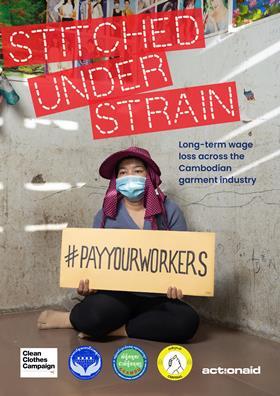
The Covid-19 pandemic had a catastrophic impact on the workers employed in garment factories across Cambodia. In early 2020, workers already earned below the living wage and relied on overtime pay to cover their basic needs. By the end of the year, factory closures and suspensions pushed thousands of workers further into poverty. Three years later, the global fashion industry is ”well on the road to recovery,” but garment workers are left to languish below the poverty line, according to new research released from ActionAid in collaboration with the Centre for Alliance of Labour and Human Rights (CENTRAL), the Cambodian Alliance of Trade Unions (CATU), and the Coalition of Cambodian Apparel Workers Democratic Union (C.CAWDU). The 43-page report, titled “Stitched under Strain: Long Term Wage Loss across the Cambodian Garment Industry,” is based on interviews with 308 garment workers, 65 percent of whom are women, employed at factories producing for brands such as Nike, Adidas, New Balance, Puma, Gap, and Levi Strauss. The interviews were conducted between December 2022 and January 2023.
At least a quarter of surveyed workers reported a decrease in monthly pay since 2020. Simultaneously, the cost of living in Cambodia has soared, with the biggest expense change reportedly linked to rising rents, trapping workers in a vicious cycle of poverty that prevents them from covering basic needs. Nearly half of surveyed workers (49 percent) said they often go to work without eating enough. Meanwhile, most of the brands covered by this research were returning to profitability, highlights the report.
Overtime pay dropped by more than 60 percent for surveyed workers from 2020 to 2023. Overtime plummeted as brands and factories took steps to recoup Covid-19 losses. The reduction in overtime hours since Covid-19 was one of the biggest concerns that garment workers raised through the survey, researchers said. Amidst these difficulties, 91 percent of surveyed workers reported holding at least one current loan, with 70 percent pointing to the pandemic as a direct link to increased debt. To make matters worse, workers are increasingly turning to informal loans, which carry interest rates as high as 20 percent, or borrowing directly from factory supervisors.
Garment factories across Cambodia employ more than 700,000 people, mainly women. The garment and footwear sector has been the country’s biggest export industry since the mid-2000s.