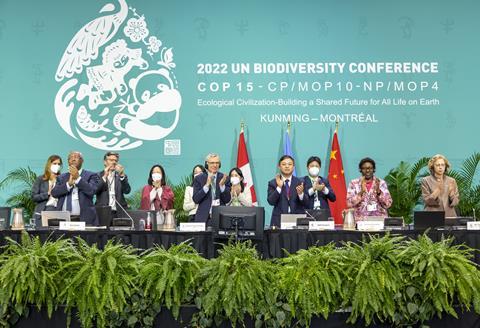
At the conclusion of COP15 in Montréal, Canada, world leaders adopted the Global Biodiversity Framework (GBF). Liesl Truscott, director of industry accountability and insights at Textile Exchange, assesses the agreement for the fashion, textile and apparel industries in a statement on the Textile Exchange website.
Textile Exchange sees the COP15 agreement as the second pillar of a complete transformation of the global economy, which interacts and is mutually dependent on the CO2 reductions agreed upon in Paris: to achieve net-zero climate targets, it is essential to work for biodiversity and net-zero in turn opens the door for nature. For many companies, climate risk has permeated the boardroom and has become part of the conversation with shareholders, investors and other stakeholders. This emphasis on climate may have led to “carbon tunnel vision,” but it has gotten things moving for nature in general, Truscott says. The task now is to advance corporate disclosure frameworks and financing tools for nature, taking into account the lessons of climate change. Accordingly, the space devoted to financing at COP15 was also large. An entire day was dedicated to biodiversity and finance, with 150 financial institutions representing $24 trillion calling on world leaders to adopt an ambitious global biodiversity framework. Not surprisingly, one of the delegates’ biggest concerns is the need for sufficient resources in developing countries to truly mobilize action on the ground. An important element of this is the decision to redirect environmentally harmful subsidies (amounting to over $1.8 trillion per year) toward regenerative approaches.
Textile Exchange, in its statement on COP15, welcomes the presence and relevant voice of indigenous peoples, who play a major role in implementing the decisions on the ground. Here, for example, we are talking about the shift to regenerative agriculture: when agricultural land and production activities come up against sensitive biodiversity hotspots in the landscape or where they impede wildlife movements. According to Textile Exchange, it is necessary to take advantage of the wealth of tools and technologies available to make the most of the enormous amount of innovation in this area.
Wrapping up, the Textile Exchange statement says: Although the negotiations took some time and developing countries left at the midterm break, the final version of the GBF is ambitious enough that most participants feel they can work with it.