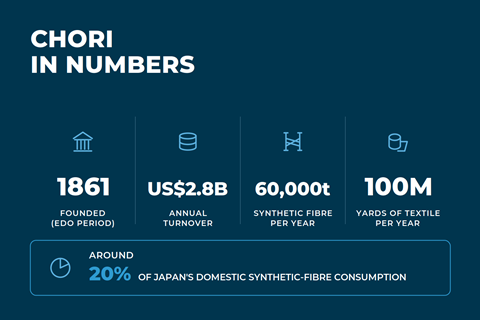
Chori was founded in 1861 as a raw silk wholesaler in Kyoto — the butterfly in its logo is a silk moth. More than 160 years later, the case it makes to European brands is that it has outgrown the trading-house label: a developer and manufacturer working from fibre and yarn to finished garment, with sustainability built into how it operates.
Chori’s story begins with silk. Founded in 1861 in Kyoto’s Nishijin weaving district, the company even carries it in its name — “cho” from the silk moth, “ri” from its first president, Riichiro Ohashi — and in the butterfly of its logo. From raw silk it moved into rayon in the 1920s, became Japan’s largest rayon yarn trader, and built from there into synthetic fibres, fabrics and garments, run today from twin head offices in Tokyo and Osaka. The current company engineers the fibres and yarns, makes the fabric and the garments, and manages the supply chain that links them.
The timing is good. More and more brands want to deal directly with the companies that develop and make their materials, with fewer intermediaries in between — and Chori, with its own recycling and manufacturing capacity, is built for exactly that kind of direct relationship, calling in outside partners only where they add something.
Beyond trading: a development partner
So what separates a development partner from a supplier? People, mostly. Chori’s teams run across fibres, yarns, textiles, dyeing technology, sustainability and garment production, backed by in-house laboratories and material-development resources — enough depth to pick up a project at any stage, from proposing and selecting materials to engineering a fabric, securing certification and seeing it through production to a finished product.
One brief might run all the way from material proposal to finished garment without ever leaving Chori. Another might be nothing more than a single new performance textile, or a recycled-content material. Either way, the relevant expertise and partners are gathered in one place — the role of an innovation connector, played from inside the supply chain rather than beside it.
From yarn to garment
In Hong Kong, Chori’s garment-manufacturing arm, MCC Industry, takes the company past materials and into finished product, working through audited factories across a diversified Asian network. Instead of coordinating a yarn supplier in one country, a mill in a second and a garment maker in a third, brands can run development and production along one route — and keep the quality control, flexibility and supply-chain resilience that tend to fray when the work is spread across a string of unconnected vendors. One partner, one point of contact.
Sustainability, built into the chain
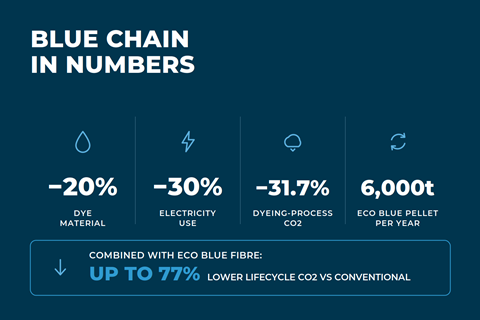
Blue Chain is the name Chori gives its sustainability approach: improvement worked across yarn, fabric and garment together, in step with supplier companies, and weighted toward what is practically achievable rather than claims pinned to a single product.
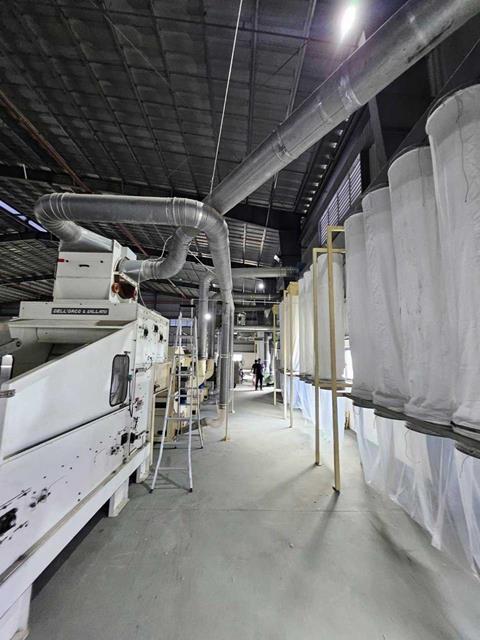
At a recycling facility in Japan, a pelletising line turns used PET bottles into the raw material for Eco Blue, Chori’s recycled polyester — and Chori runs that line itself rather than buying in pellets from mixed sources. The difference shows up in the material: tighter control over contamination, better consistency. In Vietnam, a second operation, B-Loop, recovers textile waste from before and after consumer use and turns it back into usable material.
The numbers come from named collaborations. With a globally recognised finishing partner, Chori has developed a process that cuts dye and electricity use substantially; combined with Eco Blue fibre, Chori reports lifecycle CO2 savings of up to 77 percent against conventional production.
And can any of it be proven? Increasingly, that question decides European sourcing as much as price or performance. Oeko-Tex, bluesign and GRS certifications sit alongside Chori’s in-house testing, and the company is putting growing weight on carbon-footprint measurement and supply-chain data — the evidence European brands now have to produce under tightening rules on transparency and emissions reporting.
The products that prove it
For outdoor brands, two fabrics stand out. Spiroteq covers the membrane-backed, waterproof-breathable territory technical apparel depends on. Torikumo is the more unusual one: a lightweight, waffle-structured insulation that holds warmth without conventional fibre fill — and in outdoor design, warmth is always weighed against weight.
The circular materials extend the same thinking. Blueny gives nylon a second life from unexpected sources — fibre scraps, collected fishing nets, plant-derived feedstock — while Spunlab’ s functional spun yarns and the Mesh Film bonding material carry the approach into texture and garment construction. Set side by side, the range makes the article’s larger point better than any claim could: this is what developing, rather than sourcing, actually produces.
The European opportunity
Supplier lists across the industry are getting shorter, and the names that stay on them tend to be those that can both develop materials and account for them. That is the end of the market Chori is working: functional and smart-textile development, and supply-chain management that runs from the first material proposal to distribution. It already supplies sportswear, performance and value-retail customers, and its stated European priority is to compete on what it can develop and verify, not on volume.
The operation itself is also moving closer to those customers. From a European headquarters in Frankfurt, home to strategic direction and customer support, Chori is building operational infrastructure across the continent: manufacturing capability, finishing and processing, stock and inventory management, local delivery and logistics. Lead times get shorter and planning more flexible when an order no longer hangs on one long route from Asia. Chori’s ambition in Europe is not to be a Japanese trading company exporting into the region, but an operational partner working inside it.
A partner for what’s ahead
The pressure on the industry is arriving from several directions at once: performance, sustainability credentials, and the transparency to back both up. None of it is met by a catalogue alone. It calls for a company that can develop a material, manufacture it, and stand behind the data — and connect the parts of the value chain that rarely talk to each other. That is the case Chori is putting to European brands, backed by more than 160 years in textiles and production and recycling capacity it runs itself.
Chori will be at Performance Days, booth B05-B06, to talk through what any of this could look like for your materials. Come and start the conversation in person.