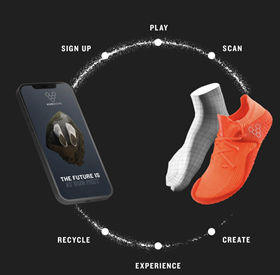
UK-based footwear and lifestyle brand Vivobarefoot has announced a partnership with Tel Aviv-based circular economy startup Balena, founded in 2020. The aim is to produce shoes that are made-to-order and made-to-measure locally and are compostable and recyclable thanks to Balena’s BioCir®flex range of materials.
BioCir®flex is an advanced, flexible, fully compostable and recyclable thermoplastic elastomer that reduces toxic, fossil fuel-based materials commonly used in the consumer goods industry. BioCir®flex can be scaled for mass production by injection molding and extrusion and for 3D printing with filaments or pellets, and it can be used in a wide range of industries.
Now, at the Biofabricate materials conference in Paris, the partners presented the prototype of a mono-material shoe 3D-printed from Balena’s compostable thermoplastic material. The product, described by Vivobarefoot as “scan-to-print-to-soil”, is produced in a “fully automated process - scanned on phone and automatically printed”. The shoes were designed for composting in an industrial plant.
Would you 3D print your footwear?
— VIVOBAREFOOT (@VIVOBAREFOOT) January 12, 2024
In a quest to reimagine the footwear industry, VivoBiome continues to push boundaries in collaboration with @BalenaScience. BioCir®flex 3D is a flexible, compostable thermoplastic designed for performance and composability.#VivoBiome #Balena pic.twitter.com/vFoqxd23OQ
The manufacturing process is based on Vivobarefoot’s VivoBiome experiential platform, which was introduced last year, and is, according to the company, “a new way to completely redefine how footwear is made, used and experienced. It’s a digital, sustainable, and personalized approach to footwear that will fit for your feet and the future.” Precise scans of a customer’s feet are sent to 3D printers for production on-site. VivoBiome will start with a center in the UK, with Germany and the US to follow. Local manufacturing reduces shipping, and 3D printing reduces production waste.
According to Balena, products made from BioCir®flex reach their end of life responsibly in a biological recycling mechanism that safely returns the material to the soil for complete decomposition and biodegradation in an industrial composting environment, completing a fully circular process required for a sustainable future. This method of controlled and safe biodegradation meets the tests for ASTM D6400-04 and EN 13432 certifications.