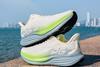
Finish Line conversions, Hibbett closures and City Gear rebranding explain most of the American margin loss, while better stock at the Iberian and Greek chains delivered the group’s only division-level margin gain.
JD Sports Fashion sold fewer sneakers and more of almost everything else in the first half. Group sales came in at £5.90 billion (€6.84 billion) for the 26 weeks to Aug. 1, down 0.8 percent at constant currency, with operating profit before adjusting items down 19.5 percent to £294 million (€341 million). The shape of the half is more interesting than the total. The group’s smallest division grew fastest, its American chains fell hardest, and the core JD stores sat somewhere in between.
| JD Sports Fashion — Segmental report | |||
| HY27, 26 weeks ended Aug. 1, 2026 (£ millions) | |||
| JD | Complementary Athleisure | Sporting Goods & Outdoor | |
| Revenue | 3,688 | 1,468 | 743 |
| Gross profit | 1,759 | 673 | 329 |
| Gross margin | 47.7% | 45.8% | 44.3% |
| Operating costs before adjusting items | -1,529 | -573 | -289 |
| Interest on lease liabilities | -54 | -15 | -7 |
| Operating profit before adjusting items | 176 | 85 | 33 |
| Operating margin | 4.7% | 5.8% | 4.4% |
| Operating margin change YoY | -120 bps | -230 bps | 80 bps |
Source: JD Sports Fashion plc HY27 results statement, Sept. 23, 2026, Segmental Report. Figures as reported, unaudited. Operating profit and operating margin are stated before adjusting items and after interest on lease liabilities. HY26 gross profit, gross margin and operating costs restated per note 14. Prior-year comparatives (HY26): revenue £3,674m / £1,567m / £699m; gross profit £1,773m / £723m / £296m; operating profit £217m / £127m / £25m; operating margin 5.9% / 8.1% / 3.6%.
Finish Line and Hibbett take the hit
Complementary Athleisure, the division that holds Finish Line, Hibbett, DTLR, Shoe Palace, Courir and the Eastern European stores, turned over £1.47 billion (€1.70 billion), down 5.3 percent at constant currency. Operating margin fell to 5.8 percent from 8.1 percent, the sharpest decline of the three divisions. Chief Financial Officer Dominic Platt told analysts Finish Line was the most promotional of all the group’s fascias during the half.
The fix is already running. Nineteen Finish Line stores were converted to JD in the first half, leaving 145 standalone sites that the company says will all be converted or closed by the end of its 2028 financial year. Hibbett shut 33 stores, part of a program to close roughly 170 over three years. Another 32 City Gear stores became Shoe Palace or DTLR, with about 60 conversions planned across the full year.
Outdoor and Iberia had the best half in the group
Sporting Goods & Outdoor, the smallest division at £743 million (€862 million), was the only one to grow. Sales rose 5.1 percent at constant currency, gross margin improved 200 basis points to 44.3 percent, and operating margin gained 90 basis points to 4.4 percent. Platt credited better stock positions at Cosmos Sport in Greece and at the UK outdoor business, which allowed both to put more new product in front of customers at full price. Sprinter in Iberia contributed to the same pattern.
The UK outdoor business moved onto Shopify in January. Chief Executive Régis Schultz told analysts total outdoor sales have run 25 percent ahead of last year since, helped by more orders being fulfilled from stores. The division also consolidated its distribution centers and refreshed its ranges during the half.
Running is holding up footwear
Footwear organic sales fell about 3 percent across the group while apparel and accessories grew about 4 percent, taking apparel to 36 percent of sales. Inside footwear the mix keeps moving. Retro basketball and retro terrace styles are fading, while performance running and newer silhouettes from On, HOKA, Salomon and Nike’s Vomero line grow. Birkenstock, UGG and Havaianas are lifting the “other” category, now 4 percent of sales.
“Running clubs and gyms are becoming the new nightclubs,” Schultz said on the results call, describing where his core customers now spend their time. Around 30 percent of the group’s footwear and 50 percent of its apparel is exclusive to JD, which the company says keeps it out of direct price comparison.
Fewer stores, more selling space
The group ended the half with 4,766 stores after 88 openings and 133 closures, 106 fewer than a year earlier, yet new and relocated space added 2.1 percentage points to sales. Forty-eight relocations and conversions accounted for 0.8 points of that. New UK flagships opened in Cardiff and Sheffield, Germany consolidated from 91 stores to 62, and more than 70 Eastern European stores are moving to Sport Vision under a franchise deal. A separate agreement with Grupo Axo will put more than 140 JD stores into Mexico from 2027, on top of 83 franchised stores already trading.
| JD Sports Fashion — Sales by channel | ||
| HY27, 26 weeks ended Aug. 1, 2026 (% of Group sales) | ||
| HY27 | HY26 | |
| Stores | 79% | 80% |
| Online | 20% | 19% |
| Other | 1% | 1% |
Source: JD Sports Fashion plc HY27 results presentation, Sept. 23, 2026. Online sales include click & collect and ship-from-store; Other mainly relates to JD Gyms sales in the UK. Store sales organic growth -2%; online sales organic growth +5%.
Online sales grew 5.2 percent to 20 percent of the group total, though the UK was flat with its new platform only live since August. JD STATUS passed 10 million active members, accounting for 40 percent of JD UK in-store revenue and 45 percent of US transactions, with average order values around 20 percent higher than non-members. At Hibbett, AI voice agents now handle 40 percent of customer service calls.
Controlling the controllables
Full year guidance is unchanged at £700 million to £800 million (€812 million to €928 million) in profit before tax and adjusting items, with free cash flow of £460 million to £520 million (€534 million to €603 million). Schultz described the half as “controlling the controllables.” Shares closed at 74.43 pence in London on Sept. 23, down 5.45 percent. The next trading update is Nov. 19.
Net cash of £168 million (€195 million) against net debt of £125 million a year ago, a narrower cash outflow, lower capex and a dividend up 21.2 percent bought the stock nothing. Platt told analysts to carry the 50 basis points of price investment into the second half and expects no shift in industry stock levels before then. Two thirds of the year’s profit is still to come, in those conditions.
Supporting documents
Click link to download and view these filesHY27-Results-Presentation
PDF, Size 11.98 mb