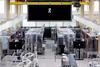
On has moved nearshoring from strategy document to factory floor. The brand’s second LightSpray facility, now operational in South Korea with 32 robots, marks a material shift in how and where the company makes shoes.

On has opened its second LightSpray robot production facility near Busan, South Korea, bringing 32 fully automated robots online and targeting a 30-fold increase in global LightSpray capacity during 2026.

The Zurich-based brand announced the development on Feb. 25, with further plants planned for the Americas and Europe. robot production facility near Busan, South Korea, bringing 32 fully automated robots online and targeting a 30-fold increase in global LightSpray capacity during 2026. The Zurich-based brand announced the development on Feb. 25, with further plants planned for the Americas and Europe.

On LightSpray Factory Busan - Photo by SeongYoun Vhae - 2026

Source: On Press Room On LightSpray Factory Busan - Photo by SeongYoun Vhae - 2026

The move addresses supply chain resilience directly.

On Holding currently sources 90 per cent of its shoes from third-party manufacturers in Vietnam and 10 per cent from Indonesia, according to its latest annual report. Co-founder Caspar Coppetti said automation allows the brand to produce faster and closer to key consumer markets, noting that rising labour costs, geopolitical uncertainty and US tariff pressure are all pushing the industry towards a different manufacturing model.

“The speed to market and the sustainability of it,” Coppetti told Reuters, “and also the fact that basically we’re running out of places with cheap labour are all speaking for automation and going closer to where consumers are.” Planned US facilities would also help mitigate tariff exposure – steep levies on goods from Vietnam and China have significantly raised costs across the sportswear industry over the past year.

On’s LightSpray technology scales from Zurich prototype to global robot network

The scale jump from On’s first LightSpray facility is striking. That inaugural plant, which opened in Zurich in July 2025, operates with just four robots. The new Busan factory adds 32 and, according to Reuters, can produce approximately 1,000 pairs per day.

LightSpray – which the brand introduced publicly during the Paris Olympics in 2024 – condenses traditional upper manufacturing, a process typically spanning around 200 steps across multiple factories, into a single automated sequence. A robotic arm sprays 1.5 kilometers of thermoplastic polyurethane filament – roughly the length of 15 football fields – onto a mold, forming a one-piece upper in roughly three minutes. Chief Innovation Officer Scott Maguire noted that each robot can be precisely programmed to replicate the same movements across locations: “The innovation remains distinctly On, distinctly Swiss – made for the world.”

South Korea’s advanced robotics infrastructure and existing manufacturing relationships with On made it the strategic choice for the second site. The company’s stated goal is to establish LightSpray facilities at nearshore locations across all major continents, with production in the Americas and large-scale European capacity as the next targets.

On aims to bring LightSpray training shoes to mass market

The Busan factory launch coincides with the debut of the LightSpray Cloudmonster 3 Hyper, the first shoe upper produced at the Korean site. Positioned as a high-performance training shoe rather than an elite racing model – featuring full-length Helion HF hyper foam – the product marks On’s effort to bring LightSpray to a wider consumer base beyond competitive runners. A limited release is planned at on.com and North American retail stores on 5 March, with a global rollout on 16 April.

A proof of concept for the future of footwear manufacturing

On’s nearshoring push is not happening in isolation. Rising US tariffs on Vietnamese and Chinese-made goods have accelerated industry-wide pressure to reconsider supply chains concentrated in Southeast Asia. Last Friday’s Supreme Court ruling against Trump’s tariffs offered no relief—on the contrary, it has added further uncertainty for importers, prompting calls from Coppetti for greater regulatory clarity and a return to freer trade conditions.

For a brand that still sources the overwhelming majority of its shoes from Asia, LightSpray regional production is better understood as a proof of concept for the factory model of the future: resistant and resilient in any scenario, scalable, sustainable and potentially cost-effective as volumes scale.