“Most people exercise for their health and appearance. We all want to stay or become healthy and beautiful,” explains Michael Nendwich, Vice President of FESI. Sports equipment has always been a means to an end, but now it’s also much more. Sports evoke emotions and create experiences that benefit both body and mind. Sports and health are driving forces in society. This is an opportunity, and not just for the industry. Let’s take a closer look at the five most important trends in sports retail.
Trend 1: Hybrid distribution
Brick-and-mortar stores are places for interaction, while social media platforms like Instagram and Facebook are being used for customer retention and acquisition. This is one of the results of the third IHK-ibi retail study, conducted in 2024. The German Chamber of Industry and Commerce (DIHK) surveyed 2,100 retailers in all of Germany’s industries to discover, among other things, the consumption habits of Germans.

The surveyed retailers were using social media mostly to increase their brand awareness (89%), but also to share customer information with the community (81%). Moreover, the majority saw social media as an ideal platform for acquiring customers and retaining existing ones. Interestingly, social commerce played a minor role, for only 16 percent. This aligns with the findings of Michael Nendwich, who, in addition to being Vice President of FESI and Managing Director of VSSÖ in Austria, is a sports retailer.
“We see that the majority of customers, both in tourist and urban areas, still prefer the shopping experience in physical stores,” Nendwich says. Traditional sports retail is thriving, especially when it offers a wide range of products, from budget-friendly to premium. “We still primarily see online as a source of information,” he continues, acknowledging that this could change with younger generations like Gen Z and Gen Alpha, with whom social media shopping channels might play a bigger role. However, Nendwich is unsure that this will actually happen.

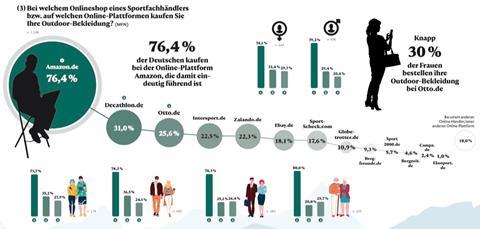
Sonja Koschel, owner of the market research and consulting institute Marketmedia24 in Cologne, Germany, has a slightly different perspective. “DACH residents primarily buy functional sportswear in sports stores [around 60%], followed by online platforms and marketplaces like Amazon and Otto [almost 38%]. The online shops of sports retailers also play a significant role, with around 26 percent.” These results derive from the Consumer-REPORT 2025 - Sports Retail D-A-CH.
The fact is, to remain competitive, sports retailers must diversify their sales channels. The physical store remains an important touchpoint for advice and experience, but digital channels such as online shops and social media are gaining importance. A successful strategy combines both worlds and offers customers a seamless shopping experience.
Trend 2: Outdoor sports tourism and the tourist sports retail sector
The Covid-19 pandemic renewed interest and appreciation for outdoor sports vacations, and the trend has largely persisted. Outdoor tourism remains a significant market driver and engine, not only for tourist sports retailers but also for businesses in urban areas. Marketmedia24, represented by Koschel, reached this conclusion: “67.6 percent of Germans prefer to buy their alpine skis at a local sports store. 18.6 percent opt for online purchases, while another 6.8 percent buy their alpine skis from a stationary retailer in a ski or vacation area. Similar purchasing behavior is evident for ski boots: 70.3 percent of buyers rely on local sports stores, 18.7 percent order online, and 5.2 percent buy their ski boots on-site in a ski or vacation area.”
Overall, there is little movement in terms of sports in the DACH region. “I can’t see any real trends. Outdoor, cycling and winter sports remain the major drivers, generating most of the turnover,” says Nendwich. “Fads like padel are good, they are offered, but they have little impact on the Austrian market. It’s different with padel in Spain, for example,” Nendwich explains further.
Alpine skiing continues to perform well in the winter sports segment. Many people still yearn for snow-capped mountains and fun on the slopes. “Of course, climate change plays a central role, and we need to adapt to the new conditions,” says Nendwich. But winter sports won’t disappear – at least not in the coming years. The emotional connection is too strong.
Trend 3: Leveraging the unique selling proposition
In a world where counterfeits and cheaply produced products are offered at dumping prices and price wars are fought both on- and offline, it’s essential to develop unique selling propositions. Retail expert Nendwich sees the greatest trend in the individualization and personalization of sports equipment. This involves all those services that neither can be offered online nor provide any added value online.
“In sports retail, we offer a service that even the agile automotive industry cannot match. Only sports retailers are capable of adjusting sports equipment to a customer’s body measurements and then checking the mechanical components in a second step.” Nendwich is referring to electronic ski-binding adjustment. This is a major advantage for retailers in the ski segment. But the fitting of ski and hiking boots – not to mention running shoes – presents another such a service.
Trend 4: Skilled professionals as future makers
People are searching for perfect sports equipment to enhance their experience. Nendwich is convinced that specialists who can provide excellent advice and customer service are essential. Especially in outdoor sports, safety is a major concern. “We need highly qualified personnel,” he says. “I see it as the responsibility of sports retailers to invest more in the training and further education of their employees. With this specialization, we are well equipped to provide in-depth training for employees across a wide range of sports. If we succeed in doing this, it will be the right approach to ensure the future viability of urban sports retail in particular.”
Trend 5: Health – society’s new “hobby”?
Health is now being equated with sports. People strive for self-optimization, a long life, beauty and youth. The overarching term is health – and for many its pursuit has become a hobby. Sports are an important piece of the “overall health puzzle.” It’s about creating emotional connections and experiences that have a positive effect on both body and mind. “Generating added value for customers will play a key role in the future, including for acquiring new customers,” says Nendwich. In addition to well-trained specialists on the sales floor, topics such as emotionalization and possibly even health coaching could be interesting and unique selling points.