Salomon has unveiled the results of its winter sports product life cycle assessment, which was conducted across the company’s entire ski and snowboard range. The study, which began in 2019, was conducted with the goal of understanding the environmental impact of Salomon’s entire product offering using a science-based approach. Now, the winter sports team is publishing the results to provide the snowsports industry with a reference to inspire more sustainable product design.
Three years ago, Salomon became the first winter sports company to commit to a science-based target approved by the Science Based Target Initiative (SBTi), which defines and promotes best practices for emissions and net zero targets in line with climate science. This means that Salomon’s winter sports division has a carbon reduction target that is scientifically consistent with the Paris Agreement and the global goal of not increasing global warming above 1.5°C. To date, Salomon is the only winter sports company to meet this standard.
Conducting life cycle analysis (LCA) of its products allows teams at the 76-year-old French ski and outdoor company to know the environmental impact of each step in the product creation process, from material sourcing to end-of-life management of the product. the LCA work is directly informing the global climate strategy of Salomon with science-based data.
“By measuring the impact of our products and sharing our findings, we want to contribute to the transformation of our industry,” said Xavier Le Guen, Vice President of Salomon Winter Sports Equipment. “One year after the adoption of our Science Based Target, we are validating our efforts with this LCA study and further developing our internal systems so that our product teams can measure and communicate the CO2 impact of our products. The goal is to develop a methodology to calculate the environmental impact of all winter sports equipment. This could be the basis for a future system for labeling the environmental impact of products.
To improve the results, Salomon Wintersport is working with its network of industry partners, including other snow sports equipment manufacturers, ski resorts and various ski industry associations such as Snowsports Industry of America (SIA), Protect Our Winters (POW), Federation of the European Sporting Goods Industry (FESI), European Outdoor Group (EOG), Outdoor Sports Valley (OSV) and the International Biathlon Union (IBU).
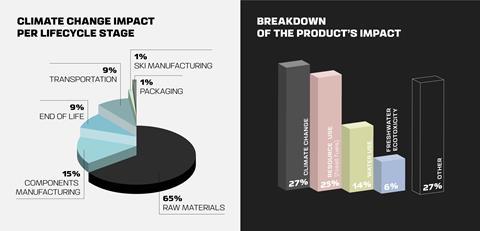
Work on the LCA has already had a noticeable impact at Salomon, even before the results were published and made available to the industry. The company’s in-house sustainability experts have enabled winter sports product development teams to change product design to incorporate recycled materials and find new ways to make products with fewer materials. The MTN ski touring ski and ski boot series was completely redesigned based on the results of the life cycle assessment and includes additional recycled and bio-based materials in the construction. As part of Salomon’s “Trash is Gold” project, production waste was incorporated into the sidewalls of skis, particularly the Addikt Pro.
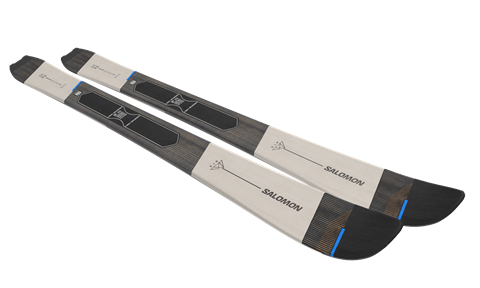
Most snowboard and snowboard boot models feature 360 eco-design, using recycled and bio-based materials and plastic-free packaging. Nordic ski R&D experts used recycled plastic bottles in the production of the S-Core 45, which is used in several ski models, and also designed the Stringer Core, found in other models, to use less material without sacrificing performance or durability.
Since 2021, Salomon has also been offsetting the travel costs of its international team of athletes, including its winter athletes who participate in various World Cups in the Nordic and Alpine disciplines.
“We have taken concrete action on climate change and are now developing a methodology that will allow us and the industry to communicate about CO2 impacts,” says Le Guen. “Creating our LCAs will help us achieve our science-based goal, and we hope they can help the industry as a whole so we can all keep skiing for generations to come.”
The LCA work conducted by Salomon’s product sustainability team is a key step in the company’s Change our Tomorrow 2030 strategy and overall goal to reduce its absolute carbon emissions by 30 percent by 2030 (from a 2019 baseline). This commitment is part of the company’s historic signing of the United Nations Fashion Industry Charter for Climate Action (UNFICCA) in 2018 and the SIA Climate Pact, which it signed in 2021. Salomon has also set itself the goal of making the environmental impact of its products 100 percent transparent by 2025, i.e., reporting the environmental values of all products.