A number of European mayors, many of them attending the latest edition of the ChangeNOW show in Paris, have signed the “Declaration to Drive Sustainable Fashion.”
The declaration is an appeal to the EU, the G7 and the OECD to tip the fashion industry’s playing field in slow fashion’s favor. Among other things, it calls on governments and their agencies to:
- lower rents at production and sales sites for slow-fashion firms
- fund research into the ecological manufacture of clothing
- create local employment
- fund new companies in the “social, circular and/or functionality economy”
- redirect grants, loans and other financial instruments toward “positive impact companies”
- adjust taxes to favor slow fashion
- create slow-fashion markets through public procurement
It calls on countries around the world to:
- ban “unfair trading practices” (protect the small player against big brands and retailers
- enforce social and environmental provisions in trade agreements
- support slow-fashion-producing countries (through governance reforms and law enforcement)
- ban advertising and other incentives for fast fashion
And it calls on Europe to:
- implement a Carbon Border Adjustment Mechanism (CBAM) and extend it to the textile industry
- adopt an EU directive requiring due diligence for corporate sustainability throughout the supply chain
- prohibit products made with forced labor
- ban chemicals from the textile industry
- revise the REACH Regulation
- make textiles essential to the European Green Deal Industrial Strategy
- adopt a European Slow Fashion Label
- support the cultivation of organic raw materials in Europe
- promote training in “forgotten skills” (e.g., for textile machinery)
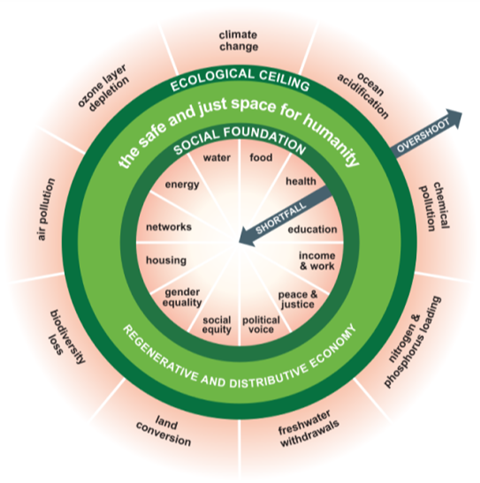
The declaration’s originator is the Belgian politician Barbara Trachte, secretary of state for the region of Brussels, in charge of economic transition and scientific research, and minister-president of the College of the French Community Commission (COCOF). Trachte is a proponent of doughnut economics, which the Doughnut Economics Action Lab explains as follows:
“The Doughnut consists of two concentric rings: a social foundation to ensure no one is left falling short on life’s essentials, and an ecological ceiling to ensure that humanity does not collectively overshoot the planetary boundaries that protect Earth’s life-supporting systems. Between these two sets of boundaries lies a doughnut-shaped space that is both ecologically safe and socially just: a space in which humanity can thrive.”
The press release for the declaration speaks of more than 30 signatories but names the mayors and deputies of only Turku (Finland), Annecy, Strasbourg, Bordeaux, Dublin, Rzeszów (Poland), Bologna, Paris, Terrassa (Spain) and Leuven (Belgium). Barbara Trachte is herself among the signatories.
By her account, the fashion industry uses 4 percent of the world’s fresh water and generates 4 percent of its greenhouse-gas emissions, while cotton grows on 2.5 percent of the world’s cultivated land and accounts for 25 percent of its pesticide use. The average European, her website continues, consumes 26 kg of textiles and produces 11 kg of textile waste every year, while less than 1 percent of clothing is recycled.
Trachte’s second concern is labor. “The textile industry,” her website reads, “employs – or exploits – people in the global South, mainly women and children,” who work long hours under poor conditions, with chemicals and in unsound buildings.
Photo: Pixabay