Six months into one of the sporting goods industry’s largest acquisitions, DICK’S Sporting Goods is running two parallel businesses with very different trajectories – and betting that a store reinvention program called Fast Break will prove the thesis.
The first full annual report to include Foot Locker reveals a company pulling in opposite directions: a core DICK’S Sporting Goods business posting record sales and double-digit non-GAAP earnings, and a newly acquired chain absorbing $390 million (€359 million) in restructuring charges while recording a $52 million (€48 million) operating loss. The numbers released March 12, 2026 set the terms of debate for one of the sporting goods industry’s most consequential deals.
Consolidated net sales for the 52 weeks ended January 31, 2026 reached $17.2 billion (€15.8 billion) – a 28.1 percent increase on the prior year – driven by a $3.1 billion (€2.9 billion) partial-year contribution from Foot Locker (acquired September 8, 2025) and 4.5 percent comparable sales growth in the DICK’S business.
Strip out the acquisition and the core DICK’S operation generated $14.1 billion (€13.0 billion) in revenue, its strongest result on record.
The consolidated picture looks considerably more complicated. On a GAAP basis, operating income fell to $1.1 billion (€1.0 billion) (6.4 percent of sales) from $1.5 billion (€1.4 billion) (11 percent) the previous year. Non-GAAP operating income reached $1.5 billion, or 8.81 percent of net sales – still well below the 11.14 percent the DICK’S business alone delivered in FY2024.
The delta is almost entirely attributable to Foot Locker integration costs and the inventory write-down program management refers to, repeatedly, as “cleaning out the garage.”
| DICK’S Sporting Goods, Inc. Consolidated Statements of Income (Unaudited) | |||||
|---|---|---|---|---|---|
| 52 Weeks Ended. All values in thousands USD | |||||
| Jan 31, 2026 | % of Sales | Feb 1, 2025 | % of Sales | % Change | |
| NET SALES | 17,215,120 | 100.00% | 13,442,849 | 100.00% | 28.1% |
| Cost of goods sold, incl. occupancy and distribution costs |
11,547,858 | 67.08% | 8,617,153 | 64.10% | 34.0% |
| GROSS PROFIT | 5,667,262 | 32.92% | 4,825,696 | 35.90% | 17.4% |
| Selling, general and administrative expenses |
4,338,162 | 25.20% | 3,294,272 | 24.51% | 31.7% |
| Merger and integration costs | 164,191 | 0.95% | n/m | ||
| Pre-opening expenses | 69,000 | 0.40% | 57,492 | 0.43% | 20.0% |
| OPERATING INCOME | 1,095,909 | 6.37% | 1,473,932 | 10.96% | (25.6%) |
| Interest expense | 64,263 | 0.37% | 52,987 | 0.39% | 21.3% |
| Other (income) expense | (110,327) | -0.64% | (98,088) | -0.73% | (12.5%) |
| PRE-TAX INCOME | 1,141,973 | 6.63% | 1,519,033 | 11.30% | (24.8%) |
| Provision for income taxes | 292,734 | 1.70% | 353,725 | 2.63% | (17.2%) |
| NET INCOME | 849,239 | 4.93% | 1,165,308 | 8.67% | (27.1%) |
| Source: DICK’S Sporting Goods, Inc. Q4 & Full Year 2025 Earnings Press Release, March 12, 2026 (Exhibit 99.1). Figures in thousands unless stated. % of Sales calculated against Net sales line. $ and % Change are formula-driven. |
|||||
The Foot Locker experiment: what six months have shown
The acquisition thesis rests on a straightforward premise: that DICK’S Sporting Goods can restore Foot Locker to relevance by applying the operational and brand-relationship playbook it has built over 25 years. The first half-year of ownership tested that premise under pressure.
The most visible intervention is the Fast Break initiative – a store merchandising reset that removes roughly 30 percent of footwear SKUs, reorganizes product presentation around key styles, and effectively decodes what Executive Chairman Edward Stack described during the earnings call as a shoe wall that “was a run-on sentence.”
An 11-store pilot launched last quarter has now expanded to 21 US locations, plus a handful of European stores, following stronger-than-expected results: Fast Break stores delivered positive comparable sales that, management said, meaningfully exceeded the DICK’S business in Q4, alongside material gross margin improvement. The target is approximately 250 stores – spanning the US and Europe – by back-to-school 2026.
| DICK’S Sporting Goods, Inc. Supplemental Financial Information by Business Segment (Unaudited) | |||
|---|---|---|---|
| 52 Weeks Ended · Foot Locker included from acquisition date of September 8, 2025 · In thousands | |||
| 52 Weeks Ended | |||
| Jan 31, 2026 ($) | Feb 1, 2025 ($) | % Change | |
| NET SALES | |||
| DICK’S Sporting Goods | 14,108,943 | 13,442,849 | 5.0% |
| Foot Locker | 3,106,177 | n/m | |
| Total net sales | 17,215,120 | 13,442,849 | 28.1% |
| GROSS PROFIT | |||
| DICK’S Sporting Goods | 5,126,299 | 4,825,696 | 6.2% |
| Foot Locker | 758,889 | n/m | |
| Corporate & other expenses — inventory write-down | (217,926) | n/m | |
| Total gross profit | 5,667,262 | 4,825,696 | 17.4% |
| Gross margin % by segment | |||
| DICK’S Sporting Goods gross margin | 36.3% | 35.9% | — |
| Foot Locker gross margin | 24.4% | — | |
| SEGMENT PROFIT (LOSS) | |||
| DICK’S Sporting Goods | 1,568,443 | 1,497,569 | 4.7% |
| Foot Locker | (52,220) | n/m | |
| Segment profit margin % by segment | |||
| DICK’S segment margin | 11.1% | 11.1% | — |
| Foot Locker segment margin | (1.7%) | — | |
| Source: DICK’S Sporting Goods, Inc. Q4 & Full Year 2025 Earnings Press Release (Exhibit 99.1), March 12, 2026 SEC Form 8-K TABLE5. Foot Locker results consolidated from September 8, 2025 acquisition date only; prior-year column not applicable (n/m). |
|||
The inventory cleanup that made Fast Break possible was completed during Q4. That work depressed reported results exactly as foreshadowed: the $218 million gross profit charge for Foot Locker inventory optimization aligned with prior guidance and is now largely behind the company.
“The inventory of Foot Locker is probably cleaner than it has ever been,” Stack said on the March 12 call.
For investors, the critical question is how quickly margin can recover once sourcing cycles catch up to the reset assortment – which management expects to begin with the back-to-school selling period.
The full-year Foot Locker segment recorded an operating loss of $52.2 million (€48 million) on $3.1 billion (€2.9 billion) in net sales (for the roughly 20 weeks of ownership), with proforma comparable sales down 3.3 percent against a prior-year proforma increase of 1.3 percent. Q4 proforma comp came in at –3.4 percent – better than the mid- to high-single-digit decline previously guided, a result attributed to the Foot Locker store teams engaging decisively with the clearance process.
The store fleet review that accompanied the inventory work produced a more cautious conclusion than originally expected: fewer closures, more repositioning. The Fast Break pilot demonstrated that stores previously considered candidates for closure can be made profitable with the right inventory and presentation. That realization pushed closure estimates down and pushed 2026 capital expenditure guidance up, with Foot Locker store reinvestment now a material component of the $1.5 billion (€1.4 billion) net Capex plan.
| DICK’S Sporting Goods, Inc. Store Count by Banner, Fiscal 2025 (Unaudited) | |||||
|---|---|---|---|---|---|
| As of January 31, 2026 · Total company: 3,195 store locations | |||||
| Banner / Concept | Beginning Stores |
New Stores |
Closed Stores |
Relocated / Converted |
Ending Stores |
| DICK’S BUSINESS | |||||
| DICK’S Sporting Goods | 677 | - | (7) | (26) | 644 |
| DICK’S Field House | 27 | 2 | - | 13 | 42 |
| DICK’S House of Sport | 19 | 3 | - | 13 | 35 |
| Total DICK’S | 723 | 5 | (7) | - | 721 |
| Other Specialty Concepts | |||||
| Golf Galaxy | 109 | 4 | - | - | 113 |
| Going Going Gone! | 50 | 11 | (10) | - | 51 |
| Public Lands | 3 | - | - | - | 3 |
| Total Other Specialty | 162 | 15 | (10) | - | 167 |
| TOTAL DICK’S BUSINESS | 885 | 20 | (17) | - | 888 |
| FOOT LOCKER BUSINESS | |||||
| North America | |||||
| Foot Locker North America | 745 | 2 | (13) | - | 734 |
| Champs Sports | 376 | - | (5) | - | 371 |
| Kids Foot Locker | 365 | 3 | (6) | - | 362 |
| WSS | 151 | - | (8) | - | 143 |
| Total North America | 1,637 | 5 | (32) | - | 1,610 |
| International | |||||
| Foot Locker Europe | 585 | 4 | (16) | - | 573 |
| Foot Locker Asia Pacific | 95 | - | (1) | - | 94 |
| atmos | 30 | - | - | - | 30 |
| Total International | 710 | 4 | (17) | - | 697 |
| Total Owned Stores | 2,347 | 9 | (49) | - | 2,307 |
| Licensed stores | 246 | 16 | (8) | - | 254 |
| TOTAL FOOT LOCKER BUSINESS | 2,593 | 25 | (57) | - | 2,561 |
| TOTAL COMPANY | — | — | — | — | 3,195 |
Brand partners signal support at NBA All-Star activation
On the brand partner front, management pointed to the NBA All-Star Game activation in Los Angeles – featuring Nike, Jordan and Adidas alongside athlete appearances – as evidence that key suppliers are aligned with the turnaround direction. Stack described sales at that event as having “meaningfully eclipsed last year’s.”
The DICK’S business: momentum and its limits
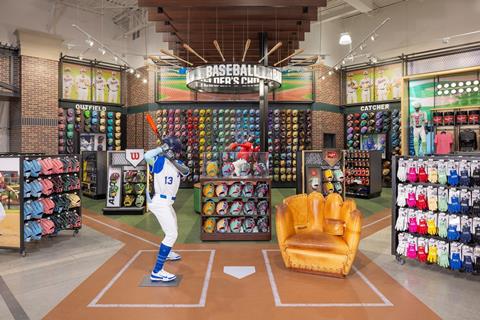
For the standalone DICK’S operation, FY2025 was a clean year. Comps rose 4.5 percent (ahead of the guidance ceiling), driven by a 4.2 percent average ticket increase and a 0.3 percent transaction gain. On a two-year stack, DICK’S comparable sales grew 9.7 percent; on a three-year basis, 12.3 percent. Segment operating margin reached 11.12 percent on a non-GAAP basis, essentially flat with the prior year – a result management framed as strong given the promotional intensity of Q4.
Chief Financial Officer Navdeep Gupta cited broad-based category strength – footwear, apparel and hardlines – alongside continued momentum in merchandise margin drivers: vertical brands, exclusives pipeline, and the contribution of GameChanger, the youth sports technology platform DICK’S acquired in 2022, which Gupta described as growing at “nearly 40% CAGR” with strong profitability characteristics.
One note of caution surfaced in the Q4 transaction count: a 1.3 percent decline in customer visits, offset by a 4.4 percent increase in average ticket. President and CEO Lauren Hobart framed the transaction dip as a function of the prior year’s difficult comparable rather than a structural trend, pointing to positive transaction growth on a two-year basis and across the full year. Analysts pushed on the point; management’s response was that the 2026 guidance – 2 to 4 percent comp growth on top of the 4.5 percent just delivered – reflects genuine conviction in traffic recovery, not reliance on price.
AI and the athlete experience
The earnings call included a more substantive discussion of artificial intelligence deployment than is typical for a sporting goods retailer – prompted partly by an analyst question, partly by management’s evident desire to position the company beyond its physical store footprint.
Hobart described current AI applications across store labor forecasting, inventory management with regional relevance weighting, and a new AI-enabled tool in the DICK’S app that generates more personalized product recommendations. The longer-term ambition, she said, centers on what the company calls its “common purpose” – making the accumulated knowledge of DICK’S staff and sports expertise available to consumers through agentic AI interfaces.
“Take all of our data, all of our knowledge, our teammates’ learnings over the years and make that available for consumers,” Hobart said.
The DICK’S Media Network (DMN) – an in-house retail media operation – also figured in the discussion. GameChanger, which delivers live youth sports streaming alongside statistics and coaching tools, gives DMN a live sports inventory asset that few retail media networks can match. That combination is being positioned as a differentiated offer for both endemic brand partners and non-endemic advertisers seeking access to youth sports audiences.
Grassroots reach as a commercial asset
Woven through both the prepared remarks and the Q&A was a consistent argument that DICK’S competitive advantage lies in its embeddedness in participation sport – not just at the professional or aspirational level, but in the daily activity of youth athletes and their families.
GameChanger is the clearest expression of that strategy: by processing game statistics, streaming matches and providing coaching tools, it places the DICK’S brand inside the sporting experience itself, not merely at the point of purchase.
The brand partnership layer extends that logic. Hobart flagged Gymshark – for which DICK’S is the US wholesale partner – and cited the House of Sport format as a commercial incubator where emerging brands gain distribution before expanding into Fieldhouse and standard DICK’S locations. Stack added Fanatics collectibles shops, announced for all House of Sport stores, as another category entry point that did not previously exist in the DICK’S portfolio.
The 2026 event calendar reinforces the grassroots narrative. Management pointed to the FIFA World Cup (hosted largely in the US), the 2028 Los Angeles Summer Olympics, and the Ryder Cup’s 2029 US return as a multiyear backdrop of sports cultural momentum that the company expects to convert into sustained traffic and basket growth.
Outlook and the unanswered question
For 2026, DICK’S guided consolidated net sales to $22.1–22.4 billion. Gupta flagged two timing dynamics investors should track.
First, DICK’S business operating margin is expected to decline in the first half of 2026 before recovering in the second, due to the front-loading of planned investments and the back-half weighting of synergy realization.
Second, Foot Locker’s profitability improvement is also back-half weighted, contingent on Fast Break stores reaching critical mass and sourcing decisions made for back-to-school merchandise working through the supply chain. Both businesses therefore become harder to evaluate before autumn.
The synergy target remains $100–125 million over the medium term, primarily from procurement and direct sourcing negotiations. A portion is embedded in the 2026 guidance; the remainder is guided to materialize within “a couple of years.” No revision to the synergy range was offered.
The unanswered question – what the normalized profitability of a combined DICK’S and Foot Locker looks like at scale – will not be answered in 2026. Management is explicitly deferring that conversation. What the first six months have established is that the operational thesis (Fast Break works, brand partners are engaged, inventory can be cleaned without catastrophic sell-through) is broadly intact. Whether the financial thesis holds up is a question for 2027 and beyond.
All financial figures are reported in US dollars as originally disclosed by DICK’S Sporting Goods, Inc. Euro equivalents are indicative, calculated at a rate of $1 = €0.867 (mid-market, March 12, 2026; source: X-Rates). Full financial statements, SEC filings and earnings materials are available at investors.dicks.com.