In France, a law on product labeling recently entered into force, which is causing quite a stir. The law, which requires companies to use the so-called Triman logo and waste sorting pictograms, may have major consequences for companies selling consumer products in France, including sporting goods, apparel and shoes. Our author, the legal consultant Rutger Oldenhuis gives you an overview of everything you should know about it.

The requirements of the new French labeling legislation are no sinecure and should not be underestimated. Companies that sell products throughout Europe are expected to adjust their labeling specifically for France. That entails an enormous burden and increase of cost. Large multinationals may – reluctantly – absorb this, but for SMEs, that may not be so easy. Moreover, extra labeling creates more waste, whereas companies – encouraged by the EU Commission – need to reduce their carbon footprint.
Many sources suggest this new law is mandatory, whereas non-compliance would lead to high fines. That is not entirely correct and needs to be nuanced. At the same time, a large number of industry associations (including FESI), supported by the EU Commission, are of the opinion that the French law is violating the EU Treaty. Furthermore, we may expect the EU to come with harmonized labeling in the near future. That leaves companies with a difficult question: should we comply or not? To help companies answer that question, in this article, I will explain what the new French labeling requirements essentially are about and will share some insights and practical tips.
The French Triman Logo is not new
As of January 1, 2022, a law has entered into force in France that requires companies to place the so-called Triman logo on products or packaging that are subject to ‘Extended Producer Responsibility’ (EPR). The OECD defines EPR as “a policy approach under which producers are given a significant responsibility – financial and/or physical – for the treatment or disposal of post-consumer products.” In other words, the polluter-pays principle.
The French Triman logo is not new. The use has been mandatory since 2015, but the number of products involved was limited, and the logo was also allowed to ‘only’ be placed on the website. However, the new law goes a lot further.
More products fall under Extended Producer Responsibility (EPR)
First of all, the list of products that fall under the EPR has been substantially extended. For example, sports equipment, including bicycles, as well as textile clothing and shoes are now also included. And since all packaging – including non-recyclable – now also falls under the French EPR scheme, most companies selling to consumers in France will be affected by the new legislation.
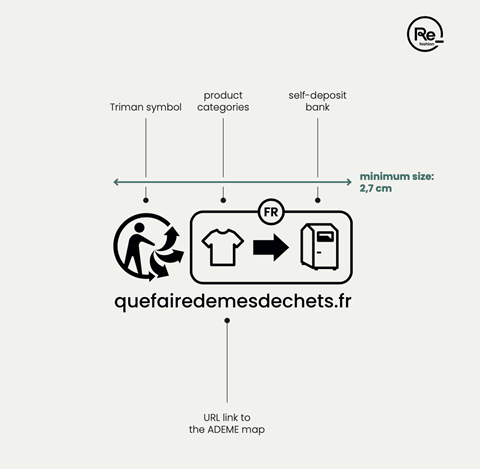
Secondly, in addition to the Triman logo, so-called Sorting Information must be depicted by means of pictograms. That means that symbols indicate how consumers should separate the waste from the product and where to dispose of it. If different elements, parts or waste of the product are subject to different disposal procedures, that should be specified element by element, which makes the new requirements a lot more burdensome.
What Sorting Information symbols do I need to use?
Although you would expect France to come up with a harmonized approach, unfortunately, that is not the case. The design of the Sorting Information pictograms is left to each Producer Responsibility Organisation (PRO), subject to approval by the French authority. For example, the pictograms used for sporting goods (organized by Ecologic) may look different than the pictograms used for clothing and textile (organized by Re_Fashion) and may look different than the pictograms used for packaging (organized by CITEO).
What is the deadline to comply?
The French law does not stipulate any harmonized fixed dates. Deadlines of implementation and disposal of stock depend on the date of approval of the pictograms submitted by each individual PRO to the French authority. For example, for clothing and footwear, according to re_Fashion, by 1 February 2023 at the latest (or 1 August 2023 for products manufactured or imported before Feb. 1, 2023), the information “must be affixed on all items of clothing, household linen and footwear”[2]. However, for packaging waste, according to CITEO, marketers have until 8 September 2022 to bring their packaging into compliance. Then, they have until 8 March 2023 to sell existing stocks of packaging manufactured or imported before 9 September 2022. As of March 9, 2023, all packaging must include Sorting Information unless exempted by law. These are just two examples. To know which deadlines apply, companies will have to check with each relevant PRO.
Different pictograms on each element of the product?
Following the French labeling requirements, companies may face some practical challenges. For example, a shoe box may be shipped to a consumer in a carton box or a plastic bag. Some shoes may have a hang tag attached to it; some may not. There may be plastic or other material inside the shoe box that you don’t know about. Et cetera. If it is unknown upfront what elements are contained in a box and how a product will be packed and shipped, which Sorting Information pictograms should be used? It is very burdensome, if not impossible, to customize the Sorting Information per each Consumer Sales Unit and have different pictograms printed or attached to each element of your product and packaging materials.
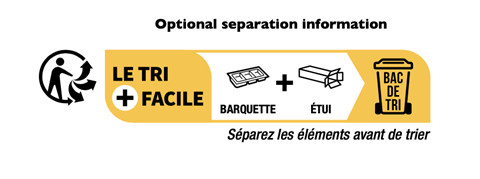
Although it is probably not envisaged by the French legislator, a practical solution may be to use a ‘one-type-fits-all’ Triman logo, consisting of pictograms of products and packaging materials that are likely to be used when shipping and selling your products (belonging to the same product family). The risk may be that a pictogram is shown of waste material that is actually not used, but what damage could that really do? Furthermore, instead of printing them on the product or packaging, the French law also allows for placing the Triman logo and Sorting Information on documents supplied with the product. Taking online D2C sales as an example, the Triman logo and Sorting Information pictograms could be shown on the order confirmation form included in the box or bag. When needed, pictograms can be changed very easily, making compliance within your supply chain a bit less burdensome.
Violation of the EU Treaty
But how about the European Union’s Holy Grail: the single market? Doesn’t this new French law create an obstacle to the free movement of goods? Can France impose these additional labeling requirements just like that? It is true that, under certain circumstances, an EU Member State may not simply introduce national legislation if it creates an obstacle to the free movement of goods unless there would be a justification. There is a principle in the EU known as the “mutual recognition principle.” Based on this principle, in the absence of harmonized rules, once a product is lawfully placed on the market of one of the EU member states, other member states cannot create market barriers based on national technical rules (including product labeling). In other words, if a product without the Triman logo is lawfully placed on the market of e.g. Germany or the Netherlands, France cannot stop this product from being sold in France unless they have a justification. The key question is, therefore, whether France has a justification for imposing these new labeling requirements. The French legislator thinks they do, invoking the protection of the environment. The European Commission on the other hand – spurred on by a large number of business associations – does not[3], but to date, it has not gone so far as to start infringement proceedings against France.
To comply or not to comply?
Although many sources suggest that the new labeling requirements are mandatory, the French law actually allows for different labeling than the Triman logo. However, the question is whether it will really help companies. Based on French law, the Triman logo can only be replaced by another label if it is similar to the Triman logo and subject to mandatory law of the EU or a member state. According to my appraisal, that is a wrong codification of the mutual recognition principle. More importantly, the labeling requirements are likely violating the EU Treaty. That triggers the question of companies whether or not to comply. Although the French legislator remarkably has chosen a relatively mild sanction regime (fines can be up to a maximum of €15,000), you can never be sure if your products will ultimately be banned from the French market. On the other hand, we may wonder if France would really be confident enough to let it come to legal proceedings now that the labeling requirements are likely violating the EU Treaty.
Problem-solving procedure: SOLVIT
The decision whether or not to comply with the French labeling requirements may strongly depend on the risk of fines and perhaps even a sales ban in France, and consequently, expensive legal proceedings. However, for situations like these, the EU offers a service called SOLVIT that may be unknown to many companies.
SOLVIT is a service provided by the national administration in each Member State that aims to find solutions for individuals and businesses when their rights have been breached by public authorities in another Member State. SOLVIT presents itself as an effective non-judicial, problem-solving mechanism that is provided free of charge. It works under short deadlines and provides practical solutions to individuals and businesses when they are experiencing difficulties in the recognition of their Union rights by public authorities. Where the economic operator, the relevant SOLVIT Centre and the Member States involved all agree on the appropriate outcome, no further action should be required. When the SOLVIT’s informal approach fails, the EU Commission would be empowered to make a decision within 45 working days. Since we already know the position of the Commission vis-à-vis the new French labeling requirements, the SOLVIT procedure may be an interesting option.
SOLVIT is only relevant for cross-border conflicts in the EU. For companies that produce locally in France, compliance with the French Triman logo will be a national matter. Therefore, the SOLVIT procedure, unfortunately, will not be accessible to them.
French dealer ban
For companies that sell in France through a retailer network, there is another risk. The French authority may visit a shop and impose a sales ban on products that do not comply with the labeling requirements. French dealers may therefore be reluctant to sell products that are not compliant. It will not be the first time that the compliance department of a large French retail chain imposes a sales stop on products that do not comply with the applicable labeling requirements. The question is how sensitive French retailers will be to the argument that the French labeling requirements are actually violating EU law.
Conclusion
Although the French authority would like us to believe that the new labeling requirements are harmonized, implementation is left to individual PROs, resulting in a mess of different pictograms and deadlines and making compliance a headache for companies. Furthermore, the new requirements violate the EU Treaty. It is also expected that the EU will sooner or later come up with harmonized labeling for the entire EU market. That triggers the question of companies whether or not to comply with the French labeling requirements. However, the risk of a French sales ban, either imposed by the French authority or French dealers, is not an attractive one. On the other hand, the question is whether the French authority would be confident enough to let it come to a trial. If so, SOLVIT seems like a fast, attractive and promising dispute resolution service. In any case, for companies selling in France, it’s a tough call!
About the author
Rutger Oldenhuis is an experienced and seasoned lawyer, holding a master’s degree in both civil and tax law. He has been Head of Legal of Shimano Europe for almost 17 years. In April 2021, Rutger became an independent legal consultant and founded RecallDesk, which is specialized in product compliance, product safety and recalls.
Contact: rutger@recalldesk.com
[1] Recently, a blog from the author on the same topic was published by Bike Europe magazine.
[2] Unlike what re_Fashion suggests, there is no obligation to affix the logo on the product. The logo can also be depicted on the packaging or on a document supplied with the product.
[3] See TRIS/(2020) 03628. Not publically available. Available for free with the author upon request.