After nearly five years of sustained pressure from labor unions, student groups and advocacy organizations, Nike has agreed to compensate approximately 3,300 workers at a Thai supplier factory who were allegedly coerced into unpaid leave during the Covid-19 pandemic.
The resolution of the Hong Seng Knitting case marks a significant moment in the ongoing debate over brand accountability in global supply chains. What began as a wage dispute in Bangkok during the early months of the pandemic has evolved into a test case for how multinational corporations respond when legal compliance, worker welfare and reputational concerns intersect.
The case centers on workers employed by Hong Seng Knitting in Bangkok between May and October 2020. During that period, the factory suspended operations due to pandemic shutdowns and placed workers on furlough without pay. According to labor groups, the unpaid leave amounted to an average of roughly $172 (€165) per worker – about two weeks’ wages – for a total impact on some 3,300 employees.
Labor organizations including the Clean Clothes Campaign (CCC) and Partners for Dignity and Rights have maintained that management pressured workers to sign forms falsely stating they wanted voluntary unpaid leave. The most severe allegation involved retaliation against Kyaw San Oo, a migrant worker from Myanmar who resisted the unpaid furlough scheme. According to the Worker Rights Consortium (WRC), a Washington, D.C. watchdog organization, Kyaw San Oo fled to Myanmar with his wife and infant child after Hong Seng Knitting filed a police complaint against him for posting about the wage issue on social media.
Years of denials finally reversed
For five years, Nike maintained that the furlough program was “consensual and voluntary” and consistent with Thai law and its own code of conduct. The company commissioned multiple investigations, including an audit by Elevate (now part of LRQA) in 2020, which concluded the unpaid leave practice was lawful. The WRC challenged these findings in a 2021 report titled “Checking Boxes, Cheating Workers: How Social Auditing Firms Fail Workers.” The organization argued it had found convincing evidence that workers were coerced and that management’s actions violated Thai labor law.
The breakthrough came after the Fair Labor Association (FLA), a multi-stakeholder organization of which Nike is a founding member since 1999, conducted its own investigation in 2024. While the FLA’s December 2024 report found no evidence of systematic coercion of all workers, it recommended compensation and acknowledged inadequate communication and worker representation at the factory.
Crucially, internal pressure within the FLA played a decisive role. Nazma Akter, president of the Sommilito Garments Sramik Federation trade union in Bangladesh and an FLA board member, resigned her seat after months of protest over what she viewed as the organization’s flawed handling of the case. According to the Clean Clothes Campaign, Akter’s principled stand was crucial to securing increased compensation for Kyaw San Oo.
The compensation package and its limitations
In February 2025, Nike announced a remediation plan that exceeded the FLA’s initial recommendations. Under the plan, Hong Seng Knitting and Cassia Garment (another Ramatex-owned facility) will provide affected workers with compensation equivalent to approximately $211,000 (€203,000) – roughly twice the $142,800 (€137,000) initially proposed by the FLA investigator.
Current workers will receive the compensation through a mix of cash payments and paid leave days. Former workers will receive direct cash payments. Kyaw San Oo will receive $1,746 (€1,680), while another terminated worker will receive $1,261 (€1,210).
However, labor advocates have noted significant deficiencies in the plan. Workers will receive no interest on wages that are now five years overdue. The compensation for Kyaw San Oo – equivalent to standard end-of-contract payments in Thailand – has been criticized as grossly inadequate given that he was forced to flee the country and lost the ability to work in Thailand.
“This victory sends a clear message that Nike can be forced to change its position on whether compensation is owed to workers in its supply chain,” said Sarah Newell, director of transnational strategies at the WRC, in an interview with Sourcing Journal. “We’re in a new era where brands are being held responsible for abuses in their supply chains. There’s no going back.”
A test case for corporate accountability
The Hong Seng Knitting case highlights fundamental tensions in how global brands manage supply chain accountability. Despite Nike’s participation in voluntary oversight bodies like the FLA, meaningful remedy only materialized after years of sustained external pressure from student activists, unions and NGOs. The WRC’s Scott Nova noted in a memo to university affiliates that the case demonstrates both progress and persistent problems. While Nike ultimately provided substantial back wages, the outcome raises questions about the efficacy of corporate accountability systems when they operate without external pressure.
Nike no longer sources from Hong Seng Knitting but maintains a relationship with Ramatex, a joint venture partner of the factory. Nike’s accreditation with the FLA remains intact.
Unresolved parallel case in Cambodia
The resolution at Hong Seng Knitting has intensified pressure on Nike regarding a parallel case in Cambodia. Workers from the Violet Apparel factory, which closed abruptly in July 2020, are still demanding $1.4 million (€1.3 million) in legally owed severance payments. The 1,400 former Violet Apparel workers have repeatedly pointed out that if Nike reconsidered its position in the Thai case, it should extend the same reconsideration to Cambodia.
Nike has maintained it has not sourced from Violet Apparel since 2006 and that an independent investigation found no evidence that Nike products had been manufactured there in recent years. However, labor groups dispute this claim and continue to press for compensation.
In a statement to Sourcing Journal, a Nike spokesperson said: “When we became aware of the allegations at Hong Seng Bangkok in 2020, we promptly worked with a third-party investigator and legal counsel to review and investigate. Since that time, multiple investigations found that the impacted workers were compensated in accordance with local law and Nike’s Code of Conduct. However, Nike often encourages its suppliers to go above and beyond legal requirements. We were glad to collaborate with involved parties to bring final resolution to this case, in alignment with the FLA’s conclusions and recommendations.”
The Clean Clothes Campaign framed the outcome as proof that worker solidarity across borders can overcome corporate resistance: “In this time of rising corporate impunity, we celebrate the fact that when workers and their allies unite across borders, we can overcome even the most entrenched resistance from global brands and suppliers and we will keep fighting to hold brands accountable.”
About
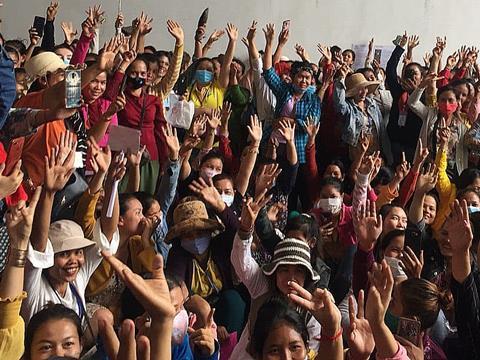
- Hong Seng Knitting is an apparel factory in Bangkok, Thailand that employs approximately 1,000 workers, including around 250 migrant workers from Myanmar. The factory is part of Hong Seng Group and has a joint venture relationship with Ramatex through Cassia Garment.
- Worker Rights Consortium (WRC) is an independent labor rights monitoring organization affiliated with over 180 universities in the US and abroad. Founded in 2000, the WRC conducts investigations into labor conditions at factories producing collegiate apparel.
- Fair Labor Association (FLA) is a multi-stakeholder initiative founded in 1999 that promotes adherence to international labor standards. Members include companies, universities and civil society organizations. The FLA accreditation process examines companies’ adherence to labor standards.
- Clean Clothes Campaign is a global alliance of trade unions and NGOs focused on improving working conditions in the garment and sportswear industries worldwide.