Around a third of the skis sold in Finland are made in Finland. Of these, a ski factory in the Finnish town of Kitee produces around 15-20,000 pairs. However, recent geo-political events may be about to change where in the world our skis are manufactured, bringing the Finnish producers to an even greater world stage. We look at how one recent big deal is shaping the ski industry and influencing what’s on offer for consumers.
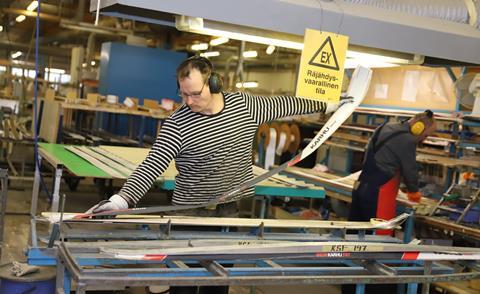
In April, the Finnish ski manufacturing industry received some good news when the Finnish Defence Forces announced that two producers, KSF Sport Oy and Peltonen Ski Oy, had won the NATO Supply and Logistics Agency’s (NSPA) tender for ski equipment: A contract of €11 million, of which the first part, including VAT, is worth approximately €3 million.
“The contract is for three years and includes two optional years. As a first order, we will supply the Defence Forces with 8,200 pairs of skis with bindings, developed by our subcontractor Kuusamon Uistin Oy,” says Harri Kirvesniemi, CEO of KSF Sport and former Finnish top skier.
“Peltonen Ski will, in turn, supply 8,200 pairs of ski poles. About 80 percent of the value of the order will go to the ski factory in Kitee,” Kirvesniemi added.
Other countries will be able to participate in the acquisition later, as the NSPA framework agreements allow for the participation of other NATO and NATO partner countries between 2023 and 2025.
“In addition to NATO countries in snowy areas, countries further south may also need to deploy troops to snowy areas. [These troops will] need their own ski equipment, even if they have no use for it in their own country,” explains Kirvesniemi.
It is also expected that Sweden itself will be a major customer, as, according to Kirvesniemi: “It is known that Sweden has a big shortage of military skis.”
New contract will create new jobs in the ski manufacturing industry
The new ski equipment will be delivered to the Defence Forces during the winter season 2023–2024.
Kirvesnemi: “We knew well before the turn of the year about the order volume from the Defence Forces, so we were able to prepare well in advance. We already have regular skis in stock for next winter, so we are now able to release our employees for the production of military skis.” As such, there is no immediate requirement to take on new staff.
However, the employment impact of making military skis for the ski factory in Kitee is about 15 man-years.
“That means hiring about 15 new employees if we can manufacture skis without interruption for the duration of the contract,” says Kirvesnemi. “We are taking on new employees little by little because making skis is a job that can only be learned by doing. Training new employees takes time.

“There will hardly be a shortage of labor; that’s how often the phone has been ringing since the announcement,” Kirvesniemi laughs.
The new ski model will also be available to consumers
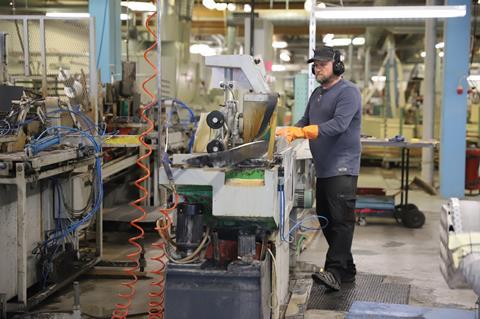
Winning the contract does not require the building of new premises, as the production facilities and warehouse required for the military skis can be partitioned off from the existing premises.
“The intention,” says Kirvesnemi, “is to build a separate department for the production of the new NATO ski model. New presses and other machinery will, of course, be needed. The new department should be fully operational by the end of the year at the latest.”
The average amateur skier will also benefit from the product development between the town of Kitee’s ski factory and the Defence Forces, with a civilian version of the ski on sale as early as next season.
“We have already started pre-sales of the ski, which will be sold under the name KSF Scout,” says Kirvesniemi.
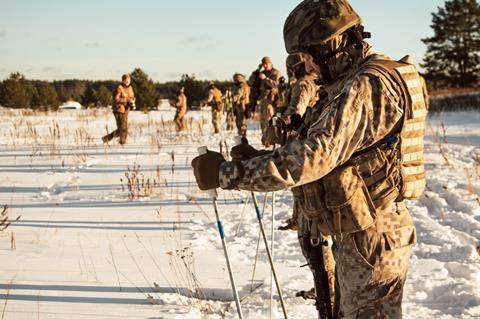
Collaboration with the Defence Force has shaped skis
Product development projects for new forest skis started in 2017, and by 2020 the final prototypes had been made and tested.
The main difference between the new skis and those previously used by the Defence Forces is that the new skis are wider. They are also side cut, which means they are wider at the tip and heel than in the middle. This has given the skis better load-bearing capacity on soft snow. The new forest skis are also lighter and weigh just under 4.5 kg with bindings.
The new poles have a more supportive basket, which is better suited to soft snow, and a more durable tube, which is better suited to extreme conditions.
War in Ukraine creating a shift in international ski supply chain
In Finland, around 150,000 pairs of skis are currently sold during a normal winter. But seasonal fluctuations are high, and during awinter with little snow, sales are closer to 100,000 pairs. Around 25–30 percent of the skis sold in Finland are made in Finland. Of these, the ski factory in Kitee produces around 15–20,000 pairs. In fact, KSF Sport Oy and Peltonen Ski Oy are the only two ski factories left in Finland. But could this be set to change?
“The war in Ukraine changed the market for skis in Finland and around the world,” says Kirvesnemi. “Previously Russia had been the source of cheap subcontracted skis […] But those imports stopped after the war started. As a result, the overall global market for skis has not grown in terms of pairs of skis, but its turnover value has increased because skis made in the West are more expensive,” says Kirvesniemi.
“Winning the international tender competition shows both consumers and retailers in Finland and elsewhere in the world that even a small factory can make very high-quality products that are even better than products from big international brands,” Kirvesniemi says with satisfaction.
The ski factory in Kitee, Finland: Numbers at a glance
- Established in 1972, operating under the name of Karhu Ski Factory.
- KSF Sport Oy was established in 2013.
- Manufactures Karhu, Yoko and Järvinen skis.
- Employs about 20 people.
- Turnover €1.8 million (financial year ending 2022/23).
- Manufactures 15–20,000 pairs of skis in a normal year.
- Exports account for one-third of production, and domestic sales for two-thirds.