Frank Rehme is one of the most important German-speaking thought leaders in retail innovation and future design. As an entrepreneur, strategy consultant and speaker, he develops practical answers to the questions of the future. The German newspaper Handelsblatt describes him as “the implementation-oriented visionary with foresight.” He also heads the Retail Competence Center of Germany’s Federal Ministry of Economics.
SGI Europe: Mr. Rehme, in 2025, many retailers will likely ask themselves the same question: Why should customers come to me?
Frank Rehme: Well, the competition for the best prices or the largest selection can no longer be won. Instead, one answer could be: because my friends are here, because my passion is shared here, because I feel comfortable here.
Those are all rather emotional-social aspects. Is retail emotional?
Absolutely, and more now than ever before. We’re in an era when we’re selling into saturated markets. We’ve climbed higher on the needs pyramid, meaning customers no longer need many of the products on offer because they have everything in multiple copies at home. […] I need to plant a desire in people’s minds and trigger a supply question. This happens through inspiration, experiences and emotionalization. That is the point we need to work on more intensively.
Isn’t sport pure emotion?
Absolutely. Sports are also leisure activities, hobbies, which are usually associated with passion. These factors create a high price insensitivity in most people. When something brings joy to life, people are willing to spend more money.
Is the sports retail sector already implementing this well?
Yes and no. Let’s look at a few examples. In many sports stores, I see good concepts, but in the majority, I still experience brick-and-mortar sports retail in old-school mode, with overcrowded shelves and product pressure. It’s certainly worth looking at flagship stores like Nike’s House of Innovations on Fifth Avenue in New York. How Nike reaches people through digitalization at the point of sale is phenomenal.
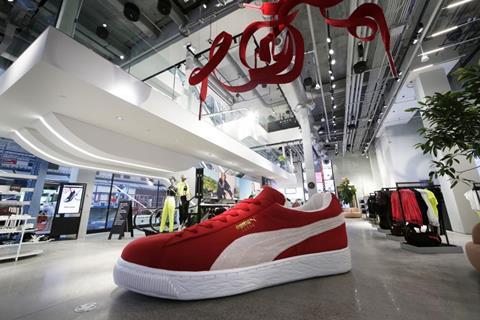
The personalization of products is also actively practiced there. The same goes for the Adidas and Puma flagship stores in New York, which are also sources of inspiration. Both offer a wealth of experiences for their customers. At Puma’s, for example, I can sit in a real Formula 1 car and race virtually. Next to it are products adorned with BMW logos, etc. Puma does this really well.
I can already hear critics saying that flagship stores cannot be compared with traditional sports retail.
Of course, they are not transferable. We all know that flagship stores don’t have to make money but are primarily there for branding. And still, or precisely because of that, it’s worthwhile to walk through such a store with open eyes and get inspired for one’s own store.
What about social media as a source of inspiration?
A very important point. First, we need to clarify what counts as social media and what does not. Most people mention Instagram, Facebook and Pinterest – all excellent sources of emotionalization. Many also consider TikTok a social media channel. However, if you ask TikTok itself, they vehemently shake their heads. TikTok sees itself as an entertainment platform, which is something completely different and requires entirely different content. TikTok means convincing users in two to three seconds that they should not swipe but stay engaged for the next 60 seconds. The result across all channels is the same: social selling, one of the major market trends, and TikTok is at the forefront of this.
Why does this work so well?
Because people get emotionally engaged in 60-second videos. TikTok has understood that this is an opportunity to move customers immediately to a purchasing platform. If I do not offer this conversion, the customer will go on to the next video and become emotionally engaged in a completely different way. The previous one is forgotten.
Amazon reacted to this success by acquiring content creators. That backfired, because it only addresses e-commerce, not entertainment. And thus not emotionalization.
And what does this mean for brick-and-mortar retail?
Well, if I can’t pick up users directly on TikTok, I need to maintain high emotionalization. So high that they come into the store. And this can certainly be achieved by developing new loyalty programs. Just giving points for a purchase is no longer contemporary – on the contrary.
Nowadays, it’s seen more as modern bribery: You buy from me, and in return I give you points. That has nothing to do with loyalty. We need to think more in terms of emotionalization, far beyond the classic bargain-hunter syndrome.
Is there a lever for brick-and-mortar sports retail?
In my view, the lever is gamification. This is the means of choice for sports retail. Let me illustrate this with a simple example: The sports retailer offers a “Jogging Diploma.” We start with five kilometers, then increase to ten and 15 kilometers, always with different equipment that helps achieve new goals. Whether it’s a running watch, a heart-rate monitor or better running shoes.
Ultimately, customers develop themselves; I guide and direct them while keeping emotions high. Let’s be honest: Sports always involve competition. We want to improve, want it to be measurable for ourselves or in competition with others. That’s pure gamification for me. And the retailer offers the perfect products for that. Especially with sports equipment, many consumers want to try, feel and receive advice.
But it feels like everyone is buying online, right?
That feeling is misleading but stubbornly widespread. In 2023 we generated in Germany €650 billion in retail sales overall, both online and offline. Of that, only 17 percent was online, primarily in fashion and consumer electronics. This means the majority still shop in brick-and-mortar stores, especially in sports retail.
The sports retail sector must see this as an opportunity to continue attracting and retaining consumers in-store. New roads must be taken, and especially new, intelligent collaborations must be established. For example, with medical-supply stores or orthopedic technicians. These are all things that I can’t cover digitally. Most people have problems with their feet; whoever offers real added value here will surely have an edge.
An appointment with an orthopedic technician has a different quality than just recommending another insole. I also understand that good stores conduct gait analyses, etc., and yet I’m convinced that it pays off in the medium and long term to integrate another “trade” here. How many people are looking for a good orthopedic technician they can trust and who has time? If the retailer brings that network, then I will go there.
So it’s about creating new, intelligent collaborations. And what about communities for customer acquisition? The sports industry, both retail and brands, has long relied on Running events, ski trips, yoga classes and much more. Is that enough of an incentive for the future?
These are all important customer-retention measures. But why not take it a step further? The Olympic Games took place in Paris in 2024. There’s hardly anything more sports than that. Retailers should offer their customers the opportunity to experience such events live. There are so many major sporting events from different areas – athletics, tennis, equestrian sports, skiing – that there’s surely a suitable event for their product range.
For me, this would be a good opportunity to generate added value and additional revenue while retaining customers. Because tickets are only available with a purchase. That would be a logical continuation of the classic retail model: moving from provider to “life enricher.”
Learn more: These are the biggest sports retailers in the world
That sounds promising, but it’s also clear: Many brands are creating their own event programs, focusing on D2C – all customer-retention measures that more or less bypass retail. Will the intermediary retailer even need to exist soon?
That would be completely wrong. In the medium and long term, success can only be achieved together. Brands can take care of events or tickets for major sporting events, but they can be obtained exclusively through the retailer in the brick-and-mortar store.
Let’s take the Thermomix model as an example: I can look at the kitchen machines online from the manufacturer, but they are purchased exclusively through the representative. It works brilliantly and is like the Weber grill, a prime example of how emotionalization can work at the highest level. No one needs a kitchen machine for €1,400, but everyone wants one. And that’s offline and involves effort, because I have to contact a representative and make an appointment. It works wonderfully.
Is Thermomix a role model for the sports industry?
Absolutely! Sports are already life enrichers. And on top of that, health is a megatrend and on everyone’s lips. Everyone wants to do something for their health, for body and mind. In my opinion, that’s the emotionalization that can be pushed much more than it currently is. The specialist retailer is the representative here if we want to stick with the Thermomix analogy.
The President of the German Sport Industry Association VDS, Stefan Herzog, said years ago that salespeople in sports retail should become health advisors in the future. Is that a possibility?
That is exactly the right path! Retail is there primarily to improve my life in the future. It’s not just about offering products but also about conveying and explaining how and why my life will be better if I buy these products. This is perfectly implementable in sports.