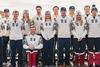
As the final medals of Milano Cortina 2026 were awarded this Sunday, one outcome has been clear for days: Team Norway dominated these Winter Games. With 41 medals—18 gold, 12 silver, 11 bronze—Team Norge finished ahead of the United States (33), host nation Italy (30, including 10 golds), and the Netherlands (10 golds) by a commanding margin.

For an executive audience tracking the business of sport and sporting goods, that medal haul translates to sustained exposure—sixteen days of podiums, broadcast coverage, social media saturation, and press visibility—for the brands that dress the world’s most decorated Winter Olympics team. Sporting Goods Intellingence Europe closes the curtain on Milano Cortina 2026 with a look at the Norwegian apparel partnerships that made the most of that exposure.

Wool, wind and the weight of seventy years

The centerpiece of Team Norge’s image this February was not a race suit or a pair of carbon-fiber skis. It was a sweater — specifically, the Dale of Norway “Cortina” design, a deliberate callback to the 1956 Cortina d’Ampezzo Games, the last time this corner of the Dolomites hosted the Olympics.

The Bergen-based knitwear brand has supplied Norway’s official Olympic sweater without interruption since 1956 — a partnership longevity that no sportswear multinational can match. The 2026 edition, featuring a high-neck half-zip and traditional Nordic geometric patterns in navy and raspberry on a base of 100% Norwegian wool, drew sustained attention during the opening ceremony and throughout the Games’ lifestyle moments.

Dale of Norway does not compete on performance claims or innovation cycles. It competes on heritage — and every Games renews that claim.

Craft: from podium to parade ground

The technical and ceremonial layer came from Craft Sportswear: the Swedish performance brand holds partnership with both the Norwegian Olympic and Paralympic Committees. Athletes collecting medals wore Craft-branded jackets and trousers in the Norwegian tricolors — placing the brand in frame for every podium moment broadcast globally across sixteen days. Craft also outfitted the opening ceremony parade — with Alfa Outdoor, the Norwegian footwear specialist, providing the official winter boots for the parade of nations.


Visualizza questo post su Instagram

Un post condiviso da Norwegian Biathlon Team (@skiskytterlandslaget)

The trousers that blew up social media worldwide 

No survey of Norway’s brand presence at Milano Cortina would be complete without the curling trousers. The Norwegian men’s curling team wore a tribute diamond-print design on Feb. 17 — a one-match homage to the late Thomas Ulsrud, the skip of the 2010 Vancouver team whose bold Loudmouth Golf trousers created an international phenomenon.

Ulsrud died in 2022 at age 50. The decision by current skip Magnus Ramsfjell and his team to wear the 2010 design—with the blessing of Ulsrud’s former teammates—generated coverage across Reuters, The Guardian, People magazine, and dozens of international outlets, not to mention thousands of blogs and social media accounts.


Visualizza questo post su Instagram

Un post condiviso da TNT Sports (@tntsports)


Visualizza questo post su Instagram

Un post condiviso da Rock Channel (@rockchannelcurl)

Also worth noting

Individual sport federations also deployed specialized gear: Dæhlie racing suits for Nordic disciplines and Helly Hansen high-speed apparel for the alpine squad.


Visualizza questo post su Instagram

Un post condiviso da Team Aker Dæhlie (@teamakerdahlie)

A closing note from Sporting Goods Intelligence Europe

We write this in the hours after the men’s ice hockey gold medal final — won by the United States over Canada — and ahead of the closing ceremony that will draw Milano Cortina 2026 to a close.

These Winter Games delivered what the best editions always do: athletic performances that will be discussed for years, personal stories of resilience and sacrifice, farewell appearances from athletes at the end of long careers, records broken and boundaries pushed.

They also raised questions that no amount of careful organizing committee language can fully resolve — about what it means, in 2026, to call a competition “non-political” when it is staged under national banners, contested between states, and rooted in a Greek tradition that was political to its foundations. Those questions are not ours to adjudicate. Other publications do that work, and do it well.

Our lane is narrower and, we would argue, no less consequential: the business of sporting goods, the economics of brand visibility, the organizational machinery that turns a mountain range into a two-week global media event. From that vantage point, two congratulations are unambiguously deserved.

To Italy — for delivering these Games with warmth, organizational competence, and a host nation performance that gave the tifosi plenty to celebrate on home snow.

To Norway — for its 41 medals and a brand presence across every discipline that will keep Dale of Norway sweaters, Craft Sportswear podium jackets, and one particular pair of diamond-print curling trousers in the conversation long after the flame goes out.

Congratulations, and grazie.