INTERSPORT Deutschland eG has published its first sustainability report aligned with the Voluntary Sustainability Reporting Standard for SMEs (VSME), reporting a 12.5 percent reduction in greenhouse-gas emissions, expanded renewable-energy generation and a growing electric fleet.
The report marks an important step toward greater ESG transparency, but it also highlights a challenge facing cooperative retail groups: how to measure sustainability performance across a network of independently owned businesses.
INTERSPORT Germany’s first VSME-aligned sustainability report is, on the surface, a story of progress. During the 2024/2025 financial year, the cooperative reduced its total greenhouse-gas emissions by 12.5 percent, expanded its renewable-energy infrastructure and continued integrating sustainability into its long-term corporate strategy.
Yet the report is also notable for what it represents: an early effort by a large retail cooperative to bring structure and transparency to sustainability reporting within a business model that does not directly control most of the stores operating under its brand.
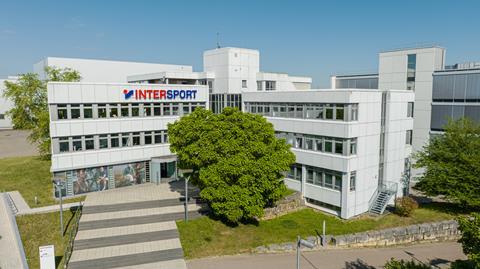
The report covers the activities of INTERSPORT Deutschland eG at its German headquarters and logistics site. It does not provide a consolidated view of the wider INTERSPORT retail network, which consists of independently owned member retailers. Rather than a weakness in disclosure, this reflects the reality of the cooperative structure. Nevertheless, it means the report should be read as an assessment of the central organization rather than of the full INTERSPORT ecosystem in Germany.
Climate progress driven by infrastructure investment
The headline environmental metric is a reduction in total greenhouse-gas emissions from 92,660.9 tonnes of CO2e to 81,071.2 tonnes of CO2e, equivalent to a 12.5 percent decrease year over year. According to the report, this was supported by a combination of energy-efficiency measures and continued investment in renewable-energy infrastructure at the Heilbronn site.
| Intersport Deutschland — GHG emissions | |||
| FY, ended Sept. 30 (tonnes CO2e) | |||
| FY 2023/24 | FY 2024/25 | Change | |
| Scope 1 | 1,316.1 | 1,093.9 | -16.9% |
| Scope 2 (market-based) | 49.7 | 77.9 | 56.9% |
| Scope 3, of which: | 90,274.0 | 79,371.8 | -12.1% |
| — Purchased goods and services | 83,822.3 | 72,856.4 | -13.1% |
| — Capital goods | 1,861.8 | 2,068.7 | 11.1% |
| — Upstream transport and distribution | 3,039.0 | 3,257.3 | 7.2% |
| — Waste generated in operations | 47.5 | 96.8 | 103.9% |
| Total (market-based) | 91,639.7 | 80,543.5 | -12.1% |
| Total (location-based) | 92,660.9 | 81,071.2 | -12.5% |
Source: Intersport Deutschland eG, Nachhaltigkeitsbericht 2024/2025, published July 21, 2026. GHG Protocol basis.
A key contributor was the expansion of the company’s photovoltaic installations. Covering more than 10,200 square meters, the solar-energy system now enables a power self-sufficiency rate of 51.4 percent at the site. At the same time, the share of fully electric vehicles in the corporate fleet increased to 41 percent, demonstrating measurable progress in reducing operational emissions.
However, the report also underscores a reality common across retail supply chains: most emissions sit outside direct operational control. Scope 3 emissions account for the overwhelming majority of the organization’s footprint, meaning future reductions will increasingly depend on supplier engagement, purchasing decisions, logistics optimization and broader value-chain collaboration rather than site-level efficiency improvements alone.
| Intersport Deutschland — Energy consumption and mix | |||
| FY, ended Sept. 30 (MWh) | |||
| FY 2023/24 | FY 2024/25 | Change | |
| Fossil energy | 4,609.9 | 3,828.1 | -17.0% |
| Purchased renewable electricity | 2,404.0 | 1,645.4 | -31.6% |
| Self-generated renewable energy | 242.5 | 990.8 | 308.6% |
| Total renewable energy | 2,646.5 | 2,636.2 | -0.4% |
| Renewable share of total (%) | 36.5 | 40.8 | – |
| Total energy consumption | 7,256.4 | 6,464.4 | -10.9% |
Source: Intersport Deutschland eG, Nachhaltigkeitsbericht 2024/2025, published July 21, 2026. Heilbronn site only.
Circularity remains at the pilot stage
One of the report’s most concrete initiatives is a footwear recycling project developed with Dutch recycling specialist FastFeetGrinded. During the pilot, 78 INTERSPORT stores took part, collecting 2,150 pairs of used shoes. The recovered materials can be reused in products such as sports flooring, insulation materials and shoe components.
While modest in scale, the initiative matters because it moves circular economy ambitions from theory into customer facing retail operations. At the same time, the figures suggest INTERSPORT is still in an early, experimental phase of circularity. The project shows proof of concept, not a mature take back infrastructure that can operate across the full network.
Across Europe, many retailers are announcing circular economy ambitions, but fewer have systems that can reliably collect, process and reintroduce materials at scale. INTERSPORT’s pilot takes a pragmatic approach: test participation, understand customer behavior and build partnerships before committing to larger investments.
Governance advances, but challenges remain
Beyond environmental performance, the report reflects efforts to strengthen governance and accountability. In 2024, INTERSPORT Deutschland became a participant in the United Nations Global Compact, committing to the initiative’s principles covering human rights, labor standards, environmental responsibility and anti-corruption practices. The sustainability report also serves as part of the company’s response to that commitment.
The document provides greater visibility into workforce and leadership metrics than INTERSPORT has disclosed previously. Women now hold one-third of executive board positions, although representation at supervisory board level remains lower. The company also reports an unadjusted gender pay gap of 17.6 percent, attributing the difference primarily to the current distribution of men and women across leadership and pay-grade levels.
These disclosures are important because they move beyond headline sustainability achievements and expose areas where further progress is needed. Strong ESG reporting is not only about publishing favorable results; it is also about documenting structural challenges and establishing transparent baselines against which future improvements can be measured.
| Intersport Deutschland — Workforce and governance | |||
| As of Sept. 30, 2025, unless stated | |||
| FY 2023/24 | FY 2024/25 | Change | |
| Total workforce | 459 | 458 | -0.2% |
| Employee turnover rate (%) | – | 9.1 | – |
| Women on executive board (%) | – | 33.0 | – |
| Women on supervisory board (%) | – | 22.2 | – |
| Unadjusted gender pay gap (%) | – | 17.6 | – |
| Collective bargaining coverage (%) | – | 85.4 | – |
| Reportable workplace accidents | – | 4 | – |
Source: Intersport Deutschland eG, Nachhaltigkeitsbericht 2024/2025, published July 21, 2026. Heilbronn site only; gender pay gap unadjusted and excludes board-level and student/intern compensation.
The real question is the reporting boundary
Unlike vertically integrated retail chains, INTERSPORT operates through a cooperative model composed of independently owned member businesses. This structure is one of the group’s strengths, combining local entrepreneurship with the scale and purchasing power of a national network.
Yet it also makes sustainability reporting inherently more complex. Measuring emissions, governance practices and social indicators within the central organization is relatively straightforward. Doing the same across hundreds of independent retailers is far more challenging.
As sustainability disclosure expectations continue to rise across Europe, cooperative groups will increasingly face questions about how to extend transparency beyond the legal reporting entity. Investors, suppliers, regulators and business partners are often interested in understanding the sustainability performance associated with an entire brand ecosystem rather than only its central office.
INTERSPORT’s decision to begin with a clearly defined entity-level disclosure is understandable and consistent with an early-stage VSME approach. The next test will be whether future reporting can provide greater visibility into the broader network while respecting the independence of member retailers.