UEFA is testing how far its sustainability framework can extend into day-to-day club operations, with Udinese Calcio, the Serie A club based in Udine, northeast Italy, serving as the test case. A one-day fan activation and a season-long emissions accounting exercise are running side by side to measure what a mid-market club can actually deliver, not just promise.
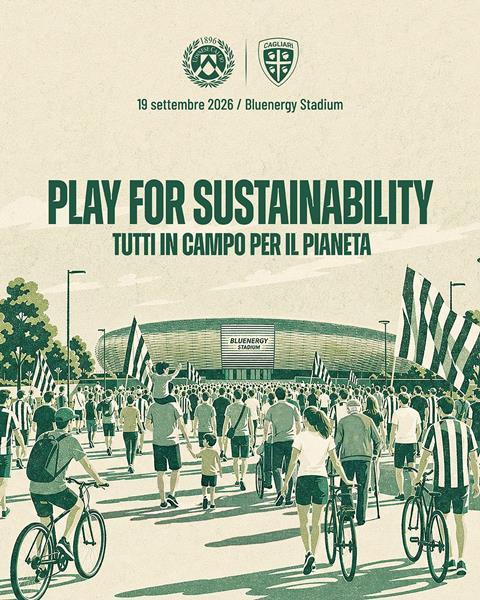
On Sept. 19, Udinese hosts Cagliari in what is being presented as Serie A’s first fully “green” fixture, part of a program called Play for Sustainability. The campaign’s official Italian name, ”Tutti in campo per il pianeta”, translates to “Everyone on the Pitch for the Planet,” the version used in Italian coverage of the launch.
The matchday plan is broad. Fans are being asked to leave cars at home for bicycles or public transit, with ticket holders riding free on the bus route linking the stadium to Udine’s train station and an added regional bus service connecting nearby towns in the province. Catering will add vegetarian, vegan and gluten-free choices, with surplus food going to the local food bank, and blind and visually impaired fans get audio match descriptions for the first time.
After the final whistle, the club will measure the game’s carbon dioxide output and run a volunteer stadium clean-up. The match will also put a spotlight on existing infrastructure: the club-owned solar array on the stadium roof, 2,409 panels generating roughly 3,000 kilowatt-hours a day.
An annual program, not a single fixture
Both UEFA and Udinese describe Play for Sustainability as an annual program, with this year’s fixture used to set a measurement benchmark rather than close out a finished project. The framework behind it is UEFA’s Football Event Sustainability Manual, built with European Leagues to help national associations, leagues and clubs build sustainability into daily operations rather than one-off campaigns. Now, the manual is out at test to deliver meaningful results. The program also connects to a Road to Zero sustainability effort run by Serie A, Italy’s top-flight football league, and to UEFA’s Strength Through Unity strategy.
But there is more than the matchday.
Udinese has also adopted UEFA’s Carbon Footprint Calculator, a tool measuring emissions across Scope 1, 2 and 3 using a methodology validated by testing and certification group Societe Generale de Surveillance. The club’s own numbers show indirect activity, meaning supply chain, services and mobility, at about seventy-eight percent of its footprint, with direct operations at roughly twelve percent and purchased energy at about nine percent.
That split mirrors the supply-chain-heavy emissions profile that sporting goods brands and retailers report themselves, and it shows a football club facing the same Scope 3 measurement problem as a multinational manufacturer.
Measuring means governing
Getting to that number took more than software. Udinese says the calculator itself was straightforward, but pulling consistent data out of different internal departments, each with its own formats and reporting timelines, was the real work. The club built that process partly through a partnership with the University of Udine, using a master’s program in industrial engineering for sustainable manufacturing to help with data collection and analysis. “Measuring means governing,” said Magda Pozzo, Udinese’s ownership and strategic lead, describing the data work as the basis for decision-making rather than a compliance exercise.
Toward a standard, starting from Italy
The recognition has followed. Udinese Calcio took part in COP29 in Baku and won the De Sanctis Prize sponsored by the Italian Prime Minister for sustainability last November, for the work done at its stadium. Serie A, for its part, has run the same Carbon Footprint Calculator for two years around the Coppa Italia Finals.